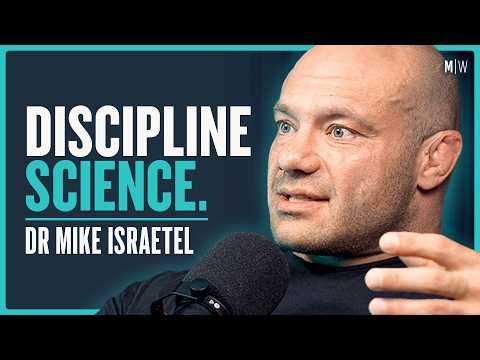
Hacking Your Psychology to Do Hard Things Consistently - Dr Mike Israetel
Chris Williamson (host), Dr Mike Israetel (guest), Narrator
In this episode of Modern Wisdom, featuring Chris Williamson and Dr Mike Israetel, Hacking Your Psychology to Do Hard Things Consistently - Dr Mike Israetel explores dr. Mike Israetel’s Blueprint For Doing Hard Things On Autopilot Chris Williamson and Dr. Mike Israetel deconstruct willpower, motivation, discipline, and habits into a practical framework for doing difficult things consistently. They distinguish between short-lived inspiration, goal-directed motivation, concrete planning (intention), disciplined willpower, and finally habit formation, showing how each layer supports the next.
Dr. Mike Israetel’s Blueprint For Doing Hard Things On Autopilot
Chris Williamson and Dr. Mike Israetel deconstruct willpower, motivation, discipline, and habits into a practical framework for doing difficult things consistently. They distinguish between short-lived inspiration, goal-directed motivation, concrete planning (intention), disciplined willpower, and finally habit formation, showing how each layer supports the next.
Israetel argues that most people rely too heavily on inspiration and brute discipline instead of designing easier environments, realistic goals, and smart systems that make adherence almost automatic. They also explore how to avoid over-rigidity, all-or-nothing thinking, and overcommitment, which cause most habit attempts to fail.
The conversation repeatedly returns to the idea of serving your future self, balancing delayed gratification with genuine rest, and using both AI tools and other people to keep your priorities honest and your recovery real. Ultimately, they frame habit-building as training a muscle: you deliberately push close to your limits, recover, and slowly expand your capacity to do hard things without burning out.
Key Takeaways
Treat inspiration as a spark, not your engine.
Inspiration (a song, a movie, an embarrassing moment, an incredible role model) is like a booster rocket: it gets you off the launchpad once, but it fades quickly. ...
Get the full analysis with uListen AI
Make motivation concrete by setting specific, tractable goals.
“Get in shape” or “not be fat” are vague and often negative goals that your brain can’t measure. ...
Get the full analysis with uListen AI
Always build a plan (intention) before talking about discipline.
Most people jump straight to ‘willpower’ without a clear plan, but discipline can only be applied to something specific. ...
Get the full analysis with uListen AI
Use willpower sparingly to bridge gaps, not as daily fuel.
Willpower is like a small battery: it’s critical when motivation dips below what your plan requires, but it depletes quickly. ...
Get the full analysis with uListen AI
Design your environment so the ‘right’ behavior is the easy behavior.
Shortening gym commutes, batch cooking, using meal delivery, and scheduling around workouts dramatically lower friction. ...
Get the full analysis with uListen AI
Start with fewer, easier habits and stack them gradually.
Trying to overhaul diet, training, work, relationships and finances all at once—especially at New Year—almost guarantees failure. ...
Get the full analysis with uListen AI
Calibrate your ‘difficulty level’ so you win often but still struggle.
To build a self-image of being capable and resilient, repeatedly choose goals that are challenging but achievable—where you usually win, sometimes barely, and occasionally fail. ...
Get the full analysis with uListen AI
Notable Quotes
“Future you is your biggest ally. Past you is completely dead.”
— Dr. Mike Israetel
“People who say, ‘I’m driven by discipline’ are speaking categorical nonsense. You have to be driven by something.”
— Dr. Mike Israetel
“Fat loss diets are definitionally unsustainable. Eventually you die of starvation.”
— Dr. Mike Israetel (via Melissa Davis’s insight)
“Most people don’t need more grind; they have no idea how to unwind.”
— Paraphrase of Dr. Mike Israetel’s point on rest ethic
“This thing I’m doing is not going to be forever.”
— Chris Williamson
Questions Answered in This Episode
How can I audit my current goals to see which are ‘run away from pain’ versus ‘run toward something meaningful’?
Chris Williamson and Dr. ...
Get the full analysis with uListen AI
Where in my life am I relying on willpower every day instead of redesigning my environment or habits?
Israetel argues that most people rely too heavily on inspiration and brute discipline instead of designing easier environments, realistic goals, and smart systems that make adherence almost automatic. ...
Get the full analysis with uListen AI
If I had to pick only one or two areas to improve over the next six months, what would they be—and what would I consciously let stagnate?
The conversation repeatedly returns to the idea of serving your future self, balancing delayed gratification with genuine rest, and using both AI tools and other people to keep your priorities honest and your recovery real. ...
Get the full analysis with uListen AI
What would a genuinely restorative rest ethic look like for me, and how would I know I’ve crossed from healthy rest into avoidance?
Get the full analysis with uListen AI
How could I use an AI assistant or journal to keep an honest record of my priorities and call me out when I overcommit or drift?
Get the full analysis with uListen AI
Transcript Preview
I wanted to talk about the science of willpower, habits, motivation, some of the buzziest of topics at the moment. Why do you think this is such a popular area of discussion for people on the internet?
You know, I'm really happy that it's a popular area of discussion on the internet. The internet has (laughs) plenty of stuff on there that is kind of just junk. Most of my stuff, for example. Like what is it, what am I really mostly about? Vanity, you know, that sucks. But, um, it's really awesome that so many people, at least by search volume, seem to be interested in motivation and habits and willpower because that tells me that people are doing two things. One, recognizing that they want success, uh, or, uh, y- to achieve some goals. And two is recognizing that, like, their motivational structure is a potential limiting factor to that success. And so if you're like, "Oh yeah, things in the outside world are important, and I'm gonna try to architect myself to be better at them," man, like, that really is a great thing and really does set you up for a significant amount of more success than you would if you never asked the question of like, "How do, how do I get maximally motivated?" And you just kind of assumed that you, uh, were, uh, uh, like, whatever motivation level you have, that's just kind of what you're, you're doing. Like, it's kind of default.
Mm-hmm.
I had a, a situation today. I was, earlier I was working on my, my, n- my next book. Yes, it's an adult, adult novel. (laughs) Yeah.
Can I be on the cover?
It's a gay adult novel.
I'm on the cover.
Yeah, I, I thought your people already signed it.
Ah.
Correct. There's a cl- two clones of you on the cover and making love. And they... But love, I don't mean lust, I mean love, Chris. And you can s- f- you can feel the love. Any- anyway, I digress.
Yeah.
So, I was writing, and it took me, like, um, uh, like, a minute or two to really get in the groove. And, uh, during a f- a few times during that one specific time during that minute or two, I was like, "Oh, my stupid brain. Like, get focused already. Look what's wrong with me. I have super bad attention deficit disorder. I suck." And then I was like, "Oh wait, wait, like, um, first of all, that was dumb 'cause it was just a matter of getting in a flow state, and it's always rocky at first. But second of all, now I'm thinking about it like, okay, there's ways to improve your attention span."
Mm-hmm.
"And if I just said, well, this is my limitation and this is just who I am, okay, fine. I'll get some stuff done. But if I ask the next question of like, okay, I know that my ability to focus is a limiting factor in my success, so is my motivation, et cetera, how can I attend to those factors and do at least two things? One, kind of understand the world of those factors to at least kind of speak the language, which is something we're gonna figure out how to do today. And two, take what I need from that and try really junior league implementing it in my life? And then if I do that, hey, maybe I'll have some more success. Then I can come back, refine the process, and do better things."
Install uListen to search the full transcript and get AI-powered insights
Get Full TranscriptGet more from every podcast
AI summaries, searchable transcripts, and fact-checking. Free forever.
Add to Chrome