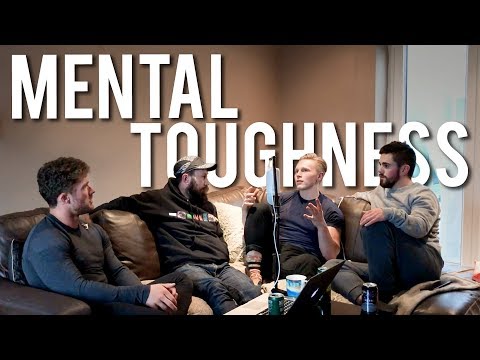
Can You Teach Mental Toughness? | Jordan Wallace, Paul Warrior & Tim Briggs
Jordan Wallace (guest), Paul Warrior (guest), Chris Williamson (host), Tim Briggs (guest), Jordan Wallace (guest), Chris Williamson (host), Paul Warrior (guest), Tim Briggs (guest), Jordan Wallace (guest), Paul Warrior (guest), Tim Briggs (guest), Jordan Wallace (guest), Narrator
In this episode of Modern Wisdom, featuring Jordan Wallace and Paul Warrior, Can You Teach Mental Toughness? | Jordan Wallace, Paul Warrior & Tim Briggs explores coaches Debate Whether Mental Toughness Is Trained Or Innate Chris Williamson talks with coaches Jordan Wallace, Paul Warrior, and Tim Briggs about mindset in CrossFit, especially how mental toughness shows up in training and competition.
Coaches Debate Whether Mental Toughness Is Trained Or Innate
Chris Williamson talks with coaches Jordan Wallace, Paul Warrior, and Tim Briggs about mindset in CrossFit, especially how mental toughness shows up in training and competition.
They argue that while some mental resilience is innate and shaped by upbringing, much of performance mindset emerges from how you train, the culture of your gym, and how well you’re prepared for suffering.
The group discusses regionals programming, the shift to four‑person teams, social media’s impact on athletes’ anxiety, and the importance of trusting coaches and processes over obsessing about competitors.
They conclude that mindset work is less about abstract theory and more about environment, habits, and having coaches who both believe in you and demand you do exactly what’s written, even when it feels impossible.
Key Takeaways
Treat hard training as mindset practice, not just fitness work.
The coaches stress that repeated exposure to brutal sessions, unrealistic EMOMs, and long grinders conditions athletes to suffer and continue, so mental toughness becomes a byproduct of how they train, not a separate skill.
Get the full analysis with uListen AI
Manage expectations and detach from outcomes to avoid collapse.
Athletes who fixate on where they ‘should’ place or how they ‘should’ perform tend to unravel after a bad event; reframing sessions as ‘did I complete the work? ...
Get the full analysis with uListen AI
Use coaching and gym culture as external accountability.
In-class, athletes often go far beyond what they’d do alone because coaches are watching and peers are suffering alongside them; that external push gradually becomes internal self-belief, especially when the culture normalizes working to the limit.
Get the full analysis with uListen AI
Be wary of social media and comparison in the lead‑up to competition.
Constantly watching other athletes’ PBs, perfect handstand walks, and highlight reels on Instagram magnifies anxiety and can make you feel unprepared; some athletes would likely perform meaningfully better if they parked their phones and focused on their own lane.
Get the full analysis with uListen AI
Failure and no‑reps are inevitable; how you respond matters more.
Stories about no‑reps on pistols or wall balls show that arguing with judges wastes energy and rarely changes outcomes; the better response is to accept it, ask what needs to change, and immediately move on to the next rep or event.
Get the full analysis with uListen AI
Trust in your coach and the written program is a performance asset.
Athletes who are fully ‘bought in’ to their coach and plan stop second‑guessing and simply execute what’s on the page—whether that’s absurd volume or uncomfortable intensity—freeing up mental space for effort instead of doubt.
Get the full analysis with uListen AI
Not all ‘mental toughness’ is equal; it’s situational and finite.
The coaches point out that everyone eventually breaks at some threshold (the ‘waterboard the hashtag mental toughness crowd’ joke), so the goal is to raise that threshold through honest self‑assessment, progressive exposure to discomfort, and better life structure, not slogans.
Get the full analysis with uListen AI
Notable Quotes
“The best don’t have that question in their head of ‘Do I need to stop?’”
— Tim Briggs
“People get so worried about failing. Just have a pop.”
— Paul Warrior
“You work so hard to get there—why let a no‑rep get in the way of it?”
— Jordan Wallace
“We probably believe in them slightly more than they believe in themselves.”
— Paul Warrior
“If you can’t handle Instagram over a competition weekend, there are probably some mindset issues you could deal with.”
— Paul Warrior
Questions Answered in This Episode
To what extent is mental toughness truly innate versus trainable, and how would you design training differently if you assumed it was mostly learned?
Chris Williamson talks with coaches Jordan Wallace, Paul Warrior, and Tim Briggs about mindset in CrossFit, especially how mental toughness shows up in training and competition.
Get the full analysis with uListen AI
How could athletes systematically reduce the negative impact of social media and comparison in the months leading up to a major competition?
They argue that while some mental resilience is innate and shaped by upbringing, much of performance mindset emerges from how you train, the culture of your gym, and how well you’re prepared for suffering.
Get the full analysis with uListen AI
What are practical ways for an everyday CrossFitter—not just a regional athlete—to use training to build better mindset and self‑talk?
The group discusses regionals programming, the shift to four‑person teams, social media’s impact on athletes’ anxiety, and the importance of trusting coaches and processes over obsessing about competitors.
Get the full analysis with uListen AI
How should a coach distinguish between an athlete who needs more volume to adapt and one who is masking insecurity by overtraining?
They conclude that mindset work is less about abstract theory and more about environment, habits, and having coaches who both believe in you and demand you do exactly what’s written, even when it feels impossible.
Get the full analysis with uListen AI
What specific habits or red flags in the weeks before competition reliably predict that an athlete is likely to ‘mentally implode’ on game day?
Get the full analysis with uListen AI
Transcript Preview
... like run and they'll j- they'll go like this. They'll go ... I have to be careful I don't poo here but ... but ... (laughs) Parkour.
Have you got your squirts?
Still not good, mate. Still not good.
No, he's had, he's had two-
Two Sorens, first squirt of the day.
... two lunch box sized Sorens wearing them.
You can wear the blood and semen pants at Valhalla.
Ah, I don't need blood and semen.
(laughs) You brought the blood and semen pants?
(laughs)
You're not getting them on?
Get them on.
£357 worth of pants?
156 pounds these.
(laughs)
It's 300 quid, the pair.
Mate, they are, they are shite them, like.
They are.
Catastrophic, aren't they?
They are.
They're so bad.
What, who actually makes them?
Battles Supreme.
No, but like who-
Whose semen is it?
No, who makes the clothes? Do you know? Like did it-
I don't know.
Did they have their own manufacturer?
Made in, uh, what is this?
I always wondered this.
(laughs) You know what's worse?
'Cause they have pins, don't they?
They wouldn't have cost two pound, mate.
They wouldn't have cost two pound?
They will.
Exploited in China, it says.
(laughs)
On the back.
Well, they like the work.
Them Built of North tracksuit bottoms on are, like, 15 quid or something.
Yeah, these are some thick quality, I just ...
Yeah, they're winner, winner pants really, aren't they?
There's a lot of them in the wrong size that mine have got, 'cause I knock off to mate.
Mate, they were 16 quid at the most though, man. You're right in there, it's the price. You're in the hot seat.
Why am I on the mic?
You're in the hot seat, bro.
Why am I on the mic?
Why do you look like one?
Why am I on the mic?
Well, everyone is. (hands clap)
Everyone's on the mic, mate.
Should be putting a raincoat on.
Do you want it?
(laughs)
Oh, it can fog up over there, can't it?
Better not like it.
Hands clap ] Are we going?
We are, man. We're already going. We'll go from your pants.
Oh, so me parkup- parkouring was a thing as well?
Parkour, like, do you need parkour on video?
Probably, yeah.
Based on-
Aw, Chris. Don't put that on.
Parkour. Uh, so Jordan, Paul, and Tim from We Dominate Nutrition, Reebok CrossFit Tyneside, Warrior Programming, Built of North, and about 45 other businesses as well, back today. Hi.
Hey.
Hi, Chris.
Hi there. How are you?
(laughs)
How was regionals?
Install uListen to search the full transcript and get AI-powered insights
Get Full TranscriptGet more from every podcast
AI summaries, searchable transcripts, and fact-checking. Free forever.
Add to Chrome