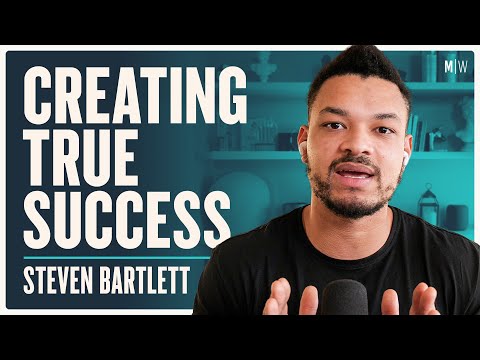
Lessons In Creating A Successful Life - Steven Bartlett | Modern Wisdom Podcast 301
Steven Bartlett (guest), Chris Williamson (host), Narrator
In this episode of Modern Wisdom, featuring Steven Bartlett and Chris Williamson, Lessons In Creating A Successful Life - Steven Bartlett | Modern Wisdom Podcast 301 explores steven Bartlett Dismantles Success Myths And Redefines A Fulfilling Life Steven Bartlett joins Chris Williamson to unpack the ideas behind his book *Happy Sexy Millionaire*, challenging cultural myths about money, status, passion, and happiness. He explains how early invalidation, Instagram-era comparison, and vague societal labels drive many people to chase the wrong goals. Bartlett shares his personal journey from broke dropout to multimillionaire CEO, why becoming rich felt anticlimactic, and why he ultimately quit his own company. Throughout, he offers mental models for building real self-belief, knowing when to quit, resisting labels, and designing a life driven by intrinsic meaning rather than external validation.
Steven Bartlett Dismantles Success Myths And Redefines A Fulfilling Life
Steven Bartlett joins Chris Williamson to unpack the ideas behind his book *Happy Sexy Millionaire*, challenging cultural myths about money, status, passion, and happiness. He explains how early invalidation, Instagram-era comparison, and vague societal labels drive many people to chase the wrong goals. Bartlett shares his personal journey from broke dropout to multimillionaire CEO, why becoming rich felt anticlimactic, and why he ultimately quit his own company. Throughout, he offers mental models for building real self-belief, knowing when to quit, resisting labels, and designing a life driven by intrinsic meaning rather than external validation.
Key Takeaways
Build self-belief from evidence, not affirmations.
Bartlett argues that confidence comes from accumulated ‘personal case studies’—small wins and hard proofs that you can do difficult things—rather than repeating mantras you don’t truly believe.
Get the full analysis with uListen AI
Question labels and roles that quietly imprison you.
He warns that many people live as the ‘social media CEO’, the ‘accountant’, or the ‘good son’ long after those labels stop fitting, and that freedom comes from seeing yourself as a flexible bundle of skills and interests rather than a fixed title.
Get the full analysis with uListen AI
Use a quitting framework: does it suck, or is it just hard?
If something is merely hard but the potential reward is worth it, persist; if it genuinely sucks, ask whether you can realistically make it not suck and whether the effort to fix it is worth the reward—if not, quit deliberately.
Get the full analysis with uListen AI
Recognize that invalidation often drives your adult goals.
Childhood feelings of being ‘less than’—about money, home, appearance, or parental approval—often become the very metrics (wealth, status, attention) we obsessively chase later, even after they stop serving us.
Get the full analysis with uListen AI
Don’t confuse external success with internal fulfillment.
Bartlett contrasts the euphoria of finding £13 in a chicken shop with the numbness of becoming a multimillionaire, showing that satisfaction is driven by expectation vs. ...
Get the full analysis with uListen AI
Treat social media consumption as a mental environment, not entertainment.
Because our brains automatically compare, following highly edited influencers (e. ...
Get the full analysis with uListen AI
Focus on ‘Does this feel good and meaningful?’ not ‘What’s my passion?’.
He criticizes the binary, vague notion of ‘finding your passion’ and suggests instead tracking what genuinely feels engaging and energizing, then doubling down with high focus and fast experimentation.
Get the full analysis with uListen AI
Notable Quotes
“The most intrinsically rewarding way I could live my life was to resist my labels.”
— Steven Bartlett
“Confidence isn’t given, it’s earned. Self-esteem is the reputation you have with yourself.”
— Chris Williamson (paraphrasing Naval Ravikant and expanding)
“The things that invalidated you when you were younger will be the things you seek validation from when you’re older.”
— Steven Bartlett
“Quitting is just as much of a skill as knowing what to start.”
— Steven Bartlett
“Everybody wants to be extraordinary, but everyone also wants to be normal. Normal people get normal results. Weird people get weird results.”
— Chris Williamson
Questions Answered in This Episode
How can someone practically start building ‘personal case studies’ to strengthen their self-belief if they currently feel completely stuck or defeated?
Steven Bartlett joins Chris Williamson to unpack the ideas behind his book *Happy Sexy Millionaire*, challenging cultural myths about money, status, passion, and happiness. ...
Get the full analysis with uListen AI
Which labels in my own life—job title, family role, social identity—are silently dictating my choices, and how might I experiment with resisting them?
Get the full analysis with uListen AI
Using Bartlett’s quitting framework, what in my life currently ‘sucks’ versus is simply ‘hard’, and what does that imply I should walk away from?
Get the full analysis with uListen AI
How is my social media feed shaping my sense of self-worth and body image, and what would a mentally healthy ‘unfollow and replace’ strategy look like for me?
Get the full analysis with uListen AI
If I stopped chasing the things that once invalidated me—money, status, attention—what goals would remain that are intrinsically meaningful on their own?
Get the full analysis with uListen AI
Transcript Preview
The most intrinsically rewarding way I could probably live my life was to resist my labels. Elon Musk or Kanye West, I don't love all of their ideas, but the thing I love and- and admire most about those individuals was they didn't let their past or a label or anything define, define them. And that inspires me. I think that's a free way to live. I think everybody, the vast majority, 99% of people, don't live freely. They live confined by words that, you know, their mum or dad or themselves have given them. (whoosh)
First off, mate, I need to say thank you for dinner because the last time that we were together, we were overlooking Downtown Dubai, and you invited me and a buddy out for a really wonderful evening dinner. But then as you left, I was in the toilet, so I haven't actually got to say goodbye. So-
(laughs)
... thanks for dinner, mate, and also welcome to the show.
Thanks for having me. I, I left abruptly because I had a, a flight to catch that night and my suitcases were actually downstairs. So when my PA grabbed me and said, you know, "You've got to go now." I just, I quickly scrambled and, uh, e- exited the building. But yeah, thank you. It was good to, good to meet you and catch up with you and such, and I'm excited to be on your podcast today.
Yeah. Me too, man. So why did you write a book? You've got a lot of stuff-
(laughs)
... online already. Like, why do you need a book as an outlet?
This is a couple of... You, you make a really good point. Um, we live in an era of, you know, instantaneous feedback. And, um, I, I'm a, I'm a connected from birth, um, I'm part of the connected from birth generation where I've had, you know, some form of online connection for my whole life. And things have got even more, um, superficial and ephemeral, um, as I've, as I've got older. So you're right, I've got millions of followers online. If I've got a message to communicate, why don't I just do an Instagram story or something which gives me that sort of instant feedback? And I think, in fact, that was, um, paradoxically why I needed to write the book because of the way that the world was, is heading and the, the lack of meaning and how shallow, um, uh, and surface level things are getting. And for me, the book w- if... The book is the antithesis of that. It is depth, it's meaning, it's something you, you spend two years doing, and then once you're done, you still have another year's wait until it's published. And, um, it was a chance to really... There's so many things with books that I came to learn that you don't get with social media as well. One of the real big things which I think changes the way you create your ideas is you... Because you don't get instant feedback or pretty much no, not a lot of feedback at all, there's no comment section, you write with a certain level of freedom, which is quite rare these days. So I got to go deeper than I've ever gone before. Y- I know that if I write a page, um, it's not going to be discussed instantaneously, and I think that allows f- thoughts and ideas to connect in a different way. So just, uh, for me, it was a bit of an experiment, to be honest, something I put off for a long time. But, um, just to conclude that point, there was one day where I looked at my diary from when I was 18 years old, and in the front page of it, I'd basically written that I wanted to be a happy, sexy millionaire. And I, I read that when I was 26 and I, you know, built this massive business and I was traveling from one country to another, and that was the moment where I thought I wanted to write the book because it dawned on me how dumb I was to aim for that and how many other people are.
Install uListen to search the full transcript and get AI-powered insights
Get Full TranscriptGet more from every podcast
AI summaries, searchable transcripts, and fact-checking. Free forever.
Add to Chrome