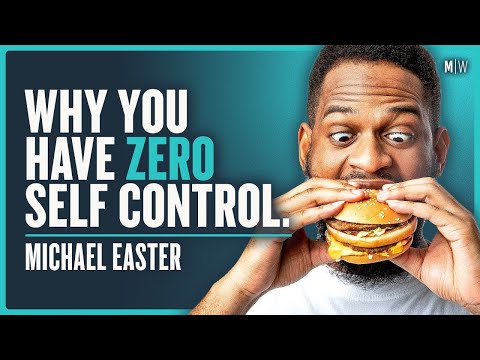
Bingeing, Escapism & Modern Addictions - Michael Easter
Chris Williamson (host), Michael Easter (guest)
In this episode of Modern Wisdom, featuring Chris Williamson and Michael Easter, Bingeing, Escapism & Modern Addictions - Michael Easter explores why Our Scarcity-Wired Brains Binge in an Age of Abundance Chris Williamson and Michael Easter explore why humans struggle with moderation in a world overflowing with food, information, status, and digital stimulation. Easter outlines the evolutionary mismatch between our scarcity-adapted brains and modern abundance, introducing his concept of the 'scarcity loop'—a behavioral cycle of opportunity, unpredictable rewards, and rapid repeatability that drives compulsive use. They trace how this loop underpins slot machines, social media, shopping, finance apps, and ultra-processed food, and how it fuels escapism and addiction. The conversation also covers addiction theory, the role of status and influence, information overload, and practical ways to break these loops and reclaim control.
Why Our Scarcity-Wired Brains Binge in an Age of Abundance
Chris Williamson and Michael Easter explore why humans struggle with moderation in a world overflowing with food, information, status, and digital stimulation. Easter outlines the evolutionary mismatch between our scarcity-adapted brains and modern abundance, introducing his concept of the 'scarcity loop'—a behavioral cycle of opportunity, unpredictable rewards, and rapid repeatability that drives compulsive use. They trace how this loop underpins slot machines, social media, shopping, finance apps, and ultra-processed food, and how it fuels escapism and addiction. The conversation also covers addiction theory, the role of status and influence, information overload, and practical ways to break these loops and reclaim control.
Key Takeaways
Our brains are built for scarcity, but we live in surplus.
Humans evolved to over-consume rare resources like food, information, and status because doing so once conferred a survival advantage; in today's world of constant availability, the same drives push us toward chronic overindulgence in everything from food to digital media.
Get the full analysis with uListen AI
The Scarcity Loop powers modern addictions.
Easter’s ‘scarcity loop’—opportunity for gain, unpredictable rewards, and rapid repeatability—explains why slot machines, social media feeds, dating apps, Robinhood-style trading, and gamified shopping are so compelling and hard to stop, even when we know they’re irrational or harmful.
Get the full analysis with uListen AI
Unpredictable rewards hijack attention more than guaranteed ones.
Studies from Skinner to modern gambling research show animals (and humans) will choose variable, lower total rewards over predictable, higher ones; this same anticipation dynamic fuels engagement with notifications, news, emails, and viral content.
Get the full analysis with uListen AI
Addiction is often a symptom of deeper problems, not just a ‘brain disease’.
Using Captagon in Iraq and Vietnam heroin data, Easter argues addiction usually arises when people with significant problems find a substance or behavior that reliably relieves their pain and lack alternative solutions, challenging purely moral or purely neurochemical models.
Get the full analysis with uListen AI
Status and quantification distort our motives and behavior.
Social media metrics, follower counts, and gamified ‘scores’ (on Twitter, activity trackers, wine ratings, grades, etc. ...
Get the full analysis with uListen AI
The modern food environment is engineered for overconsumption.
Ultra-processed foods maximize ‘value, variety, and velocity’, concentrating calories and making them easy to eat quickly; controlled studies show people consume hundreds more calories daily on such diets versus minimally processed, single-ingredient foods like those eaten by the Tsimane.
Get the full analysis with uListen AI
You can weaken scarcity loops by changing triggers, rewards, or speed.
Practical interventions include limiting options (e. ...
Get the full analysis with uListen AI
Notable Quotes
“We still have our old genes that push us into more in a world where everything we’re built to crave is now abundant.”
— Michael Easter
“The scarcity loop is the serial killer of moderation.”
— Michael Easter
“Anticipation is the bullseye of happiness.”
— Chris Williamson
“Nothing fixes a problem like using a substance—at least in the short term.”
— Michael Easter
“The move from people being judged by their deeds to people being judged by their opinions has meant that words carry more weight than actions.”
— Chris Williamson
Questions Answered in This Episode
How can individuals systematically audit their own lives to identify where the scarcity loop is subconsciously operating (food, phone, money, status, etc.)?
Chris Williamson and Michael Easter explore why humans struggle with moderation in a world overflowing with food, information, status, and digital stimulation. ...
Get the full analysis with uListen AI
What specific boundaries or routines does Michael Easter personally use to keep technology and social media within healthy limits?
Get the full analysis with uListen AI
How should public policy or product design change if we take the scarcity loop seriously as a public health and mental health issue?
Get the full analysis with uListen AI
In a world of information overload and conflicting expert opinions, what practical criteria can someone use to decide who and what to trust?
Get the full analysis with uListen AI
How can we rebuild intrinsic motivation—doing things for their own sake—when so many aspects of life are now gamified and quantified?
Get the full analysis with uListen AI
Transcript Preview
Why is moderation so hard to achieve? Why can't humans just ever get enough?
It never made sense until maybe, I don't know, the 1970s, to start moderating, (laughs) right? We're a, we're a species that came up in these environments where everything we needed to survive was scarce, food, stuff, information, even number of people we could influence, status, things like that. Um, and so the people who lived on and spread their DNA were people who tended to not try and moderate on those things, right? But the difference is that today we have an abundance of all these things that we're sort of built to crave, if you will, and, um, we still have our old, our old genes that push us into more.
So because we existed for almost all of human history with less than we wanted, less than we needed, we have seen everything as being a fleeting brief amount of abundance in a, an ocean of scarcity. We should take advantage of it right now. Give me more, more, more of everything that's in front.
Yeah. Exactly. Right? In the pa- in the- the... Take food. Food's a great example. In the past, it was hard to find food. You would have to walk around all day, pick it out of the ground, pick it off a tree. You would have to hunt it. You'd have to re- literally run it down until it was exhausted, and then you'd spear it, and then you'd take it home. And so it required effort, and there was never a maximal amount of it. So when you had the opportunity to eat, you wanted to eat as much as possible, and you even still see this today in some tribes where, um... I talked to a, a researcher who was hanging out, I think, with the Ache tribe in Paraguay, and he's like, "These guys came upon this orange bush, and they literally ate oranges until they threw up, and then they ate more oranges." (laughs) Right? 'Cause that sort of behavior gave you a survival advantage in the past 'cause you would put on that, those extra calories as, as fat. And in the times when you inevitably encountered a scarcity and you were starting to lose weight, uh, you would have something to draw on. We still have that exact same drive. In a world where... Now that you live in the US you can identify with this, where there's a 7-Eleven on every corner (laughs) pumping out Coca-Cola and Slurpees and bags of food, and we've got... You know, I live in Vegas. There's buffets where people will go up, you know, 10 times, and, uh, that often backfires. But it's not just... Of course it's not just food, right? It's all these other things. It's like, the average person today owns more than 10,000 items in a house, right? We see more information, some researchers think, in one day than the average person 700 years ago would have seen in their entire life. And so it's all these different things that used to give us a survival advantage, overdoing them, we now have an abundance of them and continue to overdo them.
Install uListen to search the full transcript and get AI-powered insights
Get Full TranscriptGet more from every podcast
AI summaries, searchable transcripts, and fact-checking. Free forever.
Add to Chrome