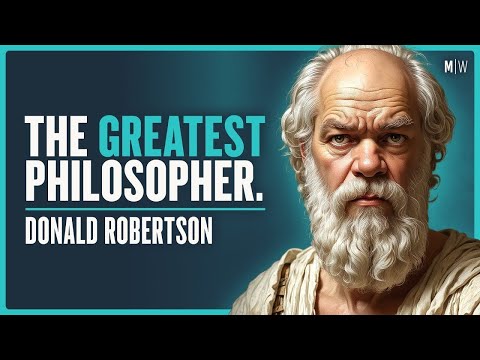
Ancient Greek Wisdom Every Man Needs To Hear - Donald Robertson
Chris Williamson (host), Donald Robertson (guest)
In this episode of Modern Wisdom, featuring Chris Williamson and Donald Robertson, Ancient Greek Wisdom Every Man Needs To Hear - Donald Robertson explores socratic Wisdom, Self-Help, And Anger: Ancient Lessons For Today’s Men Donald Robertson explains why Socrates matters today, portraying him as a relentless, Jimi Hendrix‑level obsessive of philosophy who turned abstract thought into a practical art of living. He traces how we know anything about Socrates, the world of pre‑Socratic natural philosophers and Sophists he reacted against, and how his questioning style became the root of cognitive behavioral therapy and modern self-improvement.
Socratic Wisdom, Self-Help, And Anger: Ancient Lessons For Today’s Men
Donald Robertson explains why Socrates matters today, portraying him as a relentless, Jimi Hendrix‑level obsessive of philosophy who turned abstract thought into a practical art of living. He traces how we know anything about Socrates, the world of pre‑Socratic natural philosophers and Sophists he reacted against, and how his questioning style became the root of cognitive behavioral therapy and modern self-improvement.
Robertson unpacks the Socratic method—systematic questioning of definitions, assumptions, and moral double standards—as a skill for coping flexibility, clearer thinking, and better ethics rather than a set of static rules. He explores Socrates’ views on justice, courage, self-knowledge, death, and the good life, emphasizing that character and practical wisdom matter more than wealth, status, or reputation.
The conversation also contrasts Socrates with later figures like Seneca and modern political operatives, highlighting what happens when rhetoric and power are divorced from genuine concern for truth and justice. Robertson connects all this to contemporary issues—online self-help, politics, social media outrage, and anger—arguing that Socratic-style reflection is urgently needed in a culture drowning in rules, slogans, and unexamined opinions.
Key Takeaways
Treat wisdom as a skill, not a list of correct opinions.
For Socrates, real wisdom is an ongoing process of examining your life, questioning assumptions, and refining your thinking—more like a practiced craft than memorizing doctrines or ‘rules for life’.
Get the full analysis with uListen AI
Use the Socratic method to expose contradictions and double standards.
By defining key terms (like justice or courage), testing them with counterexamples, and comparing what you demand of others versus yourself, you can uncover hypocrisy and unclear thinking that quietly drive bad decisions.
Get the full analysis with uListen AI
Focus less on rules, more on coping flexibility.
Modern research shows that people who cope best with stress can flexibly choose different strategies depending on context; Socrates prefigured this by resisting one-size-fits-all maxims and instead teaching people how to think through pros and cons themselves.
Get the full analysis with uListen AI
Question society’s default values of wealth, status, and reputation.
Socrates argues that external ‘goods’ become truly good or bad depending on the character of the person using them—making practical moral wisdom and virtue, not possessions or acclaim, the core of a flourishing life.
Get the full analysis with uListen AI
Recognize how anger quietly harms you more than its target.
Drawing on Socratic and Stoic ideas plus modern psychology, Robertson notes that anger narrows perspective, increases risk-taking, damages relationships, and often produces consequences worse than the original offense.
Get the full analysis with uListen AI
Leverage dialogue and perspective-taking to know yourself better.
Because we’re often poor judges of ourselves, Socrates uses dialogue—with real people and even imagined interlocutors—as a ‘mirror for the soul’; modern studies echo this by showing that writing about yourself in the third person improves the wisdom of your decisions.
Get the full analysis with uListen AI
Fear events less by examining the opinions underneath them.
Using Socrates’ fearless acceptance of death as a model, Robertson and the Stoics emphasize that emotions like terror or despair come largely from our judgments; changing how we interpret events (even mortality) can dramatically alter our emotional experience.
Get the full analysis with uListen AI
Notable Quotes
“He was like the Jimi Hendrix of philosophizing. He never took his guitar off.”
— Donald Robertson
“The unexamined life is not worth living.”
— Donald Robertson (quoting Socrates)
“What’s much more in your interests is learning how to think for yourself.”
— Donald Robertson
“Ignorance isn’t a problem. The problem is believing you know what you don’t know.”
— Donald Robertson (paraphrasing Socrates’ view on ‘double ignorance’)
“Your own anger usually does you more harm than the thing you’re angry about.”
— Donald Robertson
Questions Answered in This Episode
How can someone practically incorporate the Socratic method into their daily self-reflection without a trained interlocutor?
Donald Robertson explains why Socrates matters today, portraying him as a relentless, Jimi Hendrix‑level obsessive of philosophy who turned abstract thought into a practical art of living. ...
Get the full analysis with uListen AI
In what ways might modern self-help culture be repeating the same mistakes Socrates saw in the Sophists?
Robertson unpacks the Socratic method—systematic questioning of definitions, assumptions, and moral double standards—as a skill for coping flexibility, clearer thinking, and better ethics rather than a set of static rules. ...
Get the full analysis with uListen AI
How far should we accept Socrates’ claim that injustice harms the perpetrator more than the victim, especially in cases of severe wrongdoing?
The conversation also contrasts Socrates with later figures like Seneca and modern political operatives, highlighting what happens when rhetoric and power are divorced from genuine concern for truth and justice. ...
Get the full analysis with uListen AI
What are concrete signs that a coping strategy or self-help technique you’re using has become too rigid and is now backfiring?
Get the full analysis with uListen AI
How might adopting Socrates’ attitude toward death and external loss change the way we set goals and define success today?
Get the full analysis with uListen AI
Transcript Preview
Dude, I love every time that we get to speak. I- I adored all of your last books. And you've done a new one about Socrates. Why would anyone want to think like Socrates?
Why would anyone care about this old, dead white guy or whatever? He bec- I- I love Socrates. I- I love Marcus Aurelius, but Socrates is, like, the next level, you know. I- I really am excited to- to be able to talk and- and write about him and stuff. Socrates was a... I'll tell you why. This is gonna seem like an odd answer, right? There's Eric Clapton, right? And guys like that. And then there's Jimi Hendrix, right? Eric Clapton's an amazing guitarist, but Jimi Hendrix, to me anyway, sounds like he's from another planet, right? Jimi Hendrix took his guitar to bed with him. He woke up in the morning, strapped his guitar on and fried eggs wearing his guitar. He went to the lavatory wearing his guitar, right? Psychologists call that time on task. Like he was constantly practicing and stuff, like he was obsessed with it. Socrates reminds me, in that solitary regard, of Jimi Hendrix because the way he's described to us is that he's a guy who abandoned everything else and just spent all day, every day, discussing what he considered to be the most important questions in life with anybody. The- the greatest intellectuals that he could find in the, uh, in the known world. Prostitutes, uh, politicians, uh, slaves, you name it. Everybody from all walks of life. So he had... He was like the Jimi Hendrix of philosophizing. Like he never took his guitar off. He was constantly doing... I can't imagine someone in modern society spending that amount of time really analyzing the contradictions in someone else's thinking. So Socrates, to me, is a kind of unique individual. And it- it comes through. We don't know, there's this thing called the Socratic problem, that we don't know but we should acknowledge it at the beginning, that we don't know for sure how close a representation Plato's Dialogues or the other sources that we have are of the real Socrates. But I think his character comes through to some extent. The- those dialogues are probably semi-fictional, like they're embellished a bit. But the real guy kind of shines through to some extent, and he must have been an extraordinary individual. He's somebody who has a tremendous capacity for thinking outside the box, for spotting logical contradictions, and he said some of the most radical things in the history of Western philosophy. Not only that, I see him as the godfather of modern self-help and self-improvement psychology or the great-great-granddaddy of cognitive behavioral therapy. So as a- a psychotherapist, a cognitive behavioral therapist, you know, I- I look to Socrates as somebody who stands at the very origin of our tradition. But also, I think in some ways we've kind of gone astray, in ways that he warned us about. So by going back and looking at what he originally said, I think we can figure out maybe, and see beyond, some of the mistakes that we might have made along the way.
Install uListen to search the full transcript and get AI-powered insights
Get Full TranscriptGet more from every podcast
AI summaries, searchable transcripts, and fact-checking. Free forever.
Add to Chrome