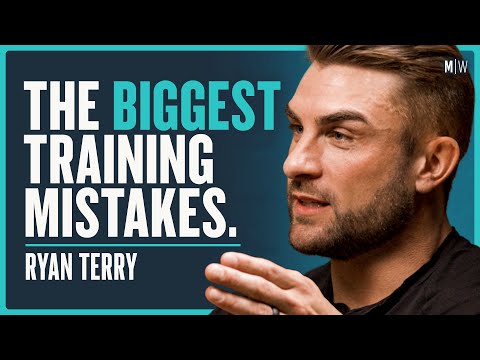
Britain’s #1 Fitness Model Shares His Bodybuilding Secrets - Ryan Terry
Chris Williamson (host), Ryan Terry (guest)
In this episode of Modern Wisdom, featuring Chris Williamson and Ryan Terry, Britain’s #1 Fitness Model Shares His Bodybuilding Secrets - Ryan Terry explores britain’s top physique model reveals discipline, obsession, and fatherhood tradeoffs Ryan Terry, Britain’s leading men’s physique competitor, explains how early insecurity, work from age 14, and obsessive competitiveness drove him from plumbing apprentice to world‑class bodybuilding. He describes the tension between data-driven ‘quantified self’ approaches and the intuitive, feeling-based style that actually keeps him performing and enjoying the sport.
Britain’s top physique model reveals discipline, obsession, and fatherhood tradeoffs
Ryan Terry, Britain’s leading men’s physique competitor, explains how early insecurity, work from age 14, and obsessive competitiveness drove him from plumbing apprentice to world‑class bodybuilding. He describes the tension between data-driven ‘quantified self’ approaches and the intuitive, feeling-based style that actually keeps him performing and enjoying the sport.
The conversation covers his training philosophy, morning routine, exercise selection, posing and iso-holds, nutrition, and why over‑tracking nearly ruined his love for bodybuilding. Terry also discusses building multiple businesses, launching a UK-wide blood-testing clinic, and chasing the one title he hasn’t yet won: Mr. Olympia.
A big portion of the discussion is about identity, pressure, and life after competition: how to be a present father, avoid spoiling his son, and use his platform to serve others’ health, all while satisfying his deep need for competition.
Key Takeaways
Intuitive training can outperform obsessive tracking if you truly know your body.
Terry’s best progress came when he trained by feel—adjusting load, volume, and rest based on energy, sleep, and pump—rather than chasing numbers from wearables and logbooks that eventually made the sport feel like a job.
Get the full analysis with uListen AI
Turning a passion into a career risks destroying the joy that fueled it.
As sponsors, teams, and expectations grew, bodybuilding shifted from a confidence-building hobby into labor, creating pressure where failure in sport felt like failure as a person; being aware of this tradeoff helps you set boundaries before burnout.
Get the full analysis with uListen AI
Mind–muscle connection and iso-holds are underused performance levers.
He credits meticulous posing practice and painful iso-tension holds for his famous midsection and stage control, arguing that muscle control and presentation separate top-level physiques when everyone is already lean and muscular.
Get the full analysis with uListen AI
Sustainable elite performance demands owning the whole process, not outsourcing it.
Terry insists on cooking and measuring all his own meals and keeping direct oversight of prep, believing that absolute ownership of variables builds confidence and reduces anxiety when it’s time to compete.
Get the full analysis with uListen AI
Your environment and peers shape your children more than your parenting ideals.
Via research discussed in the episode, Plomin’s twin studies suggest that peers and local culture (e. ...
Get the full analysis with uListen AI
Ambition must evolve as life circumstances change, not disappear.
Terry wants a Mr. ...
Get the full analysis with uListen AI
You can maintain extreme discipline without making it a spectacle.
He shows that rigid meal timing and prep can coexist with normal social life—eating in the car between events, ordering simple foods at restaurants—if you treat discipline as private routine instead of an identity performance.
Get the full analysis with uListen AI
Notable Quotes
“There was something telling me to face my fears—step out of my comfort zone and see if I can do what these guys are doing.”
— Ryan Terry
“One of the quickest ways that you can destroy your love for something is to turn it into a labor.”
— Chris Williamson
“Whenever I tried to implement too much structure, I lost the enjoyment—so I was actually being counterproductive.”
— Ryan Terry
“I don’t know what I’ll do when competing is over, because it’s always been about satisfying that hunger for competitiveness.”
— Ryan Terry
“The nurture part of nature and nurture doesn’t come from you or your wife—it comes from the friends your kids hang around with.”
— Chris Williamson
Questions Answered in This Episode
How can someone experiment to find their own balance between data-driven tracking and intuitive, feeling-based training without sacrificing progress?
Ryan Terry, Britain’s leading men’s physique competitor, explains how early insecurity, work from age 14, and obsessive competitiveness drove him from plumbing apprentice to world‑class bodybuilding. ...
Get the full analysis with uListen AI
What practical steps can athletes take to prevent their identity from becoming completely fused with their sport or career?
The conversation covers his training philosophy, morning routine, exercise selection, posing and iso-holds, nutrition, and why over‑tracking nearly ruined his love for bodybuilding. ...
Get the full analysis with uListen AI
How might Terry design a post-competition ‘second career’ that still satisfies his deep need for competition and structure?
A big portion of the discussion is about identity, pressure, and life after competition: how to be a present father, avoid spoiling his son, and use his platform to serve others’ health, all while satisfying his deep need for competition.
Get the full analysis with uListen AI
For parents with resources, how do you deliberately expose children to productive challenges without recreating the hardships you faced yourself?
Get the full analysis with uListen AI
In physique sports, where everyone is highly trained, how much of the competitive edge really comes from ‘invisible’ work like posing, iso-holds, and psychological preparation?
Get the full analysis with uListen AI
Transcript Preview
(wind blows) How do you describe what you do?
Uh, so I'm a professional athlete, um, and yeah, a sponsored athlete as well.
In what category?
So I compete in men's physique, which is a bodybuilding class, um, and that transi- transitions from a- a athletic look, um, but as the years have gone on, it's- it's got more and more muscular, shall we say.
Mm-hmm. Mm-hmm. What drives you to do what you do? Why do you choose to do this sport that involves starving yourself down to an incredibly low body fat, that involves off-seasons? You took an entire off-season where you didn't even compete for basically a year and a half in order to be able to come back. Why? Why choose that sport?
So for me, just a bit of background, uh, about myself, um, I was al- I- I was always brought up around sports. I was very competitive, uh, growing up. That was football, gymnastics, um, swimming, and golf. And it was my life, uh, that competitive edge. I had, um, an older brother and older sister who I always used to compete with at home. It never, never stopped. And basically when I came into my teenage years, around the age of 14, I started to develop a complex about the way I looked, a bit of, um, body dysmorphia, should we say. And I started to join a gym because, for me, I thought training my body, making sure that I'm- got a six pack, looking good, feeling good, that it were gonna help with confidence.
Just rolling it back a little bit there, where do you think that body dysmorphia came from? Because we're basically the same age.
Yeah.
And, you know, we didn't have the same levels of comparison certainly at the age of 14.
Mm-hmm.
Facebook didn't even exist.
No, true.
There was no Instagram. There was no YouTube really.
True.
W- what, what caused the onset of that?
I think for me it's, it's funny, because me and my siblings have spoke about this before, because we all had the same type of complex, but we don't know why. We had a great upbringing. I didn't have a father figure in my life, um, didn't know my, my dad for about 10 years growing up in that same period. Um, so whether that was a deciding factor, um, we didn't have a lot of money, all that kind of stuff. We never went without, we just never had the best of the best, um, but we had a brilliant upbringing, shall we say. It was not an unhappy upbringing. Um, but yeah, I don't know, we- we always just felt there was something missing or always... And when I- I think when I was 14, obviously girls came on the scene and it became more... I became more aware of myself. I think up until that point I was just so fixated on sports, playing, just being a kid. And I think at the age of 14 I- I had to start work. Um, I was pot washing at the age of 14, waitering at the age of 14. Every night-
Install uListen to search the full transcript and get AI-powered insights
Get Full TranscriptGet more from every podcast
AI summaries, searchable transcripts, and fact-checking. Free forever.
Add to Chrome