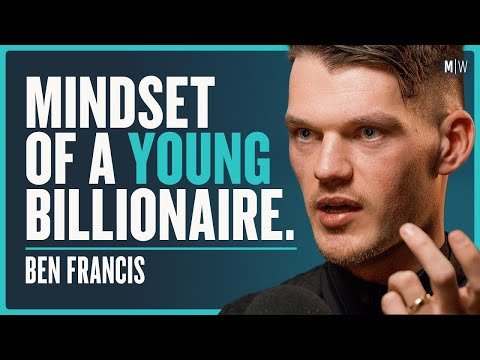
Gymshark CEO Explains His Strategy For Global Success - Ben Francis
Ben Francis (guest), Chris Williamson (host)
In this episode of Modern Wisdom, featuring Ben Francis and Chris Williamson, Gymshark CEO Explains His Strategy For Global Success - Ben Francis explores gymshark CEO Ben Francis Reveals Playbook For Growth And Grit Ben Francis discusses the evolution of Gymshark from a risky, all‑in startup to a globally scaling brand, and how his role has had to transform from dictatorial founder to inspirational CEO. He emphasizes learning from world‑class operators, the importance of being a good person in business, and keeping ego low while staying relentlessly open‑minded. The conversation ranges into modern masculinity, male and female mental health, fitness culture’s shift from aesthetics to holistic development, and the dangers of coddling and unhealthy body ideals. Ben also reflects on fatherhood, risk tolerance, raising grounded kids with wealth, and why he remains bullish on building businesses and families in the UK.
Gymshark CEO Ben Francis Reveals Playbook For Growth And Grit
Ben Francis discusses the evolution of Gymshark from a risky, all‑in startup to a globally scaling brand, and how his role has had to transform from dictatorial founder to inspirational CEO. He emphasizes learning from world‑class operators, the importance of being a good person in business, and keeping ego low while staying relentlessly open‑minded. The conversation ranges into modern masculinity, male and female mental health, fitness culture’s shift from aesthetics to holistic development, and the dangers of coddling and unhealthy body ideals. Ben also reflects on fatherhood, risk tolerance, raising grounded kids with wealth, and why he remains bullish on building businesses and families in the UK.
Key Takeaways
Great operators combine competence with genuine decency and curiosity.
Leaders Ben admires (e. ...
Get the full analysis with uListen AI
The founder role must evolve from dictatorial to inspirational as a company scales.
Ben argues that from 0–£10m revenue you often need to be decisive, ignore doubt, and move fast, but from £10m upward you increasingly rely on others, need more collaboration, and must inspire rather than just instruct.
Get the full analysis with uListen AI
Know your strengths and ruthlessly outsource your weaknesses early.
He quickly realized he was weak on ops, logistics, finance and people, so he hired an experienced CEO for six years, which both covered his gaps and gave him ‘failure without consequence’ to learn across multiple C‑suite functions.
Get the full analysis with uListen AI
Keep your personal ambition subordinate to the company’s ambition.
Delegation becomes easier and more rational if you care more about the business winning than about being ‘top dog’; otherwise you’ll cling to control and cap your company’s potential.
Get the full analysis with uListen AI
Modern fitness culture is shifting from aesthetics to holistic self‑improvement.
Where early online fitness was bro‑science about abs and supplements, today it leans more toward balanced training, diet, mental health, and questions like ‘how do I show up in the world? ...
Get the full analysis with uListen AI
Coddling and ‘it’s okay to talk’ messaging often miss what men need.
Ben and Chris argue that many men respond better to challenge, responsibility, and tangible action plans than to pure emotional validation—being told “what are you going to do about it? ...
Get the full analysis with uListen AI
We should promote health, not extremes, in body and fitness narratives.
Ben supports diverse goals (gaining muscle, losing fat, running faster) as equally valid, but is wary of glorifying both extreme leanness and obesity as ‘healthy’; admiration for extreme physiques is fine, but not as a long‑term health standard.
Get the full analysis with uListen AI
Notable Quotes
“If your ambitions for your business are larger than your personal ambitions, then you will put yourself into any role necessary for the business to succeed.”
— Ben Francis
“From naught to ten million you essentially do what the hell you want… from ten to fifty you realize you’ve actually got something to lose.”
— Ben Francis
“I had five years of failure without consequence. If you could draw the perfect environment for learning, it would be failure without consequence.”
— Ben Francis
“I don’t want someone just to sit there and stroke my ego and tell me that everything’s gonna be okay and I’m okay the way I am… that can lead to entitlement, softness and weakness.”
— Ben Francis
“Men are made to feel loved and accepted when they want to feel capable and powerful.”
— Chris Williamson (paraphrasing Adam Lane Smith)
Questions Answered in This Episode
How can an early‑stage founder practically decide when it’s time to stop being ‘dictatorial’ and start leading more collaboratively without losing speed?
Ben Francis discusses the evolution of Gymshark from a risky, all‑in startup to a globally scaling brand, and how his role has had to transform from dictatorial founder to inspirational CEO. ...
Get the full analysis with uListen AI
What concrete steps can male‑focused brands take to address men’s mental health in a way that emphasizes capability and responsibility rather than coddling?
Get the full analysis with uListen AI
Where is the ethical line between inclusive body representation and promoting physiques that are objectively unhealthy, and who should draw that line?
Get the full analysis with uListen AI
How should successful founders with young families design their schedules and device use so their kids see both hard work and genuine presence at home?
Get the full analysis with uListen AI
Given that peers and coaches may influence children more than parents, how can parents intentionally curate their kids’ environments without over‑controlling their lives?
Get the full analysis with uListen AI
Transcript Preview
I remember when I was r- I'd done something wrong and I was really, I'd completely (censored) up and I was so upset. And I was expecting my dad to sort of come and go, "You know, Ben, everything's gonna be all right." And he just sat there and he went, "Well, what are you gonna do about it?" I don't want someone just to sit there and stroke my ego and tell me that everything's gonna be okay, and I'm okay the way I am. Because I think that over a prolonged period of time can definitely lead to entitlement. I think it can lead to softness and weakness, and I don't think it's the right thing in the long term.
Ben Francis, welcome to the show.
Thank you for having me.
You have had the fortune of speaking to some of the best operators on the planet.
Mm-hmm.
What are the common threads, the most common traits that you've found between all of the high performers that you've spoken to?
I feel like there's the obvious ones, so they're very organized. I feel like there's the basics, right, organized, articulate, intelligent, the things you would expect of anyone who's a, a great operator. I also think that, that they tend to be better people than what you think for the most part. I feel like there's this, there's this view that there's this evil group of people that sit and control the world in a way, and I'm, you know, that might well be true, for all, for all I know. But certainly in the people that have run some of the really successful businesses, they tend to be really, really great people and great individuals, and really, really helpful. And a lot of those people have really helped me, and there's, um... I mean, people will know that Gymshark have, had a great relationship with Shopify for a long, long time. And Tobi, and particularly Harley who run that business, have been endlessly helpful to both me as an individual, I mean, even other people that work in the business, but our business as well. Um, and I think Harley really resonated with me and he continues to resonate with me because he is such a good human being, and the, the fact that he has such a well-balanced work life but also home life I think is, that's really interesting to me and it's been massively inspiring.
What's an example of Harley's work and home life showing up in a way that you found inspirational?
Well, there was a few. I mean, there's many. But the, first and foremost I think, this is, this is gonna sound so basic and some of these are gonna sound so trivial, but he's always happy to see you. Like, which is, which is really cool, right? And he'll, I think he remembers people's names and there's those sorts of common traits. And he will not remember this by any stretch of the imagination, but we were working in Germany a few years ago, a f- few years ago, this is pre-COVID now. Um, and I think there was something particular he had to do, it was like, say, 9:00 PM or something like that. We'd been working through the day. We did like, the talks and the events and all that, and then everyone went for food after. There was probably a table of 12 or so people. Um, but I knew that he had, had to get off by let's say nine o'clock. And it was actually, it was a really good conversation, it was a really good chat, and I think everyone was really interested in him because it was a lot of Shopify's largest merchants there. And literally like clockwork, at 8:59 he stands up, shakes everyone's hand, he knows everyone's name, and he heads off and he goes to bed and just sort of carries on with his day. And that level of efficiency, albeit to him was just probably just something that was so basic and normal, to me that was, that was really, that was really interesting because it would've been so easy to stay another 30 minutes, another 45 minutes, another hour. And I know the things that he wanted to do, by the way, is he wanted to get off 'cause he wanted to speak to his family and he wanted to prepare for the next day. And I think those little things over a prolonged period of time really add up, and, and being able to watch him and observe him do that I think was interesting. Um, and it, listen, it's, it's similar with other people. There's, um, there's a guy who, who's based in London that runs, I think it might be the world's biggest digital marketing agency, a company called AKQA, a guy called Ajaws, who is just, like, a really, really good human being, and he just, he, he seems to maintain relationships with people over a really, really long period of time. And that doesn't happen on accident. And by the way, bad people, f- in my experience, aren't able to maintain relationships with people for really prolonged periods of time. So having met lots of different people, I would say I've definitely been pleasantly surprised with the fact that they generally tend to be good people rather than bad people.
Install uListen to search the full transcript and get AI-powered insights
Get Full TranscriptGet more from every podcast
AI summaries, searchable transcripts, and fact-checking. Free forever.
Add to Chrome