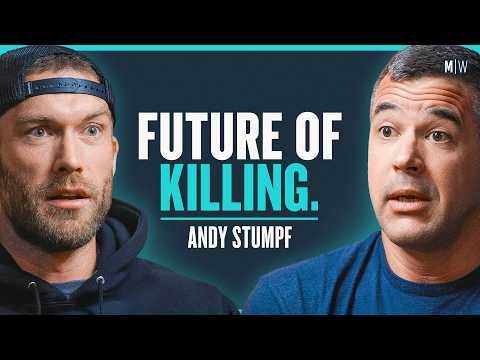
No One is Ready for This Coming War - Navy SEAL Andy Stumpf
Chris Williamson (host), Andy Stumpf (guest)
In this episode of Modern Wisdom, featuring Chris Williamson and Andy Stumpf, No One is Ready for This Coming War - Navy SEAL Andy Stumpf explores navy SEAL Andy Stumpf on war tech, training, resilience costs Stumpf argues modern warfare is simultaneously more lethal and more detached, with drone and AI-enabled killing lowering human friction while increasing battlefield danger.
Navy SEAL Andy Stumpf on war tech, training, resilience costs
Stumpf argues modern warfare is simultaneously more lethal and more detached, with drone and AI-enabled killing lowering human friction while increasing battlefield danger.
He describes how SEAL/SERE training is less about elite physiology and more about emotional control, attention to detail, and resisting overwhelm by narrowing focus to the next small step.
The conversation challenges civilian myths about special operations, emphasizing operators are “normal people” whose strengths (like a no-quit mindset) can become liabilities in family life and mental health.
Stumpf critiques unclear political end-states for war, warns against outsourcing combat to private military contractors, and stresses the importance of rules of war for strategic and moral reasons.
He frames personal development as learning to “suffer better,” reject victim narratives, ask for help, and choose goals that are truly worth the sacrifice.
Key Takeaways
Technology can reduce moral friction while increasing tactical risk.
Stumpf sees drones and remote killing as making combat both “more humane and more dangerous”: precision and standoff can reduce some harms, but ubiquitous cheap drones and screen-mediated violence create new threats and desensitization.
Get the full analysis with uListen
The scariest AI step is “human out of the loop.”
He outlines a progression from human-in-the-loop to on-the-loop to out-of-the-loop, arguing fully autonomous lethal decisions could force adversaries into an arms race where speed beats judgment.
Get the full analysis with uListen
War often becomes a surreal mix of cutting-edge tech and trench-level brutality.
Ukraine is his example of electronic warfare and internet-enabled drones existing alongside close-quarters trench fighting, making predictions about “the future of war” unreliable.
Get the full analysis with uListen
Don’t romanticize killing—or design systems that make it too easy.
He believes lethal force should carry a psychological burden; outsourcing killing to screens risks flippancy and further erodes already-thin cultural barriers against violence.
Get the full analysis with uListen
Special operators aren’t superheroes; treating them like they are can break them.
Stumpf says operators are “exceptionally normal people” doing exceptional tasks; external myth-making can become internal pressure, pushing people toward burnout, secrecy, and collapse.
Get the full analysis with uListen
Failure is tuition—some lessons are cheap, some near-bankrupting.
Reframing failure as paid learning reduces defensiveness and increases adaptation, but he warns the most expensive lessons often come from misapplied virtues like relentless persistence.
Get the full analysis with uListen
A ‘no-quit’ mindset must be aimed carefully—or it becomes self-harm.
He stayed ~10 extra years in a damaging relationship because quitting threatened his identity; he’d now rather see people fall short than destroy themselves for a goal that isn’t worth it.
Get the full analysis with uListen
People quit when they fixate on the remaining distance, not the next step.
As an instructor, he saw “time horizon” overwhelm break candidates; the antidote is chunking—compressing attention to the next actionable task until progress accumulates.
Get the full analysis with uListen
Emotional control and procedure-following matter more than raw toughness.
Tests like underwater knot-tying are engineered to provoke panic; success comes from detaching emotion from decisions and executing steps even when breathing feels threatened.
Get the full analysis with uListen
Training must reflect job danger—even if that implies nonzero fatality risk.
He controversially argues that if nobody ever dies in training for a lethal profession, the training likely isn’t hard or realistic enough to prepare people for real operational consequences.
Get the full analysis with uListen
Outsourcing war to PMCs creates accountability and allegiance hazards.
He opposes “renting the American flag,” warning contractors can incentivize rule-skirt behavior, lack robust rescue backstops, and shift loyalty toward whoever pays most.
Get the full analysis with uListen
Feeling alone is a dangerous lie—ask for help early.
Stumpf ties isolation to anomalous veteran suicide rates and says he has “never asked for help and not received it,” but people often wait until crisis because competence masks need.
Get the full analysis with uListen
Notable Quotes
“We usually didn't go out at full moon.”
— Andy Stumpf
“I don't think you should outsource killing.”
— Andy Stumpf
“If we take humans off the loop, I don't know how you combat that as an adversary without doing exactly the same thing.”
— Andy Stumpf
“Competence and currency are not the same thing.”
— Andy Stumpf
“They're normal, exceptionally average people.”
— Andy Stumpf
Questions Answered in This Episode
When you say warfare is “equal measure” more humane and more dangerous, what specific technologies push it in each direction (drones, EW, precision weapons, social media exposure)?
Stumpf argues modern warfare is simultaneously more lethal and more detached, with drone and AI-enabled killing lowering human friction while increasing battlefield danger.
Get the full analysis with uListen AI
Where do you think “human out of the loop” becomes most likely first: air defense, drone swarms, targeting intelligence, or cyber—and what would a realistic safeguard look like?
He describes how SEAL/SERE training is less about elite physiology and more about emotional control, attention to detail, and resisting overwhelm by narrowing focus to the next small step.
Get the full analysis with uListen AI
You said the go/no-go decision will “never” be made by AI; what are the real edge cases where automation already pressures commanders into immediate action?
The conversation challenges civilian myths about special operations, emphasizing operators are “normal people” whose strengths (like a no-quit mindset) can become liabilities in family life and mental health.
Get the full analysis with uListen AI
On the Bin Laden raid controversy: what parts of operator storytelling tend to diverge most across people who were present, and why does that happen structurally?
Stumpf critiques unclear political end-states for war, warns against outsourcing combat to private military contractors, and stresses the importance of rules of war for strategic and moral reasons.
Get the full analysis with uListen AI
You called post-engagement face-shooting a war crime; how should units train for ‘no uncertainty’ in clearing while preventing post-secure mutilation or retribution killings?
He frames personal development as learning to “suffer better,” reject victim narratives, ask for help, and choose goals that are truly worth the sacrifice.
Get the full analysis with uListen AI
Transcript Preview
I'm gonna play a little trick for the first time ever in this studio-
Okay
... to make you feel a little bit more at home. So you're a man who operated largely in the dark when you were doing raids, when you would've been operating, I imagine some stuff would've been by day, but other stuff would've been by night.
Unless there was an extremely compelling reason to do so exclusively at night.
Mm-hmm.
Oh, nice. Here we go. Transitioning, evening.
And now we're in a blood moon. And now-
We usually didn't go out at full moon.
Oh, okay. Because there's too much visibility.
Illumination. So, you know, even though you can see at night with night vision goggles, we constantly were looking at the illumination, the external illumination, because at some point people can almost see you as well as you can see them with the technological advantage. So we would avoid the high illumination nights, and obviously aviators and things that fly that could be backlit against those, they try to avoid it as well.
What are you surprised by with what's happening with warfare over the last few years? Like, I can't work out whether technology is making things more humane or more dangerous.
I think an equal measure of both. I've had a lot of conversations about this with guys, uh, during the time period that I served. I'd never for a single second thought about, uh, the danger of drone warfare. And I don't mean-- D- drones to us was Predators or Reapers or overhead surveillance platforms that had great, you know, sensor pods, and they could pipe stuff down, and you could have the ability to look at what they could see. It was great for situational awareness. I never once was concerned about somebody essentially ordering a drone on the internet. Not that that's how it's being built in, uh-- or made in Ukraine specifically, and Iran has some smaller ones as well. But having that be a kinetic option on the battlefield, didn't think about it a single time, and I am glad that I am not a part of that because, I mean, I have an internet connection just like anybody else, and I, I don't go searching for those videos, but sometimes they find you, and people running away from a, basically a DJI drone that detonates.
Mm-hmm.
Uh, hard pass. The hardest of passes being involved in that.
I read that field medics are not getting the same sort of trauma training that they used to because the kind of injuries that soldiers are getting on the battlefield are totally different now.
Well, towards the tail end of Afghanistan and Iraq, it was very IED heavy, so it would be explosive wounds, which are really gnarly. Um, not that any kind of wound is particularly great, um, but it just, it just tears things to pieces.
Mm-hmm.
And most of the stuff I'm seeing with the drone warfare is kind of the same. It's explosive-based. So maybe. I don't know.
Install uListen to search the full transcript and get AI-powered insights
Get Full TranscriptGet more from every podcast
AI summaries, searchable transcripts, and fact-checking. Free forever.
Add to Chrome