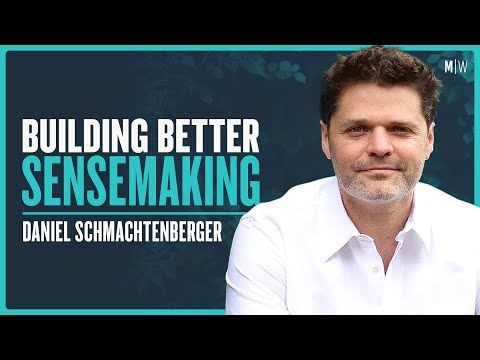
Daniel Schmachtenberger - Building Better Sensemaking | Modern Wisdom Podcast 348
Daniel Schmachtenberger (guest), Chris Williamson (host), Narrator, Narrator
In this episode of Modern Wisdom, featuring Daniel Schmachtenberger and Chris Williamson, Daniel Schmachtenberger - Building Better Sensemaking | Modern Wisdom Podcast 348 explores daniel Schmachtenberger on Sensemaking, Governance, and Designing Better Futures Daniel Schmachtenberger and Chris Williamson explore how individuals and societies can improve "sensemaking"—our ability to understand reality accurately enough to make meaningful choices. Schmachtenberger explains why modern democracies are failing at shared sensemaking and how media, algorithms, and incentives are driving polarization and bad collective decisions.
Daniel Schmachtenberger on Sensemaking, Governance, and Designing Better Futures
Daniel Schmachtenberger and Chris Williamson explore how individuals and societies can improve "sensemaking"—our ability to understand reality accurately enough to make meaningful choices. Schmachtenberger explains why modern democracies are failing at shared sensemaking and how media, algorithms, and incentives are driving polarization and bad collective decisions.
He distinguishes sensemaking (what is), meaning-making/values (what matters), and choice-making/governance (what we do), arguing that most of our conflict comes from collapsing these together and fighting over pre-baked propositions instead of underlying values. At the individual level, he offers practical epistemic tools: studying opposing narratives, seeking out bias-challenging information and friends, and cultivating comfort with uncertainty.
They also discuss human nature versus cultural conditioning, the dangers and possibilities of exponential technologies, and why we must redesign economic, media, and governance systems to support human development rather than exploit our worst tendencies. Schmachtenberger’s current work, The Consilience Project, aims to map the "metacrisis" and create better information and coordination architectures.
Key Takeaways
Separate sensemaking (facts) from values (what matters) before debating solutions.
Most political and social conflicts happen because people argue over policies (vaccines, bridges, climate laws) without first surfacing the full set of values involved (health, freedom, environment, economy) and then designing proposals that respect all of them as much as possible.
Get the full analysis with uListen AI
Actively study strong opposing narratives to improve your own understanding.
For any contentious topic (lab leak vs. ...
Get the full analysis with uListen AI
Curate your information environment to challenge rather than confirm your biases.
Because social platforms optimize for attention and confirmation, he recommends deliberately following high-quality voices from opposing camps, confusing the algorithm, avoiding pure recommendation feeds, and using search and direct sources (papers, longform essays) to reduce filter-bubble effects.
Get the full analysis with uListen AI
Cultivate epistemic humility: be comfortable with “I don’t know” while still caring.
He warns against two easy exits from discomfort: premature certainty (“the science is settled”) and nihilism (“no one can know anything, so why try”). ...
Get the full analysis with uListen AI
Focus your sensemaking on domains where you actually have agency.
Given finite time and attention, a nurse or parent may gain more real impact from deeply understanding their craft and relationships than from obsessing over geopolitical risks they cannot influence; sensemaking should serve choice-making, not just in-group identity battles.
Get the full analysis with uListen AI
Redesign incentives and technologies so they develop people instead of degrading them.
Technologies and markets are not value-neutral: they encode behaviors and values (e. ...
Get the full analysis with uListen AI
Human "nature" is highly plastic; better conditioning could support far higher civilizational capacity.
He challenges social-science fatalism by pointing to cultural outliers (Jains, Quakers, Jewish educational traditions, elite schooling) as evidence that vastly different levels of violence, rationality, and cooperation are possible if we change cultural, educational, and economic structures.
Get the full analysis with uListen AI
Notable Quotes
“Sense-making and meaning-making are the prerequisites for choice-making.”
— Daniel Schmachtenberger
“Everybody has biases. I can see everybody else’s; I’m just pretty sure I don’t have any.”
— Daniel Schmachtenberger
“Good sensemaking and high certainty don’t happen in the same place.”
— Daniel Schmachtenberger
“You’re being socially engineered right now, and you never aren’t. The question is whether we do it consciously and well.”
— Daniel Schmachtenberger
“The idea of the irrational, rivalrous masses is one of the deepest pieces of ruling-class propaganda, because it justifies rulership.”
— Daniel Schmachtenberger
Questions Answered in This Episode
How can individuals practically distinguish between legitimate expertise and narrative warfare in real time, without becoming paralyzed by skepticism?
Daniel Schmachtenberger and Chris Williamson explore how individuals and societies can improve "sensemaking"—our ability to understand reality accurately enough to make meaningful choices. ...
Get the full analysis with uListen AI
What would a social media platform designed explicitly to increase collective intelligence and moral development look like in concrete product terms?
He distinguishes sensemaking (what is), meaning-making/values (what matters), and choice-making/governance (what we do), arguing that most of our conflict comes from collapsing these together and fighting over pre-baked propositions instead of underlying values. ...
Get the full analysis with uListen AI
How can we redesign education so that perspective-taking, bias detection, and epistemic humility become baseline civic skills rather than elite extras?
They also discuss human nature versus cultural conditioning, the dangers and possibilities of exponential technologies, and why we must redesign economic, media, and governance systems to support human development rather than exploit our worst tendencies. ...
Get the full analysis with uListen AI
If human behavior is so strongly shaped by cultural conditioning, what are the minimal institutional changes that could most quickly shift us away from rivalrous dynamics?
Get the full analysis with uListen AI
Given the pace and incentives around AI and biotech development, what realistic governance or coordination mechanisms could prevent catastrophic or dystopian outcomes?
Get the full analysis with uListen AI
Transcript Preview
I actually want to understand the world I live in as best I can because I actually hold that life is meaningful, and I hold that my life could be meaningful, which means that my choices can be meaningful. And so I want them to be informed as well as they can be. (wind blowing)
What I think people really liked about our first conversation was that we brought some of your work down to an individual level. So a friend referred to it as creating a narrative of resonance. And given that, I thought it would be nice to start by looking at something that you talk about a lot, which is sensemaking, but from the level of the actor. So how do you define a sensemaking agent?
Well, I don't know what, um, background the other people listening to your show will have on the general topic. When you're mentioning individual agents, I think you mean individual humans. Obviously, an organization can act like an agent, um, act like a, a, a unit of agency. Uh, but I think you mean, uh, individuals seeking to make sense of the world they live in better. We oftentimes talk about sensemaking at a societal level, meaning, uh, and currently it comes up a lot, like, why do we have such a hard time coming to clear understanding about what the nature of climate change is, or what the nature of COVID viral origins or vaccines, or whatever, you know, systemic racism or how we should deal with nuclear disarmament, or why does it seem like there are such radically divergent views? Meaning the way that we're sensing the world is leading to very different senses of the world, which of course leads to very different senses of what should happen, which makes it very hard to coordinate, which makes it very easy to have conflict. And so when we're talking about sensemaking, we're usually talking about it in the context of shared sensemaking as a prerequisite for shared choice-making, w- i.e. governance. Sensemaking is not the only prerequisite. When we talk about governance, and by governance I don't mean government, which is a, maybe a specific, um, establishment that has, uh, rule of law and monopoly of violence. But governance meaning some process by which a bunch of people who want different things and see the world differently come to coordinate force in some effective, positive, productive ways. Um, so we're talking about how do we get people to have some kind of coherence or coordination between the choices they make such that it isn't making choices that we would think of as crime or something that really messes up each other's choice-making capacity, and where we need to coordinate on choices. Like, we're not gonna all make our own roads and things like that, that we're able to coordinate effectively regarding shared resources, shared infrastructure, shared choices. It happens to be that lots of humans who don't know each other and have experienced the world differently and feel different things and want different things, coordinating on what the right choice is is a tricky thing, right? 'Cause they have a different sense of what is and what they want and what should be. So this is why for most of human history, the number of people that would coordinate was small. Tribes were small. They classically stayed beyond, you know, smaller than the Dunbar number, give or take 150-ish, where there were no strangers. Everybody that you were coordinating with, you'd known your whole life. They had known you your whole life. Everybody had the same shared basis of experience, and everybody could be in a single conversation around a campfire. And so the ability to coordinate, we could coordinate sensemaking because we were sensing the same stuff. We were living in the same place, right? We weren't even reading different books. We weren't even watching different TV shows. Like we were... nobody had been... w- we weren't speaking different languages. We were exposed to the same stuff. And so you could also fact-check anybody just by o- looking there, right? By just m- having such a shared basis. And it was pretty easy to unify values because the culture that had conditioned them was the same culture. Um, so there might be little differences of weighting. And so then the ability to, you know, unify choice-making if we have shared values and we have shared sense of the world, so both what we think is and what we want to be, uh, it's not that hard. Um, once we started to get to larger scales where now I've got to maybe make compromises for strangers, I've got, you know, we're, we're gonna have some coordination with people who I don't have any shared sense of real fealty with or whatever, that becomes a different topic and where they really do see the world differently. And so this is where mostly the order came through some kind of imposition or oppression or top-down force, which is why it was largely empires. O- And then that still meant a number of people smaller than Dunbar that would equal the king and a, a council making the decisions and imposing it by rule of law enforce- on everybody, right? So shared sensemaking didn't matter 'cause people didn't really have meaningful choices. They were gonna do the thing that they were gonna do within that context. So the idea of something like democracy or a republic or an open society where some humongous number of people who don't know each other, who don't have the same experiences are all going to not just do totally different stuff that creates chaos, but also not need somebody to kind of rule. They're gonna find order that isn't imposed, it's emergent order. That's actually a wild idea, right? Like it's a really fucking wild idea that that would even be possible. And, you know, the, the modern democracies came following the Enlightenment, the cultural kind of European Enlightenment with the idea that we could have this thing called the philosophy of science where we could all measure the same thing and get the same result independent of biases. Didn't matter, you know, what we thought beforehand. If we measure the speed of sound in the right way or whatever it is, we're gonna get the same result. So there's this unifying nature to objectivity that allows us to sensemake together.... which is why Karl Popper, who advanced the philosophy of science, was a guy who termed open society, right? That we can do open societies based on the ability to do shared sense-making using- using a more methodological rather than, "I had divine revelation and it's true and you don't know," kind of approach. (sniffs) And- and then- but like we said, the- the idea of governance is that there's some kind of emergent choice-making or order a- at the level of the choices we're making. The choices are both the result of our sense-making. What do we think is actually happening? What do we think the causes of what's happening are? And if we do X, what do we think will happen, right? That's kind of forecasting sense-making. But it's also, what do we want to happen, which is our values, which is not sense-making, right? Sense-making is sensing what is. The values is what ought, what do we think ought to be, what do we really care about, so we can call that values generation or meaning-making. (sniffs) So sense-making and meaning-making are the prerequisites for choice-making. The thing that we call governance in an open society is that there's some coordinated process for choice-making that doesn't have to be imposed by a king, doesn't just turn into, "There's no way we can get on the same page, so it has to be chaos," because we can sense the world together and we can sense each other's values and find a higher order set of values that includes everyone, so this was another part of the Enlightenment, was the idea that we could do a dialectic on values. You could say, "I- I really believe in doing X," whatever X proposition is, and we're like, "Why do you want to do it?" "Well, 'cause it's in service of, uh, decreasing infant mortality and the value that you have is infants." And we're like, "Yeah, but if you do that thing, it'll be bad for this other thing because it whatever. It'll damage the water supplies, but what you care about is the water supply." Well, let's not focus on the proposition for a moment. What you value is children. What you value is the water supply. Let's hold all those as legitimate values, right? What you value is individual freedom. What you value is the responsibility of the individuals to the collective that- that they are benefited by, so the ability to hear each other's values and synthesize them and say, "A good solution will meet everybody's values as best as possible." So often, we get stuck with, you know, a proposition is created to meet some value before even looking at what all the values are, and so it benefits the environment, but it hurts the economy, or it benefits the economy and hurts the environment, or whatever it is. So those who feel particularly connected to the thing being hurt are like, "This is terrible. We have to do everything to fight it," and those who feel connected to the thing that's being benefitted are like, "This is critical. Someone finally gets us." Now, those two sides is- have to become enemies if the only chance they have is to vote on a preexisting proposition that is a shitty proposition 'cause it was based on a theory of trade-offs between those that was never even consciously explicated. They never even said, "Oh, this is gonna harm this thing. Both these are values. Is- Can we take these values and find a better way forward, a better proposition that maybe could meet them both better?" (sniffs) Maybe rather than that bridge that is going to harm the environment the way that it is, um, but helps transportation, which will help the economy, a barge could do it without harming the environment, or we could just build better local economies on both sides, or whatever it is, right? So the dialectic process is where I want to hear the values that you care about, and so you believe everyone needs to be vaccinated, or no one should be forced to be vaccinated, or everyone should have to wear a mask, or nobody should- What is the value you care about independent of the strategy? The strategy is the way to fulfill a value. There is something legitimate in the value even if... Then the sense-making about, is that thing about vaccines, or about masks, or about whatever, is that true, is separate from, is that value legitimate, right? And so if- so we don't have participatory governance in the US. We don't really in the world in any very meaningful way. We have the- the legacy story of it, but we don't have a population hardly anywhere that are really seeking to understand the world we live in where there- where the government is gonna make choices on stuff, and for the government to be informed by the people that we understand enough to be able to weigh in well, and we seek to understand our own values and other people's values (laughs) and be able to have the dialectical conversations to see if we're missing some sense-making, somebody knows some stuff we don't and we really want to hear it rather than have our, um, in-group continue to feel right by saying how dumb the people in the out-group are. So there isn't anything like participatory governance, which is why open societies are basically failing and doing shittily while the authoritarian societies that aren't even claiming to do that and are just doing top-down government better are just doing better at long-term planning and infrastructure. So, you know, uh, people will hear me talking about sense-making. Usually, it's in this context of, how do we develop better capacity as a society as a whole for everyone to be doing a better job making sense of the world than just believing whatever happens to come through the Facebook feed that is algorithmically optimized to appeal to their current biases and kind of l- limbicly hijack or maximally bother them and drive in-group dynamics where people's fear of being out-group by believing the wrong thing in there w- w- i- messes with subtle, deep tribal biases? How can we do a better job with sense-making at the level of training individuals, at the level of how we change education and train people, and at the level of the quality of media we put out, at the level of how we design the information architecture so that rather than a Facebook or YouTube having an algorithm to maximize time on site, that it does through appealing to your biases which make you spend more time, it- which makes people on the right more right, the left more left, anti-conspiracy theorists, more hate conspiracy theorists, conspiracy theorists farther down that direction? And so there's this just hyperfragmentation as a result of the dis- uh, the financial model of this information technology, right? So how do we make better information technology? How do we make, uh, better media
Install uListen to search the full transcript and get AI-powered insights
Get Full TranscriptGet more from every podcast
AI summaries, searchable transcripts, and fact-checking. Free forever.
Add to Chrome