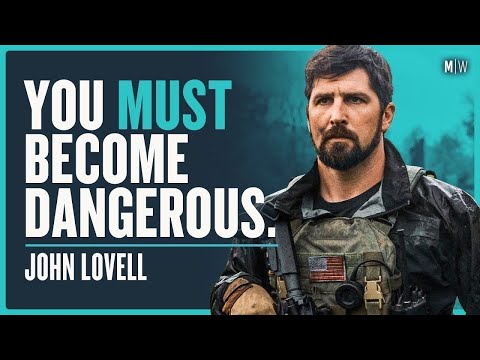
How To Kill Your Inner B*tch - John Lovell
Chris Williamson (host), John Lovell (guest)
In this episode of Modern Wisdom, featuring Chris Williamson and John Lovell, How To Kill Your Inner B*tch - John Lovell explores killing Cowardice: John Lovell’s Warrior-Poet Blueprint For Men John Lovell discusses his “warrior poet” ethos: living with death in mind, embracing courage, and cultivating both strength and deep emotional/spiritual life. Drawing on combat experiences, he explains how fear actually works, why no one ever permanently “masters” it, and how humility is the gateway to real toughness. He contrasts hollow pursuits of fame and wealth with the richer goal of becoming a good man, husband, father, and friend. The conversation challenges modern passive masculinity and offers a framework for men to become both dangerous and loving—lion and lamb, warrior and poet.
Killing Cowardice: John Lovell’s Warrior-Poet Blueprint For Men
John Lovell discusses his “warrior poet” ethos: living with death in mind, embracing courage, and cultivating both strength and deep emotional/spiritual life. Drawing on combat experiences, he explains how fear actually works, why no one ever permanently “masters” it, and how humility is the gateway to real toughness. He contrasts hollow pursuits of fame and wealth with the richer goal of becoming a good man, husband, father, and friend. The conversation challenges modern passive masculinity and offers a framework for men to become both dangerous and loving—lion and lamb, warrior and poet.
Key Takeaways
You will die the way you live—so live intentionally now.
Lovell argues that people delay ‘real life’ for retirement or future milestones, but facing the reality of death reveals that today is all you truly have. ...
Get the full analysis with uListen AI
No one ever permanently masters fear; courage must be earned daily.
Even after multiple combat tours, Lovell describes moments where he froze in terror and others where he was calm or enraged. ...
Get the full analysis with uListen AI
True strength is multi-dimensional: physical, emotional, mental, and spiritual.
He insists that being ‘strong’ is not just about muscles or pain tolerance; it includes emotional regulation, intellectual development, character, and spiritual depth. ...
Get the full analysis with uListen AI
Humility is the root of real toughness and growth; pride caps your potential.
The most dangerous men Lovell has met—elite soldiers and operators—are usually quiet and unassuming. ...
Get the full analysis with uListen AI
Men must become both warrior and poet: dangerous and deeply loving.
Lovell’s ‘warrior poet’ ideal is a man who can protect, provide, and fight if necessary, but who also pursues truth, faith, romance, emotional intimacy, and beauty. ...
Get the full analysis with uListen AI
Run toward what scares you to kill cowardice and expand courage.
If you fear heights, go bungee jumping; if you fear confrontation, have the hard conversation. ...
Get the full analysis with uListen AI
Face death before you die: resolve unfinished business and core questions.
Describing the ‘death letter’ soldiers write before combat, Lovell recommends a similar exercise: express what people mean to you, offer forgiveness, seek reconciliation, and confront questions about God, meaning, and what’s worth killing or dying for. ...
Get the full analysis with uListen AI
Notable Quotes
“You’ll die the exact same way that you live, whether that’s poorly or well.”
— John Lovell
“No one ever masters fear. Every single day, you gotta keep earning it.”
— John Lovell
“Passive men are neither warriors nor poets. They’re weak in both areas.”
— John Lovell
“Hiding your vulnerability from the world doesn’t make you any less vulnerable, it just makes you less honest.”
— Chris Williamson
“The arrogant guy can only get so tough. You have to be teachable, and arrogance will only let you get so far.”
— John Lovell
Questions Answered in This Episode
How can an ordinary person practically ‘face death before they die’ without a combat context—what specific exercises or rituals would you recommend?
John Lovell discusses his “warrior poet” ethos: living with death in mind, embracing courage, and cultivating both strength and deep emotional/spiritual life. ...
Get the full analysis with uListen AI
Where is the line between healthy humility and self-erasure, especially for men already prone to passivity or low self-worth?
Get the full analysis with uListen AI
How can men cultivate the ‘poet’ side—emotional openness, romance, spiritual depth—if they grew up without any role models showing that?
Get the full analysis with uListen AI
In a digital world that constantly rewards performance and image, how can someone keep their identity rooted in goodness rather than greatness, fame, or metrics?
Get the full analysis with uListen AI
What fears in modern civilian life (e.g., social rejection, cancellation, financial risk) deserve to be ‘run at’ and which, in your view, are better sidestepped or ignored?
Get the full analysis with uListen AI
Transcript Preview
What does it mean to live free and die well?
Sure. So it's wrapped up in our whole warrior poet ethos that's living for higher purpose, being ready to sacrifice in the defense of others. Ultimately, to live well in the present, you have to really start with the end in mind. Uh, lots of folks just go through life in an extremely reactionary manner. Things happen, the tyranny of the urgent comes up, and before you know it, all of your waking hours and even your kind of off-hours are spent stressing about stuff. Though if you were given a death diagnosis, you know, you are terminally ill, much of the stuff that we droll on with every single day would immediately sift to the edges of our attention as not important. And what can happen in the tyranny of the urgent is the most important stuff gets shuffled to the back. Being able to die well means that you lived a life that was worthy of your calling, so to speak. And in so doing, uh, y- you're able to live well with, uh, kind of that end in mind. And so, uh, in my estimation, having faced death, you know, many different times, it really allowed me to focus on what did I, what I wanted to do in life. And so it turns out that you'll die the exact same way that you live, whether that's poorly or well.
I love the tyranny of the urgent. I absolutely love that. I think it's- it's so accurate for how many people live their lives. There's this meme that I saw floating around a while ago that said, um, "Adulthood is just one series of weeks after the next saying, 'After this week it'll calm down,' and then you die."
Oh, it's such a trap. You know, folks think of like, "Man, uh, m- my 9:00 to 5:00 sucks and, uh, if- if I can just get through all the chores and the tasks, and I fix up the house, and I pay that off, and I work, and, you know, ultimately one day I'll have a nest egg big enough. And then when I'm 65 years old, I'm gonna really start living. That's when it'll get really good." Uh, and, uh, what you don't realize is that is overrated once you even get there. Uh, you look back of like, no, no, let's start living well right now. All there is is today. Y- you're not promised tomorrow. And so I don't want to delay living and having a meaningful impact on the world around me for hoping that one day I can start living right.
You mentioned that you've faced death. Uh, you were in the armed forces for a long while. You did a number of tours and you were in some kinetic, uh, encounters, I guess you could say. What was the closest that you think you came to death during your active service?
Install uListen to search the full transcript and get AI-powered insights
Get Full TranscriptGet more from every podcast
AI summaries, searchable transcripts, and fact-checking. Free forever.
Add to Chrome