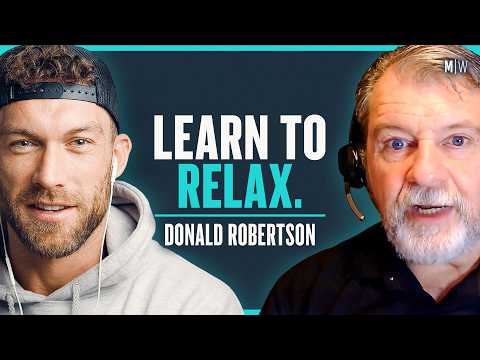
Practical Tools for a Less Anxious Life - Donald Robertson
Chris Williamson (host), Donald Robertson (guest)
In this episode of Modern Wisdom, featuring Chris Williamson and Donald Robertson, Practical Tools for a Less Anxious Life - Donald Robertson explores cBT, Stoicism, and exposure-based habits for lasting anxiety relief tools Anxiety is not a single “blob” of emotion but a recipe made of thoughts, sensations, images, memories, and behaviors that interact and reinforce one another.
CBT, Stoicism, and exposure-based habits for lasting anxiety relief tools
Anxiety is not a single “blob” of emotion but a recipe made of thoughts, sensations, images, memories, and behaviors that interact and reinforce one another.
The most robust anxiety intervention discussed is exposure: staying with feared cues long enough for physiological arousal to fall and for new learning (habituation/extinction) to occur; avoidance and “safety behaviors” prevent this.
Chronic worry is treated as a form of cognitive avoidance; a simple protocol—worry postponement—reduces worry meaningfully by moving problem-solving into a calmer brain state.
The conversation expands into third-wave CBT/ACT ideas (acceptance, cognitive defusion), the importance of applying skills in real contexts (not just on the “yoga mat”), Stoic parallels, and why anger may be an underestimated, high-leverage target for self-improvement.
Key Takeaways
Exposure works because arousal naturally falls if you don’t escape.
In phobias, heart rate spikes rapidly but will come down if the person remains with the trigger and nothing catastrophic occurs; repeated sessions reduce the spike over time (low relapse for simple animal phobias). ...
Get the full analysis with uListen AI
Avoidance is often the real long-term problem, not anxiety itself.
Anxiety can be tolerated and even reframed as adrenaline/excitement, but avoidance shrinks life (jobs, relationships, opportunities) and preserves false beliefs because they’re never tested in reality.
Get the full analysis with uListen AI
Safety behaviors can quietly maintain anxiety by preventing full contact with fear.
Overpreparing, avoiding eye contact, controlling breathing, distracting, or “exposing” yourself while sidestepping the feared element can stop habituation and teach the brain that anxiety must be controlled to be safe.
Get the full analysis with uListen AI
Second-order anxiety fuels spirals: you fear the symptoms of fear.
Social anxiety often includes fear that others will notice anxiety; panic includes fear that sensations mean death or catastrophe. ...
Get the full analysis with uListen AI
“Peel back the label” to de-catastrophize bodily sensations.
Instead of treating anxiety as a monolith, identify components (heart rate, sweating, images, predictions). ...
Get the full analysis with uListen AI
Worry often maintains chronic anxiety by keeping you in abstract, low-yield thinking.
Worry can feel like problem-solving but functions as avoidance: it keeps threat-processing at a moderate level without concrete engagement. ...
Get the full analysis with uListen AI
Worry postponement is a simple, high-impact protocol.
Catch worry early, defer it to a planned “worry time,” and write the topic down. ...
Get the full analysis with uListen AI
Cognitive defusion helps you stop being hijacked by intrusive thoughts.
Shift from looking through thoughts to looking at them: “I notice I’m having the thought that…”. ...
Get the full analysis with uListen AI
The biggest self-help failure is skills not generalizing into real life.
Many people acquire tools (journaling, meditation, affirmations) but don’t apply them under stress; the fix is more continuous self-observation (“prosoche”) and deliberate practice in real situations—similar to “taking it off the cushion.”
Get the full analysis with uListen AI
Anger may be ‘low-hanging fruit’ with strong CBT outcomes and broad spillover.
CBT for anger shows ~70% clinically significant improvement in meta-analyses and may be worth prioritizing because consequences are urgent (relationships, violence, self-harm) and because anger often masks hurt/shame/anxiety while creating an illusion of control.
Get the full analysis with uListen AI
Notable Quotes
“We tend to think of emotions... [as] the hydraulic model... a blob of energy... and that's wrong.”
— Donald Robertson
“Exposure therapy... is probably the most reliable type of therapy that we have.”
— Donald Robertson
“Avoidance is the root of all evil... anxiety isn't as bad as people think.”
— Donald Robertson
“Worrying is... avoidance in disguise.”
— Donald Robertson
“You guys are like lions in the school and foxes in the streets.”
— Donald Robertson
Questions Answered in This Episode
On exposure: in practice, how long should someone stay with a trigger to avoid turning exposure into “white-knuckling” or covert avoidance?
Anxiety is not a single “blob” of emotion but a recipe made of thoughts, sensations, images, memories, and behaviors that interact and reinforce one another.
Get the full analysis with uListen AI
You note breathing/relaxation can backfire as avoidance—what’s the clearest rule for when a regulation technique is helpful vs safety behavior?
The most robust anxiety intervention discussed is exposure: staying with feared cues long enough for physiological arousal to fall and for new learning (habituation/extinction) to occur; avoidance and “safety behaviors” prevent this.
Get the full analysis with uListen AI
For social anxiety, what are your top 3 ‘fear of negative evaluation’ exposure exercises that reliably generalize to real settings (work meetings, dating, public speaking)?
Chronic worry is treated as a form of cognitive avoidance; a simple protocol—worry postponement—reduces worry meaningfully by moving problem-solving into a calmer brain state.
Get the full analysis with uListen AI
Worry postponement reduces worry ~50% in weeks—what should someone do with the remaining 50% when it still feels compulsive?
The conversation expands into third-wave CBT/ACT ideas (acceptance, cognitive defusion), the importance of applying skills in real contexts (not just on the “yoga mat”), Stoic parallels, and why anger may be an underestimated, high-leverage target for self-improvement.
Get the full analysis with uListen AI
Your “peel back the label” method sounds like interoceptive work—how would you adapt it specifically for panic symptoms (heart racing, dizziness, breathlessness)?
Get the full analysis with uListen AI
Transcript Preview
What do you wish more people knew about how anxiety works and what causes it from your perspective?
Gosh! Well, anxiety used to be my specialism, although now I focus a bit more on anger these days. Um, but they're both, they're two of my favorite, uh, emotions. The main thing I think that people should know about anxiety, uh, is it's- we tend to think of emotions, uh, in a very simplistic way in our society. We have very simplistic language for emotions, and most people buy into something that psychologists sometimes call the hydraulic model of emotion, which is the idea that emotions are just like a blob of energy that sort of wells up inside you, and you can sort of try and push them down, or you can sort of vent them or whatever, and that's wrong. That isn't how our emotions work, basically. It's massively overly simplistic, unfortunately. That's what we sometimes call the folk psychology or kind of default psychology. So we get off to a bad start by not having the faintest idea how our emotions work in the first place. So the main thing I would say is I, I think of a, an emotion like anxiety, more like a recipe for baking a cake. Like it's got milk and sugar and eggs and raisins and whatever else you might put in. So the thoughts, actions, feelings, mental images, memories, all these things kind of get mixed together, and that bakes the cake of whatever type of anxiety that you've got. And the main thing people should know about treating anxiety, I'll hammer this home because it really is one of the main things. Uh, I like to call this the most robustly established technique in the entire field of psychotherapy research. How would you like to hear about that, right? And that's no exaggeration. So there's a thing that we use in CBT that we've known about for, like, well over half a century, maybe it's cracking on like seventy years or more now that it's been used in therapy, called exposure therapy, right? And it's probably the most reliable type of therapy that we have basically. It's used for phobias and other types of anxiety as well. So Chris, what would happen if you take someone that's got a cat phobia? Animal phobias are generally considered to be pretty much the simplest type of anxiety. It's pretty straightforward. There's other types of anxiety. It comes in flavors like social anxiety, panic attacks, PTSD, stuff like that, right? But we'll start off with a nice, easy snake phobia or, uh, cat phobia. So you get someone with a cat phobia, right, and you sling them in a room with a bunch of cats. What's gonna happen to their heart rate, for a start?
It's gonna go up a lot.
It's gonna go up. So it's probably gonna almost double, Chris, like as if you're sprinting or something like that, and it'll do that in less than five seconds. And that's a pretty robust measure of anxiety, generally speaking, certainly for phobias, it is, right? So that's easy. We start off with an easy question to kind of lure you in, buddy. Now I'm gonna ask you a slightly trickier question. What happens next?
Install uListen to search the full transcript and get AI-powered insights
Get Full TranscriptGet more from every podcast
AI summaries, searchable transcripts, and fact-checking. Free forever.
Add to Chrome