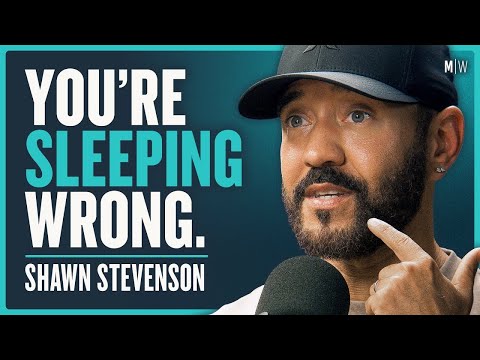
Simple Fixes For A Good Night's Rest - Shawn Stevenson (4K)
Chris Williamson (host), Shawn Stevenson (guest)
In this episode of Modern Wisdom, featuring Chris Williamson and Shawn Stevenson, Simple Fixes For A Good Night's Rest - Shawn Stevenson (4K) explores sleep, Food, And Culture: Simple Habits For Radical Health Change Shawn Stevenson explains how disrupted circadian rhythms, poor sleep, and ultra-processed diets are driving metabolic disease, hormonal dysfunction, and even mood and cognitive issues. He connects sleep quality to testosterone, body fat, and long‑term health, emphasizing that light exposure, evening routines, and nutrient status are more powerful than most supplements. A major theme is culture: our modern environment, food system, and tech habits normalize poor sleep and health, but we can build protective “micro‑cultures” at home through shared meals, better food choices, and simple nighttime rituals. The conversation closes with practical tactics—from blackout curtains and blue‑blocking glasses to specific sleep-supportive foods and stress-management techniques—to make great sleep and better health achievable without overhauling your entire life.
Sleep, Food, And Culture: Simple Habits For Radical Health Change
Shawn Stevenson explains how disrupted circadian rhythms, poor sleep, and ultra-processed diets are driving metabolic disease, hormonal dysfunction, and even mood and cognitive issues. He connects sleep quality to testosterone, body fat, and long‑term health, emphasizing that light exposure, evening routines, and nutrient status are more powerful than most supplements. A major theme is culture: our modern environment, food system, and tech habits normalize poor sleep and health, but we can build protective “micro‑cultures” at home through shared meals, better food choices, and simple nighttime rituals. The conversation closes with practical tactics—from blackout curtains and blue‑blocking glasses to specific sleep-supportive foods and stress-management techniques—to make great sleep and better health achievable without overhauling your entire life.
Key Takeaways
Protect your circadian rhythm by controlling light, especially at night.
Artificial light—overhead LEDs, screens, and even small light leaks—can disrupt sleep cycles and melatonin. ...
Get the full analysis with uListen AI
Prioritize sleep as a primary performance and hormone enhancer.
Even one week of sleeping 5 hours per night dropped young men’s testosterone by about 15%, equivalent to aging 10–15 years hormonally. ...
Get the full analysis with uListen AI
Shift your diet away from ultra-processed foods toward nutrient-dense whole foods.
Around 60% of the average American’s calories now come from ultra‑processed products that are nutrient-poor and often loaded with obesogens like BPA and synthetic additives. ...
Get the full analysis with uListen AI
Use dinner and shared meals as your nightly “off switch.”
Eating with family or friends triggers oxytocin, shifts the nervous system from fight‑or‑flight into rest‑and‑digest, and is linked to better diet quality, fewer ultra‑processed foods, lower stress, and lower obesity and eating disorder risk in kids. ...
Get the full analysis with uListen AI
Design a realistic, enjoyable pre‑sleep ritual rather than chasing perfection.
Most people won’t give up all screens or stimulation, so Stevenson suggests a practical approach: enjoy some light entertainment with blue‑blocking glasses, but set at least a one‑hour screen curfew before bed for reading, talking, sex, or relaxing audio. ...
Get the full analysis with uListen AI
Address stress and “inner chatter” to reduce time spent lying awake.
Sleep latency is often driven by rumination and unresolved stress, not a lack of hacks. ...
Get the full analysis with uListen AI
Build a home micro‑culture that makes healthy choices the default.
You can’t easily change the larger sick society, but you can control your environment: keep better snacks on hand, store food in glass/steel instead of hot plastics, normalize shared meals, and model sleep-respecting habits. ...
Get the full analysis with uListen AI
Notable Quotes
“We want change, but we don’t want to change that much.”
— Shawn Stevenson
“A good night of sleep starts the moment that you wake up in the morning.”
— Shawn Stevenson
“It is normal to be unwell. We are living at a time where if you are healthy, you are not normal.”
— Shawn Stevenson
“The performance enhancer that you’re looking for is not in a supplement store, but it’s your bedtime and your wake time.”
— Chris Williamson
“Food isn’t just food; it’s information. Our genes expect us to eat together, move together, and sleep in sync with nature.”
— Shawn Stevenson
Questions Answered in This Episode
How would my sleep, mood, or hormone levels change if I treated light exposure as seriously as I treat nutrition and exercise for 30 days?
Shawn Stevenson explains how disrupted circadian rhythms, poor sleep, and ultra-processed diets are driving metabolic disease, hormonal dysfunction, and even mood and cognitive issues. ...
Get the full analysis with uListen AI
What small, realistic changes could I make to my evening routine this week to create a genuine wind‑down period instead of scrolling until I’m exhausted?
Get the full analysis with uListen AI
In what ways is my current food environment—packaging, storage, and ultra‑processed options—silently pushing me toward weight gain or poor sleep?
Get the full analysis with uListen AI
How could I reintroduce regular shared meals or “virtual dinners” into my life if I live alone or far from family?
Get the full analysis with uListen AI
If I created a deliberate micro‑culture of health at home, what would I remove, what would I add, and how might that influence the people I live with over the next year?
Get the full analysis with uListen AI
Transcript Preview
Andrew Huberman mentioned in an interview that I did with him recently that the potential mental health epidemic that we're seeing at the moment could be downstream of poor circadian rhythm, uh, dysregulated sleep, disrupted sleep. How much truth do you think is in that?
Ooh. Circadian medicine is really top tier science right now. We're synced up with the 24-hour solar day. All of our hormone production, our neurotransmitters, we're synced up with what the universe is doing. And the funny thing is humans can kind of hide out from that, that interface, but our, our genes are really expecting us to be in constant communication with what's happening outside. And humans are really interesting, we can create our own habitats. We're kinda like big hairless beavers, or many of us are hairless. Um, but even when we're creating, it's still nature, because we're a part of nature, but we can e- essentially hide out and create a 24-hour day artificially. And so our circadian timing system is getting really screwed up. So absolutely I agree with him, and here's the rub, right now in the United States estimated about 115 million Americans are regularly sleep-deprived, to boot.
Out of 330?
Yeah, so it's a sizable amount, and we're talking about on a regular basis, like essentially daily. And my big thing is always looking for what is the connective tissue, why should people really care about this? And I, I always like to tie it to metabolic health and how we look, right? And a really fascinating study was done, and this was actually published by the American Academy of Sleep Medicine, and they looked at people's biometrics and used CT scans to look at their belly fat for five years, tracking a group of people. And they found that people who were sleep-deprived gained over twice as much belly fat in that five-year period. And sleep-deprived in this particular study was less than six hours a night. All right? So kind of there's something about six as being that sweet spot, and by the way, there is no cookie-cutter amount of sleep. That's one of those things that, you know, we just kind of drink eight glasses of eight-ounce water a day, like it's very superficial. Is that the same for Shaq and for Simone Biles? It's gonna be different, and the same thing holds true with sleep. It's not just the number of hours, it's the quality of those hours. It's a lot like the calorie conversation, you know, yes, calories matter but the quality of those calories definitely matter. And I've been a big proponent in pushing into popular culture this term epicaloric controller recently, which we can circle back to and talk about. But in particular with sleep, I wanna share one other piece too because especially right now in this energy equation and how important this is and some of your friends and colleagues as well like doc- Dr. Gabrielle Aline, really good friend of mine, we're looking at how important testosterone is not just for maintaining our muscle mass and our energy but for longevity, and this is critical for men and women, and it's finally really shifting gears to be all-encompassing of humanity how impo- how important testosterone is. Now listen to this. This was published in 2011 in JAMA, the Journal of the American Medical Association, top tier medical journal here in the United States, and they tracked young men, average age about 24, all right? And they brought them into the lab and they put them in this awards study. So they sleep-deprived them for just one week, all right? So they basically got five hours of sleep for one week. That one-week period their testosterone dropped 15%, all right? Now that might not sound like a lot, but suddenly that's as if they're 10 to 15 years older as far as their testosterone production is concerned. This is the power of sleep. Testosterone is right next to HGH, our most sleep duration dependent hormone, it's kind of like you're a human Tesla jacking into your charging station at night and filling up the testosterone. There are things we can get little spikes during the day, but a- basically when we get up, testosterone is just going down, and when we go to sleep, it starts rising again.
Install uListen to search the full transcript and get AI-powered insights
Get Full TranscriptGet more from every podcast
AI summaries, searchable transcripts, and fact-checking. Free forever.
Add to Chrome