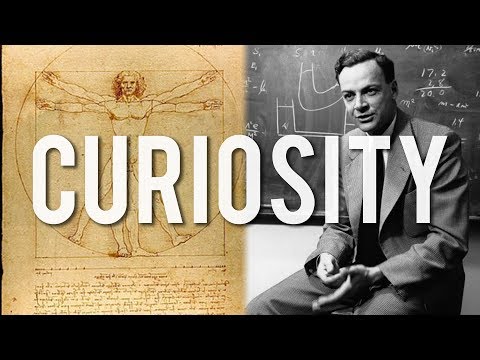
What Makes Us Curious? | Dr Mario Livio
Chris Williamson (host), Dr. Mario Livio (guest), Narrator, Narrator
In this episode of Modern Wisdom, featuring Chris Williamson and Dr. Mario Livio, What Makes Us Curious? | Dr Mario Livio explores astrophysicist Explains The Many Faces And Power Of Curiosity Astrophysicist and author Dr. Mario Livio discusses his book "Why? What Makes Us Curious," exploring curiosity from psychological, neuroscientific, and historical perspectives.
Astrophysicist Explains The Many Faces And Power Of Curiosity
Astrophysicist and author Dr. Mario Livio discusses his book "Why? What Makes Us Curious," exploring curiosity from psychological, neuroscientific, and historical perspectives.
He explains that curiosity is not a single trait but a family of distinct types—perceptual, epistemic, diversive, and specific—each with different functions and brain mechanisms.
Livio illustrates extreme curiosity through figures like Leonardo da Vinci, Richard Feynman, and modern polymaths, and shares how genetics, environment, and upbringing shape how curious we become.
He also offers practical ways to cultivate curiosity, especially in children, and argues that curiosity is a powerful antidote to fear and ignorance in both personal life and society.
Key Takeaways
Curiosity is multi-dimensional, not a single unified trait.
Psychologist Daniel Berlyne’s framework distinguishes at least four types of curiosity—perceptual, epistemic, diversive, and specific—each triggered by different situations and serving different purposes in our lives.
Get the full analysis with uListen AI
Perceptual and epistemic curiosity feel different and use different brain circuits.
Perceptual curiosity (surprise, ambiguity) is experienced as unpleasant tension that we want to resolve, activating brain regions linked to conflict; epistemic curiosity (desire to understand) feels like pleasant anticipation of reward and activates reward-related areas.
Get the full analysis with uListen AI
Curiosity is roughly half genetic and half environmental.
Twin studies show that about 50% of curiosity variation is heritable, while the rest is shaped by factors like family culture, schooling, country, era, and personal experiences, meaning it can be meaningfully cultivated.
Get the full analysis with uListen AI
You can deliberately nurture curiosity by how you ask and answer questions.
Encouraging others (especially children) to propose their own explanations first, then testing those ideas together, builds epistemic curiosity and reasoning skills instead of just filling them with answers.
Get the full analysis with uListen AI
Start from existing interests to ‘hook’ deeper learning.
Beginning with what someone is already curious about (dinosaurs, celebrities, money, etc. ...
Get the full analysis with uListen AI
Curiosity is a powerful antidote to fear and prejudice.
We often fear what we don’t understand; actively learning about unfamiliar groups, situations, or threats reduces anxiety and dismantles simplistic, fear-based narratives—making curiosity a social as well as personal virtue.
Get the full analysis with uListen AI
Extreme polymathic curiosity can drive excellence across multiple domains.
Figures like Leonardo da Vinci, Richard Feynman, Brian May, Noam Chomsky, and Fabiola Gianotti show how a wide-ranging, sustained curiosity can produce deep achievements in science, art, music, activism, and more.
Get the full analysis with uListen AI
Notable Quotes
“Everything is interesting if you go deeply enough into it.”
— Richard Feynman (quoted by Mario Livio)
“Curiosity is the best remedy for fear.”
— Mario Livio
“Perceptual curiosity puts us in an unpleasant, aversive state; epistemic curiosity puts us in a pleasant state of anticipated reward.”
— Mario Livio
“Had we known from the start how different these are, we might not have used the same word, ‘curiosity,’ for both.”
— Mario Livio
“Leonardo da Vinci beats everybody hands down. There has not been something like this, neither before nor after.”
— Mario Livio
Questions Answered in This Episode
How could schools redesign curricula and classrooms if they truly embraced the different types of curiosity rather than treating curiosity as one generic trait?
Astrophysicist and author Dr. ...
Get the full analysis with uListen AI
In a world saturated with diversive curiosity (social media, notifications), how can individuals protect and strengthen their deeper epistemic curiosity?
He explains that curiosity is not a single trait but a family of distinct types—perceptual, epistemic, diversive, and specific—each with different functions and brain mechanisms.
Get the full analysis with uListen AI
What practical steps can adults take to use curiosity to reduce their own fears about politically or culturally charged issues (e.g., immigration, polarization)?
Livio illustrates extreme curiosity through figures like Leonardo da Vinci, Richard Feynman, and modern polymaths, and shares how genetics, environment, and upbringing shape how curious we become.
Get the full analysis with uListen AI
Are there potential downsides or limits to extreme curiosity—times when ‘knowing more’ might genuinely be harmful or counterproductive?
He also offers practical ways to cultivate curiosity, especially in children, and argues that curiosity is a powerful antidote to fear and ignorance in both personal life and society.
Get the full analysis with uListen AI
Given that curiosity is only modestly studied compared to other psychological traits, what critical research questions about curiosity should neuroscience and psychology tackle next?
Get the full analysis with uListen AI
Transcript Preview
(wind blowing) Hello, friends. This week I'm sitting down with Dr. Mario Livio. He's an internationally known astrophysicist, a fellow of the American Association for the Advancement of Science, bestselling author, and a popular speaker. His new book, Why? What Makes Us Curious, is a bit of a departure away from his previous topics on physics and astrophysics, and it's really, really interesting. The field of curiosity is a lot deeper and more complex than I thought. Curiosity sounds like one word. Turns out that it is a whole host (laughs) of very different and subtle things that all contribute together to manifest what we consider to be curiosity. So through the lens of the great Richard Feynman, Leonardo da Vinci, and many other famous historic examples, Dr. Livio manages to lay out, uh, a lovely landscape for us to understand curiosity in this podcast. I owe an awful lot for finding time to come and speak to me. I'm trying to avoid too much public audible masturbation here while I, (laughs) uh, while I introduce this particular podcast but feeling very excited about the next few months. I have booked, without a doubt, some of the best minds on the planet to come on this podcast. Mr. Jonathan Haidt, author of The Righteous Mind, is coming on. Rory Sutherland, vice chairman of Ogilvy Advertising, which is one of the biggest advertising companies in the world, Tiago Forte of the Praxis Blog, plus an awful lot of other guests that I can't even talk about yet. And on top of that, myself, Johnny, and Yusuf are doing our first ever live podcast this week for CommuniCorp's Christmas conference. Now, CommuniCorp own Smooth FM, Capital FM, and a number of different areas, along with a few other broadcasting companies, and for some reason, they are allowing us to sit down in front of all of their marketing executives this Thursday and talk about influence, the podcasting platform generally, and doing a live Q&A onstage in front of an audience at the Tyneside Cinema. So although my sphincter is puckering with the nerves, I'm absolutely buzzing to get stuck in, and hopefully, as long as they let me do it, I'll actually be publishing the podcast live through this channel as well. In the meantime, we're going to find out what makes us curious. Here's Dr. Livio. (upbeat music) Mario Livio, welcome to Modern Wisdom. How are you today?
Thank you. It's my pleasure.
It's really good to have you on. So when I was having a look at the different options (laughs) to go through for this podcast with yourself, your backlog of books is, uh, it's pretty vast. There's an awful lot (laughs) that we could have decided to cover, um, but your most recent book is on curiosity. That's right.
All right. Yes. And it-
So-
It's called Why? What Makes Us Curious.
That's a departure from the maths-
(beep) .
Install uListen to search the full transcript and get AI-powered insights
Get Full TranscriptGet more from every podcast
AI summaries, searchable transcripts, and fact-checking. Free forever.
Add to Chrome