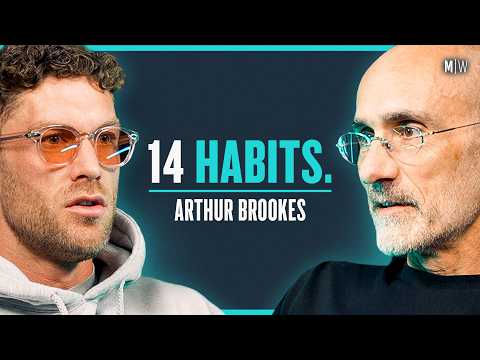
14 Habits for an Optimised Morning & Evening Routine - Arthur Brooks
Chris Williamson (host), Arthur Brooks (guest), Chris Williamson (host), Chris Williamson (host)
In this episode of Modern Wisdom, featuring Chris Williamson and Arthur Brooks, 14 Habits for an Optimised Morning & Evening Routine - Arthur Brooks explores designing Mornings, Evenings, And Mindsets That Turn Suffering Into Strength Arthur Brooks and Chris Williamson explore how biology and psychology intertwine to shape happiness, suffering, and our daily routines. Brooks explains that emotions are biological signals, not moral verdicts, and that happiness and unhappiness run on separate circuits, meaning you can be both very happy and very unhappy. They discuss temperament types, addiction to success, workaholism, anxiety, relationships, breakups, and why suffering is often the teacher of life's meaning. The conversation culminates in Brooks’ evidence-based morning and evening routines designed to optimize mood, productivity, and long-term well-being.
Designing Mornings, Evenings, And Mindsets That Turn Suffering Into Strength
Arthur Brooks and Chris Williamson explore how biology and psychology intertwine to shape happiness, suffering, and our daily routines. Brooks explains that emotions are biological signals, not moral verdicts, and that happiness and unhappiness run on separate circuits, meaning you can be both very happy and very unhappy. They discuss temperament types, addiction to success, workaholism, anxiety, relationships, breakups, and why suffering is often the teacher of life's meaning. The conversation culminates in Brooks’ evidence-based morning and evening routines designed to optimize mood, productivity, and long-term well-being.
Key Takeaways
Treat negative emotions as biological signals to be understood, not enemies to be eradicated.
Fear, anger, sadness, and disgust are evolved alert systems, not signs that you’re broken; learning what each is signaling lets you respond intelligently instead of overreacting or numbing out.
Get the full analysis with uListen AI
Happiness and unhappiness are separate systems, so target the one that’s your bigger problem.
High “affect” people can be both very happy and very unhappy; judges, poets, mad scientists, and cheerleaders each require different strategies—some need to dampen negative affect, others need to amplify positive affect.
Get the full analysis with uListen AI
Design your mornings for body, soul, and focus before you touch work.
Brooks’ template: wake before dawn, do substantial exercise, engage in spiritual/meditative practice, then add caffeine and a large protein-rich breakfast to support four high-quality hours of creative work.
Get the full analysis with uListen AI
Use evenings to downshift physiology and deepen connection, not to stimulate yourself.
Early, lighter dinners, a walk after eating, no late caffeine or alcohol, and in-bed rituals like eye contact, touch, and reading together improve sleep architecture and strengthen relationships.
Get the full analysis with uListen AI
Don’t anesthetize anxiety and sadness; channel them with better coping strategies.
High negative affect people often self-medicate with alcohol, drugs, or work; swapping these for exercise, meaningful challenge, spiritual practice, and understanding your emotions reduces suffering without destroying growth.
Get the full analysis with uListen AI
Know your primary ‘idol’—money, power, pleasure, or fame—because it predicts your worst decisions.
Once you see which worldly goal you overvalue, you can anticipate where you’ll compromise your values or wellbeing and consciously reorient toward deeper sources of meaning like faith, family, friends, and service.
Get the full analysis with uListen AI
In breakups and loss, focus on learning and reasons, not just what you miss.
Post-breakup healing accelerates when you stay socially engaged, remember why the relationship had to end, sometimes even use small aids like acetaminophen, and treat grief as a normal, temporary biological process.
Get the full analysis with uListen AI
Notable Quotes
““Psychology is biology. You cannot disconnect from your brain.””
— Arthur Brooks
““You can be a very happy person and also a very unhappy person.””
— Arthur Brooks
““The problem is not what you want. The problem is that your desires aren’t right.””
— Arthur Brooks
““My suffering is sacred… therein lies my growth. Bring it on.””
— Arthur Brooks
““Woe be to the man whose dreams come true. He will find he had the wrong dreams.””
— Arthur Brooks (citing an old axiom)
Questions Answered in This Episode
How can I accurately identify whether my main challenge is too little happiness or too much unhappiness?
Arthur Brooks and Chris Williamson explore how biology and psychology intertwine to shape happiness, suffering, and our daily routines. ...
Get the full analysis with uListen AI
Which affect profile (mad scientist, judge, cheerleader, poet) best fits me, and how should that shape my habits and career choices?
Get the full analysis with uListen AI
What is my true ‘idol’ among money, power, pleasure, and fame, and how is it already distorting my decisions?
Get the full analysis with uListen AI
How could I simplify my current morning and evening routines to support both productivity and emotional resilience rather than just one or the other?
Get the full analysis with uListen AI
In which areas of my life am I avoiding necessary ‘band-aid rip’ decisions—like ending a relationship, changing jobs, or stopping an addiction—because I’m afraid of the temporary emotional pain?
Get the full analysis with uListen AI
Transcript Preview
When it comes to well-being-
Yeah.
... what do you think contributes more, psychological elements or physical elements? Because we experience our well-being-
Right.
... psychologically-
Right.
... and, uh, but we experience everything psychologically.
Mm-hmm.
Including our physical well-being.
Mm-hmm.
When it comes to well-being, what contributes more, psychological or physical elements?
The answer is yes. Because-
(laughs)
... because psychology is biology. Fundamentally, psychology is biology.
What's that mean?
That means that, that you're, you cannot disconnect from your brain. Now, p- perhaps there's some external consciousness that people are experiencing, but, but the truth of the matter is that the functioning of the limbic system of your brain, where you're having positive and negative emotions all day long, that's, that's, that's, that's biology. That's a part of the brain that was evolved between two and 40 million years ago as an alert system to what's going on outside of you. You perceive things, threats and opportunities, you react, your brain reacts with negative and positive emotions, which then give you a sense of being happy or unhappy at any, at any particular time.
Mm-hmm.
And so that being the case, we should be very grateful for our negative emotions, but we also need to learn how to manage them. That's the great goal of life. That's the great goal of becoming a self-managing, self-leading person when you're in a state of suffering, to understand why that is, how it can be productive, what you can learn, and, and how you can manage it such that it doesn't dis- dysregulate you or ruin your complete quality of life.
So if psychology is biology, should we just attack the biology?
Well, the way that we attack the biology is by understanding the psychology and actually acting in a different way.
Which really does sound like the human centipede.
Yeah, it really is. It really is. No, it's, uh, no, my whole philosophy is sort of a self-licking ice cream cone because no matter-
(laughs)
... if you say biology, I say psychology. (laughs)
Yeah, yeah, yeah.
But, but the truth of the matter is that once, if you wanna become a happier person, the first thing you need to understand is the science, which is the reason that I teach the science of happiness to my students. I don't go in and teach woo-woo and say, "You know, here's, you know, why don't we all, uh, try to manifest some sort of happiness?" It's like, no, this is what's going on in your brain. When you're feeling sad, what's happening is that you've, the, the dorsal anterior cingulate cortex of your limbic system is highly alerted to the fact that you're perceiving a loss, and that loss in your life of a person or something that you love is a very normal reaction. In the, in the ancestral environment where we lived in bands of 30 to 50 individuals, to be rejected, to have a breakup, to have a schism with somebody else in your band meant that you were at a, a real risk of walking the frozen tundra and dying alone. You need to be really averse to that. That's why you feel grief when you have a, when you're disconnected from somebody that you love, and you have a part of your brain that's evolved to make you feel that grief, and that's completely normal. That's the most normal thing that could possibly happen. And people find a lot of comfort in saying, "Oh, oh, there's nothing wrong with me. There's not something I need to cure. That's actually evidence that my brain is working the way that it should-"
Install uListen to search the full transcript and get AI-powered insights
Get Full TranscriptGet more from every podcast
AI summaries, searchable transcripts, and fact-checking. Free forever.
Add to Chrome