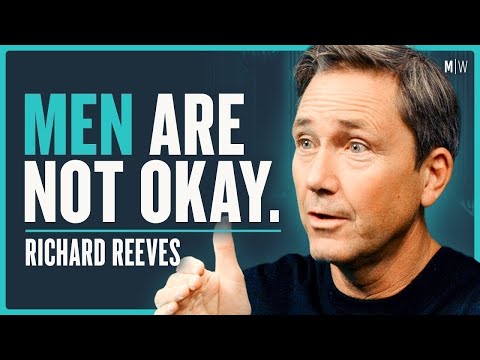
Male Inequality & The Fall of Men - Richard Reeves
Chris Williamson (host), Richard Reeves (guest), Narrator, Narrator, Narrator
In this episode of Modern Wisdom, featuring Chris Williamson and Richard Reeves, Male Inequality & The Fall of Men - Richard Reeves explores richard Reeves Dissects Male Decline, Empathy Politics, And Neededness Crisis Richard Reeves and Chris Williamson explore why advocating for men and boys remains culturally fraught, despite clear evidence of male underperformance in education, work, and mental health. They discuss how public conversations get pulled toward reactionary spaces, the danger of “criticism capture,” and why tone and framing matter if you actually want to persuade institutions rather than just vent. A major theme is the idea of “neededness” — men’s psychological need to feel indispensable to family, work, and community — and how modern shifts have hollowed that out, particularly for working‑class men. They also examine structural blind spots on the center‑left, such as the erasure of men in policy rhetoric and mental‑health systems that are implicitly designed around female patterns of distress.
Richard Reeves Dissects Male Decline, Empathy Politics, And Neededness Crisis
Richard Reeves and Chris Williamson explore why advocating for men and boys remains culturally fraught, despite clear evidence of male underperformance in education, work, and mental health. They discuss how public conversations get pulled toward reactionary spaces, the danger of “criticism capture,” and why tone and framing matter if you actually want to persuade institutions rather than just vent. A major theme is the idea of “neededness” — men’s psychological need to feel indispensable to family, work, and community — and how modern shifts have hollowed that out, particularly for working‑class men. They also examine structural blind spots on the center‑left, such as the erasure of men in policy rhetoric and mental‑health systems that are implicitly designed around female patterns of distress.
Key Takeaways
Advocating for men is politically and culturally coded as right‑wing, which deters moderates.
Reeves notes that simply starting an ‘Institute for Boys and Men’ makes many people assume he’s a reactionary, which makes recruiting women staff difficult and forces him to carefully manage who covers his work first and how he frames it.
Get the full analysis with uListen AI
Tone and caveats are strategic tools, not just moral niceties, if you want real impact.
Reeves willingly contextualizes male issues alongside women’s progress because policymakers and liberal institutions come in skeptical; acknowledging their concerns lowers defenses and increases the odds of policy change.
Get the full analysis with uListen AI
A “zero‑sum” view of empathy blocks progress on male issues.
Many assume caring more about boys and men means caring less about women and girls; Reeves argues empathy isn’t finite and compares it to parenting — loving a second child doesn’t reduce love for the first.
Get the full analysis with uListen AI
Male mental health crises are being misread and under‑served by feminized systems.
Surveys and CDC instruments overweight internalizing symptoms more common in girls, under‑measure male‑typical externalizing behavior, and the mental‑health workforce is increasingly female, many of whom report discomfort with male‑specific issues such as violence, suicide risk, and porn/sex addiction.
Get the full analysis with uListen AI
Suicide and drug deaths among men, especially young and working‑class men, are structurally driven, not just individual weakness.
Male suicides are about four times higher than females at every age, drug poisonings have killed the equivalent of a World War II’s worth of men since 2001, and young male suicide has surged since 2010 — all correlated with economic stagnation, retreat into drugs/porn/gaming, and a collapse in feeling needed.
Get the full analysis with uListen AI
‘Neededness’ — the sense that others genuinely rely on you — is a critical, overlooked male psychological need.
Reeves ties male resilience to feeling indispensable as fathers, workers, or mentors; when men lose work and family roles, their suicide risk spikes, and many retreat into sedation or despair because they no longer believe their presence matters.
Get the full analysis with uListen AI
Working‑class men face a compounded crisis in work, family, and mobility that policy largely ignores.
Non‑college men’s real wages have been flat since the late 1970s, labor‑force exit is high (half of 30‑ and 40‑something non‑college men don’t live with children now vs. ...
Get the full analysis with uListen AI
Notable Quotes
“We treat a struggling boy like a malfunctioning girl and then try to fix him, instead of fixing the school.”
— Richard Reeves
“It is thought necessary of any man who knows anything of the world to think ill of it.”
— Richard Reeves (quoting John Stuart Mill)
“The state of feeling unneeded is literally fatal.”
— Richard Reeves
“If a woman has a problem, we ask, ‘What can we do to fix society?’ If a man has a problem, we ask, ‘What can men do to fix themselves?’”
— Chris Williamson
“Empathy is not a limited resource. It’s like saying to a parent, ‘If you have a second child, you’ll love the first one 50% less.’”
— Richard Reeves
Questions Answered in This Episode
How can public institutions redesign mental‑health services to better recognize and treat male‑typical distress without pathologizing masculinity?
Richard Reeves and Chris Williamson explore why advocating for men and boys remains culturally fraught, despite clear evidence of male underperformance in education, work, and mental health. ...
Get the full analysis with uListen AI
What concrete policies would most effectively restore a sense of ‘neededness’ for working‑class men in both work and family life?
Get the full analysis with uListen AI
How can advocates talk about male disadvantage without being captured by reactionary movements or triggering zero‑sum backlash from feminists?
Get the full analysis with uListen AI
To what extent are pornography, video games, and drugs causes versus symptoms of young men’s withdrawal from society?
Get the full analysis with uListen AI
What responsibilities do media and political parties have in honestly representing male suicide and drug‑death data, and what are the risks when they don’t?
Get the full analysis with uListen AI
Transcript Preview
Obama endorsed your book.
Yeah, that was a- a bit of a surprise. I mean, first of all, it was also a year late. I don't wanna criticize, I don't come out the gate criticizing, but the book came out in 2022. And so when his 2023 list came out, everybody who'd written a book in the previous year or so was like, "Would I make it? Would I make it?"
Mm-hmm.
I didn't make it. I wasn't surprised. But then 2024 comes around. Ta-da, there it is.
Has that been the growth of this discussion about boys and men? Has it been one of those little compoundy things that didn't spike super hard, but has been building?
I think so, yeah. What- My sense of this is that, I mean, even si- even since we spoke, when did we speak? Couple of years? A year and a bit?
Uh, about- about maybe 18 months, a little bit more, between 18 months and two years ago, I think.
I think even since then, the permission space around this conversation has widened.
Mm-hmm.
So, you know, just to- to be very autobiographical about it, when I tried to find a publisher for my book in 2020, I couldn't. I was turned down by every publishing house. Uh, at the time, it was just seen as, like, too controversial a topic to- to engage in, and then you fast-forward, and then you're on Bara- Barack Obama's reading list. And-
Wow.
... whatever you might think about Barack Obama, he's not a reactionary. He's not seen as a kind of, like, men's rights reactionary type.
Mm-hmm.
And so, that's obviously, as an author, that's a great accolade, because I do think his- his lists tend to be quite thoughtful.
Broadening the conversation to an audience that-
But it's- It's more that. Yeah. It's- It's okay. And it very- it really helps me if I'm having a conversation with people who still sometimes understandably think this is a bit men's rightsy.
Mm-hmm.
Really, the skepticism that people bring to the debate, which I not only understand, I actually have a lot of time for.
Mm-hmm.
I think if you're not a bit skeptical to start with, then you're probably not thinking that hard about it.
Mm-hmm.
But then to say, "Well, Barack Obama's thinks the book's w- worthy of reading."
Mm-hmm.
It just helps to sort of take a little bit of the heat out of it. But I would just say that's one of the perhaps most prominent examples of a just general sense that the temperature around this conversation has gone down, even just in the few years I've been talking about it.
Well, we'll see what we can do today to turn that temperature up-
(laughs) Yeah.
... a little bit.
I knew I could rely on you.
Install uListen to search the full transcript and get AI-powered insights
Get Full TranscriptGet more from every podcast
AI summaries, searchable transcripts, and fact-checking. Free forever.
Add to Chrome