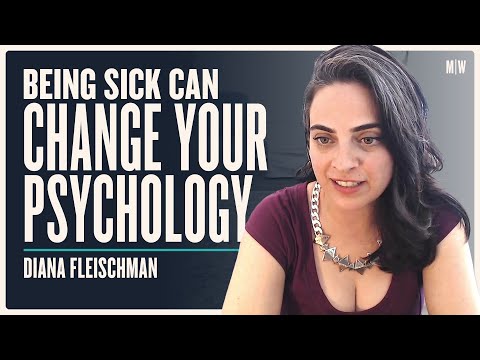
How Catching Covid Can Change Your Personality - Dr Diana Fleischman | Modern Wisdom Podcast 290
Dr Diana Fleischman (guest), Chris Williamson (host)
In this episode of Modern Wisdom, featuring Dr Diana Fleischman and Chris Williamson, How Catching Covid Can Change Your Personality - Dr Diana Fleischman | Modern Wisdom Podcast 290 explores how COVID, Inflammation And Illness Quietly Rewire Your Personality And Desires Chris Williamson and Dr. Diana Fleischman explore how infections—especially COVID—can temporarily or permanently shift personality, mood, social behavior and sexual desire through inflammation-driven “sickness behavior” (lassitude).
How COVID, Inflammation And Illness Quietly Rewire Your Personality And Desires
Chris Williamson and Dr. Diana Fleischman explore how infections—especially COVID—can temporarily or permanently shift personality, mood, social behavior and sexual desire through inflammation-driven “sickness behavior” (lassitude).
They connect evolutionary psychology with real-world phenomena: why we crave familiar food and people when ill, why chronic inflammation can mimic depression or introversion, and how disease threats nudge individuals and societies toward conformity and conservatism.
The conversation broadens into pathogens’ role in mental illness, life-history strategies (live fast vs. slow), changing sexual dynamics post‑COVID, and the ethical/pandemic risks of animal agriculture and the promise of “clean meat.”
Underlying it all is a challenge to modern dualism: our sense of a sovereign, rational self is far more biologically and evolutionarily constrained—and predictable—than we like to admit.
Key Takeaways
Recognize lassitude as an adaptive sickness state, not just ‘feeling off.’
Fatigue, emotional sensitivity, withdrawal, and heightened pain or rejection sensitivity during illness are part of an evolved program (lassitude) that conserves energy and elicits care, rather than mere weakness or laziness.
Get the full analysis with uListen AI
Avoid reflexively suppressing fevers and forcing food when ill.
Fever is generally beneficial for fighting pathogens, and digestion is energetically costly and immunologically risky; pushing antipyretics and “you must eat” can work against the body’s evolved strategies for recovery.
Get the full analysis with uListen AI
Expect temporary personality shifts during and after infections—especially toward caution and conservatism.
High inflammation and perceived pathogen threat reliably reduce openness, risk-taking, novelty-seeking, and extroversion, pushing people toward familiar foods, known relationships, and more conformist behaviors.
Get the full analysis with uListen AI
Consider chronic inflammation as a hidden driver of mood and cognitive changes.
Conditions like obesity, long COVID, and other inflammatory states can sustain “sickness behavior” (brain fog, low motivation, social withdrawal, anxiety) long after an acute illness seems over; anti-inflammatory strategies may modestly improve emotional resilience.
Get the full analysis with uListen AI
Understand that illness can fundamentally change relationship dynamics and attraction.
Because traits like energy, extroversion, openness, and libido are costly, serious or chronic illness can alter a partner’s behavior and perceived mate value, making “in sickness and in health” a deeper psychological commitment than most people realize.
Get the full analysis with uListen AI
Treat animal agriculture as both an ethical and existential risk problem.
Factory farming densely housed animals—especially pigs and poultry—creates ideal conditions for new zoonotic viruses; supporting moves toward clean (cultivated) meat and shifting away from high-suffering products like eggs can reduce both suffering and pandemic risk.
Get the full analysis with uListen AI
Use evolutionary psychology as a lens to understand your own mind, not just others.
Seeing cravings, jealousy, ideological shifts, or sexual changes as evolved strategies responding to cues (threat, disease, scarcity) can increase self-insight, reduce self‑deception, and make meditation or self‑development practices more grounded and effective.
Get the full analysis with uListen AI
Notable Quotes
“Lassitude is the emotion of being sick – the whole suite of feeling tired, cold, in pain, and needing care.”
— Dr. Diana Fleischman
“When you’re sick, your fundamental goals really change.”
— Dr. Diana Fleischman
“In sickness and in health really means: I’ll stay even if your personality fundamentally changes.”
— Dr. Diana Fleischman
“Nature is, in some fundamental sense, just a suffering cesspool.”
— Dr. Diana Fleischman
“Until I can hold my evolved psychology at arm’s length, I’m going to be too into it to actually figure out what’s going on.”
— Dr. Diana Fleischman
Questions Answered in This Episode
If chronic inflammation can mimic low mood, introversion, or anxiety, how should clinicians distinguish between ‘true’ personality traits and inflammation-driven states?
Chris Williamson and Dr. ...
Get the full analysis with uListen AI
To what extent should people factor in potential long-term personality changes from illness when making major life decisions (e.g., marriage, children, career)?
They connect evolutionary psychology with real-world phenomena: why we crave familiar food and people when ill, why chronic inflammation can mimic depression or introversion, and how disease threats nudge individuals and societies toward conformity and conservatism.
Get the full analysis with uListen AI
How might societies change—politically and culturally—if high background pathogen loads reliably push populations toward conformity and conservatism?
The conversation broadens into pathogens’ role in mental illness, life-history strategies (live fast vs. ...
Get the full analysis with uListen AI
What ethical responsibilities do individuals and governments have to phase out high-risk animal agriculture given its role in both suffering and future pandemics?
Underlying it all is a challenge to modern dualism: our sense of a sovereign, rational self is far more biologically and evolutionarily constrained—and predictable—than we like to admit.
Get the full analysis with uListen AI
How far can self-knowledge through evolutionary psychology and mindfulness actually free us from our biological programming, versus simply making us more aware of it?
Get the full analysis with uListen AI
Transcript Preview
I certainly am feeling better every day, and kind of more like myself. But there was a period of, of a week or two after I caught COVID where I knew I wasn't infectious, I was, like, going for a walk outside, and strangers scared me more than they usually do. I was much more socially anxious.
(wind blowing) Talking about whether COVID can change your personality. Uh, what even is that question? What, what are we on about?
So, there's a lot of evidence that viruses and bacteria try and change host behavior. So, there's some really interesting stuff about that, how they might try and change your behavior in order to make themselves transmit more easily. But also, about how you, as an organism, your, your goals and priorities from a, from an evolutionary perspective change a lot when you have an infection. So, if you're healthy, you might have certain goals like seeking out new people to engage with, seeking out new social and mating opportunities, feeding, foraging, stuff like that. But when you are sick, your fundamental goals really change. And what I'm thinking about, since I, since I just recovered from COVID, is about how my personality changed, and how there might be millions of people who have had COVID who now feel different. And during COVID, you have this incredible level of inflammation. Many people who are long-haulers and otherwise have what's called a cytokine storm, which is a level of inflammation. And when you have high inflammation, it tells your immune system, it tells you that you have an infection, and that you should behave accordingly, which involves a whole bunch of different aspects of personality and behavior changing.
So, is there a little bit of a battle going on? There is the pathogen which is trying to find its way around, and then there are the defenses of the host which are trying to stop its way to get through.
Yeah. So, there are some things that you're... if you think about what you feel like when you're ill, there are some things that are good for the pathogen and good for the host. So, one example of that is sneezing. Sneezing clears you out. It's good to get the pathogens out, but the pathogen also wants you to sneeze, 'cause it's the best way for you to spray everybody with copies of itself, right? So, that's one way in which your interests are aligned, so long as you're not, like, sneezing on your kids, right? But there's other things where your interests are not aligned. So, fever is one way that your interests are not aligned. The, the virus and the bacteria, whatever you're infected with, does not want you to have a fever, because a fever is really optimal for you. This is why I get very frustrated when people take antifebrile, you know, anti-fever medications when they're sick. I, I never do, because the fever is really the best possible thing for you to be, uh, you know, doing. Um, also, you know, there's other things, like, there's a reason why you're more interested either in not eating or eating familiar foods when you're sick. That's because unfamiliar foods might have pathogens that will compete for access to your immune system. Uh, so they'll, they'll be more costly. Uh, and also it takes a lot of energy to digest. So, in that sense, your body's also winning and... as an appetite suppressant. Um, if a, if a virus or a bacteria could really properly manipulate you, they'd probably try to make you hungry.
Install uListen to search the full transcript and get AI-powered insights
Get Full TranscriptGet more from every podcast
AI summaries, searchable transcripts, and fact-checking. Free forever.
Add to Chrome