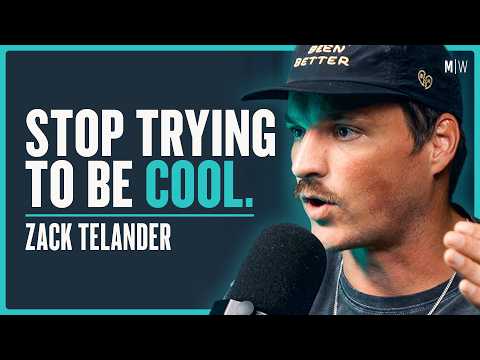
Everything You Want Is On The Other Side Of Cringe - Zack Telander
Chris Williamson (host), Zack Telander (guest), Narrator, Narrator
In this episode of Modern Wisdom, featuring Chris Williamson and Zack Telander, Everything You Want Is On The Other Side Of Cringe - Zack Telander explores cringe, Coolness, And Gratitude: Building Dreams In Public Online Chris Williamson and Zack Telander unpack why pursuing dreams in public feels 'cringe' and how online irony and comment culture punish sincerity and experimentation.
Cringe, Coolness, And Gratitude: Building Dreams In Public Online
Chris Williamson and Zack Telander unpack why pursuing dreams in public feels 'cringe' and how online irony and comment culture punish sincerity and experimentation.
They explore the tension between being deeply grateful for simple joys and still being wildly ambitious, especially after life changes like becoming a parent.
The conversation dives into what makes someone 'cool' versus 'good,' how authenticity, scarcity, and aloofness play into status, and why results often neutralize accusations of cringe.
They finish by touching on running culture, performance vs. optimization, and the irreplaceable value of in‑person connection, ending with an emotional acknowledgement of their friendship.
Key Takeaways
Everything you want is on the other side of cringe.
Pursuing meaningful goals in public will almost always look cringe to people who gave up on their own dreams; tolerating that discomfort is the price of admission for doing anything ambitious.
Get the full analysis with uListen AI
Irony and criticism protect you from risk, but also from growth.
Constantly calling things cringe or speaking only ironically creates distance between your real beliefs and the world, which keeps you safe from embarrassment but also prevents sincere engagement, learning, and contribution.
Get the full analysis with uListen AI
Learn to hold gratitude and ambition at the same time.
Zack describes 'gratitude maxing' while being 'dream‑pilled'—fully appreciating small, ordinary moments (a meal, a movie, a drink with a friend) without abandoning long‑term, high‑aiming goals.
Get the full analysis with uListen AI
Know your domain of competence before you pontificate online.
Because the internet ruthlessly punishes overconfident takes, especially on sensitive or complex topics, you need awareness of where your expertise ends and where you’re just 'playing with ideas.'
Get the full analysis with uListen AI
Cool and good are not the same—and authenticity is non‑negotiable.
Research they discuss shows 'cool' people are seen as adventurous, autonomous and hedonistic, while 'good' people are seen as warm, conscientious and conforming; trying to look cool usually backfires because coolness demands genuine autonomy, not visible effort.
Get the full analysis with uListen AI
Results are the best antidote to accusations of cringe.
Whether it’s a band in masks or an intense endurance athlete, once someone’s performance and outcomes are undeniably strong, their allegedly 'cringe' aesthetic or methods become much harder to attack.
Get the full analysis with uListen AI
Online impact feels hollow without offline contact.
Both note that views, comments, and charts rarely feel as real as a stranger recognizing your work in person or a live audience reacting in the room—suggesting creators need some real-world feedback to avoid burnout and alienation.
Get the full analysis with uListen AI
Notable Quotes
“The only time the critics can access their hopes and dreams is when they’re sleeping—so when they wake up, make sure they keep watching you pursue yours.”
— Zack Telander
“Irony is the song of a bird who’s never left its cage.”
— Zack Telander (referencing a quote he’d seen)
“To profess an honest belief in anything, especially something open to challenge, is a pretty exposing thing to do in the public square.”
— Chris Williamson (quoting Joe Follley)
“Coolness works differently. If people think you’re trying to be cool, you lose credibility.”
— Chris Williamson
“So much of the good in my life has occurred because you’ve been in it… Because of you, I believe in myself.”
— Zack Telander (to Chris Williamson)
Questions Answered in This Episode
How can someone practically train themselves to push through the feeling of cringe when starting a new creative or public project?
Chris Williamson and Zack Telander unpack why pursuing dreams in public feels 'cringe' and how online irony and comment culture punish sincerity and experimentation.
Get the full analysis with uListen AI
What are some concrete ways to balance 'gratitude maxing' with being 'dream‑pilled' so that ambition doesn’t poison the present?
They explore the tension between being deeply grateful for simple joys and still being wildly ambitious, especially after life changes like becoming a parent.
Get the full analysis with uListen AI
Where should the line be drawn between healthy skepticism of online figures and paralyzing 'grifter/shill' paranoia that silences non‑experts?
The conversation dives into what makes someone 'cool' versus 'good,' how authenticity, scarcity, and aloofness play into status, and why results often neutralize accusations of cringe.
Get the full analysis with uListen AI
How can creators design their careers so they get enough real‑world, in‑person feedback to offset the hollow nature of metrics and comments?
They finish by touching on running culture, performance vs. ...
Get the full analysis with uListen AI
Given the research on cool vs. good, should people even try to be cool—or would they be better off optimizing for being 'good' and capable instead?
Get the full analysis with uListen AI
Transcript Preview
Zac Tylander, welcome to the show.
(sings) It's been a while-
(laughs) It's been too long.
... since I have been on this (censored) show. (laughs)
(laughs) Damn (laughs) . You've been busy.
I have been busy, dude. I've been very busy. I just wanna say also that this is a perfect representation of you and I, like the autism architects-
(laughs)
... and then like the degenerate kind of cowboy-
Mm-hmm. Mm-hmm.
... Waylon Jennings figure outlaw.
Yeah. Yeah. I'm trying to subliminally change, uh, people's music choices through what I wear as a T-shirt. I don't think it's working. I don't think anybody is listening to any of the bands that I wear.
I think they... I feel like they are.
You wanna know?
Yeah. But yeah, I'm not gonna give you... I'm not gonna allow you to be the only person that wears a band T-shirt in here.
That's true.
I got... I bought this purposefully for this episode. (laughs)
For this? Oh, nice.
Yes. (laughs)
Hey.
I do love Waylon Jennings, so...
Sick. Uh, everything you want is on the other side of cringe.
Yeah. So I saw... Actually, I made this post about cringe. And a lot of times people say if you want to, like, defeat cringe, you just have to... It's like a muscle you have to flex. You just have to keep going for whatever it is and, like, learn how to take failure. And it's almost as if failure and cringe are kind of, like, aligned.
Mm-hmm.
But my nuanced take was, uh, from it was, the people who are calling you cringe, uh, or, or like the critics, like everyone has hopes and dreams. Everyone. You know, it's not like there are some people who are born and they're just like, "I don't want to do anything with my life ever." Right? But the critics and the people calling you cringe, essentially what they're doing is saying like, "Oh, you're pursuant of some sort of hope and dream."
Mm-hmm.
"How dare you?"
Mm-hmm.
And so at some point in their lives, they had to make a decision, uh, "I'm not gonna pursue my hopes and dreams because that is quote unquote cringe."
Mm-hmm.
Which I found super interesting.
Mm-hmm.
And so in this video, I just... All I said was like, you know, "The only times that the critics or the people calling you cringe can access their hopes and dreams is when they're sleeping. So then when they wake up, just make sure they keep watching you pursue yours." And it's like, for me, that, that is a... Adds another layer on top of what you typically hear, which is just like, "Keep moving, keep-"
Mm-hmm.
"... keep going. Push. Like fail so you can get better at failing," stuff like that.
Install uListen to search the full transcript and get AI-powered insights
Get Full TranscriptGet more from every podcast
AI summaries, searchable transcripts, and fact-checking. Free forever.
Add to Chrome