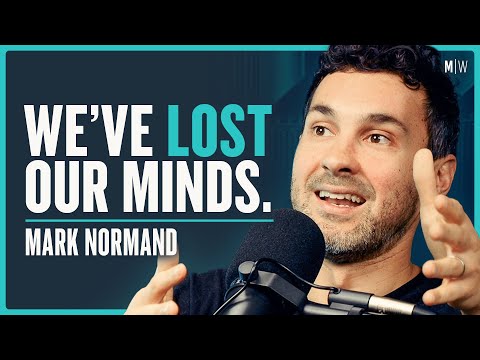
Secret Hollywood Rituals, Shane Gillis & Toxic Masculinity - Mark Normand
Chris Williamson (host), Mark Normand (guest), Narrator
In this episode of Modern Wisdom, featuring Chris Williamson and Mark Normand, Secret Hollywood Rituals, Shane Gillis & Toxic Masculinity - Mark Normand explores comedy, Culture Wars, and Masculinity: Mark Normand Unfiltered With Williamson Chris Williamson and comedian Mark Normand riff on race, religion, immigration, media bias, and modern masculinity through the lens of dark, boundary-pushing comedy. They move from P. Diddy rumors and Mormon sex loopholes to migrant crises in New York, bail reform, and the AI “woke” controversy around Google’s Gemini. The pair dissect cancel culture, deplatforming, hypocrisy around representation and feminism, and how public narratives are enforced inside Hollywood and mainstream TV. They close by exploring addictive tech behavior, gambling, shifting gender norms, and why stand-up comedy thrives on saying the unsayable in an increasingly sensitive culture.
Comedy, Culture Wars, and Masculinity: Mark Normand Unfiltered With Williamson
Chris Williamson and comedian Mark Normand riff on race, religion, immigration, media bias, and modern masculinity through the lens of dark, boundary-pushing comedy. They move from P. Diddy rumors and Mormon sex loopholes to migrant crises in New York, bail reform, and the AI “woke” controversy around Google’s Gemini. The pair dissect cancel culture, deplatforming, hypocrisy around representation and feminism, and how public narratives are enforced inside Hollywood and mainstream TV. They close by exploring addictive tech behavior, gambling, shifting gender norms, and why stand-up comedy thrives on saying the unsayable in an increasingly sensitive culture.
Key Takeaways
Comedy thrives where cultural taboos and hypocrisies are strongest.
Normand repeatedly points out that his best material comes from exposing double standards—around race, gender, religion, or politics—because audiences instinctively recognize when society is saying one thing and doing another.
Get the full analysis with uListen AI
Modern ‘progress’ often overshoots, creating new forms of distortion or unfairness.
From AI image generators turning Nazis into Asians to festivals choosing weak acts to fill diversity quotas, they argue good intentions can produce inaccurate history, soft racism, and mistrust when accuracy and merit are sacrificed.
Get the full analysis with uListen AI
Deplatforming is empirically effective at reducing attention, but costly for individuals.
Williamson cites research showing deplatformed figures lose around 60% of Google attention and 40%+ on Wikipedia, while Normand highlights the intense psychological and career damage people endure when mobs or institutions push them out.
Get the full analysis with uListen AI
Mainstream institutions often enforce narratives while denying they exist.
Normand says TV and Hollywood clearly have ideological lines you can’t cross, yet insiders pretend nothing is happening—he’s fine with agendas, he claims, as long as people openly admit them instead of gaslighting critics.
Get the full analysis with uListen AI
Shifts in gender norms are real, but underlying behaviors remain stubbornly traditional.
They discuss the ‘baby girl’ male archetype, OnlyFans as ‘empowerment,’ and data showing Gen Z still expects men to pay for first dates, suggesting aesthetic changes in masculinity haven’t fully transformed core expectations.
Get the full analysis with uListen AI
Media outrage cycles create shallow, fashion-driven convictions.
Ukraine flags, ‘Stop Asian Hate,’ Gaza, and other causes spike then vanish from feeds, leading them to describe activism as an ‘opinion pageant’ where people change focus as trends shift rather than from deep principle.
Get the full analysis with uListen AI
Tech and convenience are eroding resilience and attention, even for high-functioning adults.
They admit compulsive phone use, Uber dependence, and fear of discomfort, comparing phones to a built-in drug that we can’t avoid because life admin, work, and even ‘mindfulness’ now run through the same addictive device.
Get the full analysis with uListen AI
Notable Quotes
““I’m fine with all the bullshit, you just gotta stop lying to me.””
— Mark Normand
““It’s one thing to be nice and progressive, but now we’re inaccurate.””
— Mark Normand, on AI rewriting history with diverse Nazis and Founding Fathers
““People made a career off getting you. That’s why cancel culture was so scary.””
— Mark Normand
““The perfect luxury belief is one that makes you look good, but someone poorer than you has to pay the price.””
— Chris Williamson (paraphrasing Rob Henderson’s concept of luxury beliefs)
““We’re all gonna die one day. And you’re telling me this tweet is the thing that defines me?””
— Mark Normand
Questions Answered in This Episode
How do you draw the line between necessary social progress and ideological overreach in comedy and entertainment?
Chris Williamson and comedian Mark Normand riff on race, religion, immigration, media bias, and modern masculinity through the lens of dark, boundary-pushing comedy. ...
Get the full analysis with uListen AI
Is there a responsible way for institutions to pursue diversity and representation without creating the ‘soft racism’ Normand describes?
Get the full analysis with uListen AI
Given that deplatforming clearly reduces attention, when—if ever—is it justified, and who should hold that power?
Get the full analysis with uListen AI
How should men today balance emotional openness and the ‘baby girl’ aesthetic with traditional expectations of masculinity and provision?
Get the full analysis with uListen AI
Are we underestimating the long-term psychological and cultural costs of compulsive phone use and online outrage cycles on both creators and audiences?
Get the full analysis with uListen AI
Transcript Preview
Marc Normand, welcome to the show.
Hey, good to be back. What is this, big three?
Three, man. Third time.
Third time and two from the airport.
(laughs)
I come straight here.
Yeah, fly in. It's Women's History Month.
Oh, no.
Don't say that.
Wow.
We just exited Black History Month.
That's true. Wow.
(laughs)
That was a tough month just like... I feel like there's more black on black, uh, talk and trash than before.
How so?
Well, you got the Katt Williams, which was like the Black Epstein list-
(laughs)
... you know. And then like, uh, what's her face did it, uh, Mo'Nique did it after hi-... I don't know, they just feel... And now like P. Diddy is gettin'... You see all the P. Diddy stuff?
No.
Oh my God, you gotta get on Black Twitter.
(laughs)
It's wild.
Blitter?
Blitter, yeah. (laughs)
What, what's P. Diddy been involved in?
Uh, P. Diddy... Oh, Black Twitter be Malcolm X. All right.
(laughs)
Um, P. Diddy is, uh, getting called gay and apparently hooked up with a bunch of young boys and stuff. So-
He's getting called gay and apparently hooked up... So it's like the R. Kelly 2.0. It's the R. Kelly sequel.
Yeah, no urine. Sans urine. But, uh, yeah, apparently he had like a Bieber moment an an Usher thing and a Meek Mill and all this, so-
Jeez.
... check it out.
Yeah, I, uh... Watching that Katt Williams Club Shay Shay appearance made me realize that Black people live in an entirely different universe, like linguistically.
Oh, yeah.
Like, that's not a surprise to, to anyone, but you j-... Just seeing that kind of a conversation. You know when someone comes in, they've got a very strong accent, and you kind of tune-
Yes.
... the radio in your head? You're like, "Where am I piki-" And then you kind of hit the rhythm and you're like, "Ah, there we are."
Yes, yes.
It took a little while for me to th-... Because... And it's not just that. It was, references are different and the cadence that they-
Sure.
... speak at's different and the, the, the way that they use pauses is, is different and the colloquial terms that they use. Everything is so different.
Yeah. Well, I feel like they, Black people come up with all these, these terms and lingo and then we take it like a year later. Whitey'll get it a year later and then we fuck it up and then Black peop-... Like, we need some new shit. Like, white people are still saying bling.
Right.
You know, and stuff like that.
So we're permanently chasing down the cool of Black people, is that what you're saying?
Install uListen to search the full transcript and get AI-powered insights
Get Full TranscriptGet more from every podcast
AI summaries, searchable transcripts, and fact-checking. Free forever.
Add to Chrome