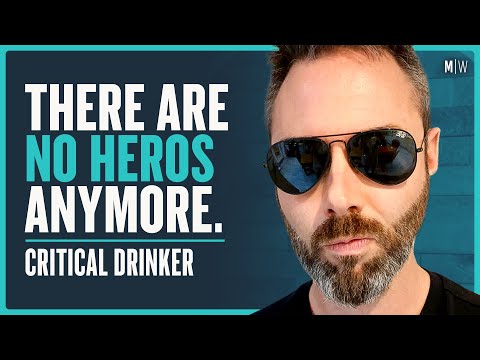
Hollywood’s Message Is Dead - Critical Drinker
Critical Drinker (guest), Chris Williamson (host)
In this episode of Modern Wisdom, featuring Critical Drinker and Chris Williamson, Hollywood’s Message Is Dead - Critical Drinker explores hollywood’s Woke Messaging Alienates Audiences And Erodes Classic Storytelling Chris Williamson interviews YouTuber and novelist Critical Drinker about why he thinks mainstream Hollywood has lost touch with audiences. Drinker argues that modern films prioritize ideological messaging, identity quotas, and industry politics over character development, merit, and compelling stories, leading to a widening gap between critic and audience scores. They discuss how male and female characters are flattened into propaganda, how fanbaiting and guilt-based marketing backfire, and why mid-budget, risk-taking movies have largely disappeared. The conversation also covers the decline of superhero films, the rise of TV as a better storytelling medium, and how market pressures may eventually force studios to recalibrate.
Hollywood’s Woke Messaging Alienates Audiences And Erodes Classic Storytelling
Chris Williamson interviews YouTuber and novelist Critical Drinker about why he thinks mainstream Hollywood has lost touch with audiences. Drinker argues that modern films prioritize ideological messaging, identity quotas, and industry politics over character development, merit, and compelling stories, leading to a widening gap between critic and audience scores. They discuss how male and female characters are flattened into propaganda, how fanbaiting and guilt-based marketing backfire, and why mid-budget, risk-taking movies have largely disappeared. The conversation also covers the decline of superhero films, the rise of TV as a better storytelling medium, and how market pressures may eventually force studios to recalibrate.
Key Takeaways
Audiences are rejecting overt ideological messaging in favor of entertainment and authenticity.
Drinker contends that viewers largely want to be entertained, not lectured or shamed; when films foreground politics over story (e. ...
Get the full analysis with uListen AI
The critic–audience gap reflects both corrupted incentives and ideological capture.
He argues professional critics are incentivized to be positive toward studio output for access and perks, while also punishing movies that diverge from prevailing ideological norms, leading audiences to distrust them and rely on independent reviewers.
Get the full analysis with uListen AI
Flattening characters into flawless symbols undermines meaningful growth arcs.
Modern ‘strong’ female characters are often portrayed as inherently perfect and unchallenged, which Drinker sees as patronizing and harmful compared to older arcs like animated Mulan, where struggle, ingenuity, and failure drove genuine empowerment.
Get the full analysis with uListen AI
Quotas and identity-based hiring may satisfy institutions but don’t guarantee quality.
He criticizes award-eligibility rules (e. ...
Get the full analysis with uListen AI
Fanbaiting and guilt tactics are short-term PR shields that damage long-term trust.
The tactic of provocatively race/gender-swapping legacy IP, then branding critics as bigots, may generate headlines but ultimately erodes goodwill; viewers resent being morally blackmailed into supporting mediocre content (e. ...
Get the full analysis with uListen AI
Economic and structural shifts have killed mid-budget experimentation.
With DVD revenue gone and piracy and streaming compressing margins, studios lean on huge, ‘safe’ tentpoles and recognizable IP, avoiding $20–30M riskier projects that once produced many beloved, original films.
Get the full analysis with uListen AI
Market pressure and time lags may eventually force Hollywood to course-correct.
Drinker notes that current releases reflect decisions made years ago; as flops accumulate and executives like David Zaslav cancel unprofitable ‘woke’ projects, he expects a delayed but real shift back toward audience-pleasing stories.
Get the full analysis with uListen AI
Notable Quotes
“We’re gonna actively hate you as an art form… and if you dare to push back, we label you as a bigot or a reactionary.”
— Critical Drinker
“It used to be such a much more inspiring message that movies gave you about the power of self‑improvement… now the lesson is you’re amazing the way you are and the world needs to accept it.”
— Critical Drinker
“It’s like trying to tell a story with one arm tied behind your back… you’re crippling the writer’s ability to tell a good story because of all the rules.”
— Critical Drinker
“We are just living in a world where the movies that we’re getting are so terrible that anything that’s just borderline okay is suddenly hailed as a masterpiece.”
— Critical Drinker
“I think the DC on film over the past 10 years is going to go down as one of the biggest wastes of talent and time and money and potential in all of cinema history.”
— Critical Drinker
Questions Answered in This Episode
To what extent is Hollywood accurately reflecting broader cultural shifts versus actively driving them through its storytelling choices?
Chris Williamson interviews YouTuber and novelist Critical Drinker about why he thinks mainstream Hollywood has lost touch with audiences. ...
Get the full analysis with uListen AI
How can films include meaningful social themes without slipping into the kind of didacticism and character flattening criticized here?
Get the full analysis with uListen AI
Are there recent mainstream movies that successfully balance representation, ideology, and strong, merit-based storytelling—and what do they do differently?
Get the full analysis with uListen AI
If mid-budget, experimental films are dying in theaters, can streaming platforms realistically become the new home for that kind of creative risk-taking?
Get the full analysis with uListen AI
Is the ‘four-stage genre lifecycle’ inevitable, or can superhero and other saturated genres reinvent themselves without collapsing into self-parody?
Get the full analysis with uListen AI
Transcript Preview
I guess I just have to accept now that all white men are just awful at everything, and they suck. And myself included, like should just hang my head in shame for the rest of my life. It's a strange sort of offering that they're giving us now, where we're gonna actively hate you as a art form. We're gonna make it our business to make you feel awful about yourself. And if you dare to push back on that and reject the offering that we're giving you, then we just label you as a bigot or a reactionary, or whatever stupid term we label people with these days. (wind blowing)
What is your background? Tell me how you end up getting interested in critiquing movies.
Oh, gosh. Um, right. What's the short version here? Um, yeah, I mean, I guess, like, from being a, a young kid, like, I was always just fascinated by movies, and I was fascinated by, like, the, the way that the stories worked. You know, the way that they would introduce us to the different characters, the way that they were structured so that, you know, you had that, that well-defined, like, uh, build-up of action, and then the, the sort of catastrophe that leads you to the lowest point, and then the big resolution at the end to give you that dramatic high that, that finishes it off. Like, I remember being, even as a kid, I started to recognize that pattern in movies, and it was something that kind of interested me. Um, and it led me into wanting to do storytelling of my own, eventually. And so I got into writing novels, that sort of thing. Um, and obviously YouTube came along, and um, you know, I was interested in the idea of, of starting to break that down and critique things a little bit. Um, you know, my, my early videos were shockingly amateurish, but you know, it was just fun. It was a fun, like, experience to get used to it, get used to editing videos, all that sort of stuff. Um, yeah, obviously I took a break from that to actually focus on my writing career for a good long while. Uh, and then a few years ago, I decided to come back and, um, start doing it again. And uh, gosh, I just, uh, really got into character one time as the drunken critical drinker. Uh, I think it was, uh, after a few glasses of jack, and I noticed I was slurring my words, and I just thought, "What the hell. I'm just gonna, I'm gonna embrace it and lean into it." And uh, that video just went viral, man. Like, within, uh, a few days, it had like a million views, and suddenly my channel exploded. And that's, that's what got me started on the path I'm on now, I suppose. So it worked out well.
What was the first video that, uh, that kicked off?
Install uListen to search the full transcript and get AI-powered insights
Get Full TranscriptGet more from every podcast
AI summaries, searchable transcripts, and fact-checking. Free forever.
Add to Chrome