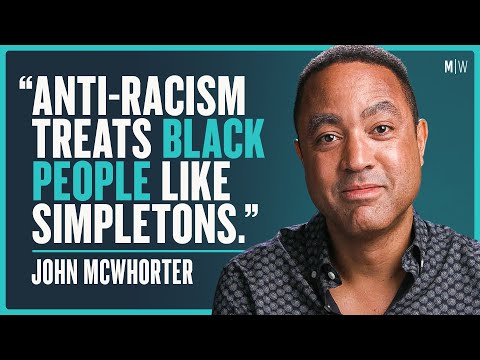
How Does Anti-Racism Hurt Black People? - John McWhorter | Modern Wisdom Podcast 390
John McWhorter (guest), Chris Williamson (host)
In this episode of Modern Wisdom, featuring John McWhorter and Chris Williamson, How Does Anti-Racism Hurt Black People? - John McWhorter | Modern Wisdom Podcast 390 explores john McWhorter: How Woke Anti-Racism Becomes a Harmful New Religion John McWhorter argues that a specific strain of modern anti-racism—what he calls "woke racism"—functions as a religion centered on displaying awareness of racism rather than solving concrete problems for Black Americans. He traces how terms like "woke" and movements like Black Lives Matter evolved, and contends that elite-driven ideology, amplified by social media, now punishes dissent as heresy. McWhorter believes this focus on symbolic virtue and power narratives diverts attention from practical solutions such as reducing homicide in Black communities and improving schooling. He concludes that this movement ultimately infantilizes Black people, entrenches victimhood, and harms those it claims to protect.
John McWhorter: How Woke Anti-Racism Becomes a Harmful New Religion
John McWhorter argues that a specific strain of modern anti-racism—what he calls "woke racism"—functions as a religion centered on displaying awareness of racism rather than solving concrete problems for Black Americans. He traces how terms like "woke" and movements like Black Lives Matter evolved, and contends that elite-driven ideology, amplified by social media, now punishes dissent as heresy. McWhorter believes this focus on symbolic virtue and power narratives diverts attention from practical solutions such as reducing homicide in Black communities and improving schooling. He concludes that this movement ultimately infantilizes Black people, entrenches victimhood, and harms those it claims to protect.
Key Takeaways
Woke anti-racism operates like a religion, not a policy framework.
McWhorter says this ideology demands suspension of logic, treats dissenters as heretics, and prioritizes ritualized confessions of racism over evidence-based debate or measurable outcomes.
Get the full analysis with uListen AI
Fetishizing victimhood undermines Black agency and resilience.
He describes a "victimization complex" where both white and Black participants are rewarded for centering Black people as permanent victims, which offers moral comfort but discourages responsibility, ambition, and pragmatic problem-solving.
Get the full analysis with uListen AI
Focusing on rare racist incidents diverts resources from major Black community harms.
McWhorter argues that energy spent on defunding or vilifying police after rare high-profile killings should largely be redirected to solving everyday homicide in Black neighborhoods and supporting local anti-violence initiatives.
Get the full analysis with uListen AI
Data-free bias claims in education can worsen outcomes for Black students.
He contends that attributing higher suspension rates of Black boys solely to bias—against the data—has led some schools to tolerate more violence, which disproportionately harms other Black children’s safety and academic achievement.
Get the full analysis with uListen AI
Elite discourse on race often fails to reflect everyday Black opinion.
McWhorter notes a gap between academic/media narratives that portray racism as unchanged since 1960 and more mixed, pragmatic views he encounters among ordinary Black people, who are less invested in totalizing victim narratives.
Get the full analysis with uListen AI
Labeling basic norms as “whiteness” is both illogical and condescending.
He criticizes frameworks that frame punctuality, precision, nuclear families, or analytical thinking as “white,” arguing this implicitly suggests Black people are suited only for improvisation and emotion—echoing old racist stereotypes.
Get the full analysis with uListen AI
Pushing back requires social courage against online mobs and ‘the elect.’
McWhorter believes most people quietly disagree with extreme woke positions but are cowed by social media shaming; he urges individuals and institutions to tolerate being called racist and insist these ideological “priests” return to being just one voice at the table.
Get the full analysis with uListen AI
Notable Quotes
“There is a victimization complex that is a human trait… This race, the Black American race, is encouraged to OD on that.”
— John McWhorter
“Woke racism is the heartbeat of a religion… Even when they do things that hurt Black people, they don't care because what they really care about is showing that they know racism exists.”
— John McWhorter
“Anti-racism treats Black people like dum-dums.”
— John McWhorter
“All of that stuff sounds like something some white supremacist in 1895 would come up with and promulgate.”
— John McWhorter
“We’re going to be run by prelates… anti-intellectual priests who have no genuine concern with the wellbeing of the people they claim to speak for.”
— John McWhorter
Questions Answered in This Episode
Where is the line between necessary moral fervor against racism and the kind of ‘religious’ thinking McWhorter warns about?
John McWhorter argues that a specific strain of modern anti-racism—what he calls "woke racism"—functions as a religion centered on displaying awareness of racism rather than solving concrete problems for Black Americans. ...
Get the full analysis with uListen AI
How can institutions address genuine racial inequities without adopting frameworks that, in practice, infantilize or harm Black communities?
Get the full analysis with uListen AI
What alternative, concrete policy agenda would McWhorter propose to reduce violence and improve education outcomes in Black neighborhoods?
Get the full analysis with uListen AI
To what extent are ordinary Black Americans truly aligned with elite anti-racist narratives, and how could we measure that more accurately?
Get the full analysis with uListen AI
How should we differentiate between harmful cultural appropriation and healthy cultural exchange in a diverse, interconnected society?
Get the full analysis with uListen AI
Transcript Preview
There is a victimization complex that is a human trait. It is a way that human beings can go wrong where you fetishize victimhood, you exaggerate victimhood, because being the victim gives you a sense of absolution and significance. This race, the Black American race, is encouraged to OD on that. (wind blows)
John McWhorter, welcome to the show.
Thank you, Chris.
I've been wanting to ask someone this for quite a while, and as a linguist, the task's fallen to you. Have you looked at the development of the word woke over the last few years and where it's come from and how it's rose to prominence?
Yeah, it's become pejorative actually, and I've, um, actually seen it happening. Even as recently as five years ago, woke just meant politically informed in a leftist way, but there's been a certain segment of woke people who have been so noxious in the public square, especially over the past couple years, that usually now woke is used in quotation marks to mean that annoying kind of woke person. And so we really need a new term because it doesn't mean what it meant in, say, 2015. It's weird how quickly these things can happen.
It shows the power of ridicule, I think. You saw that with politically correct. For a while-
Mm-hmm.
... politically correct was a thing that meant politically correct and then it got taken by people that objected to politically correct to use as a pejorative, and now woke has kind of supplanted that position.
It really has. I remember when you could say politically correct and not flinch. It was in the early '80s that I first heard it, and even by '89, '90, it had already fallen down the well and now is virtually unusable. Woke was a very handy replacement 'cause it's good to have a word to indicate that you are enlightened in a leftist way. But, you know, once the fights start, then the word is gonna get worn out and, and abused and hurt, and then you need a new term. I'll be very interested to see what the new term is, but it's too early to tell.
What's woke racism then?
Woke racism is that there's a certain kind of woke person who feels that, um, it's not only about being leftistically informed, but that there's this basic proposition that we must be primarily focused on overturning power differentials and especially what they call white supremacy, that that must be the focus of intellectual, artistic, and moral endeavor! And if you're not doing that, then you are evil and you should be chased out of the public square, you should lose your job, you should be shamed. That's a kind of woke person. With that kind of person, they're so committed to this basic display that they know what racism is, that's, it's become the, it's the heartbeat of a religion, very much a religion. That has become so important that even when they do things and stick up for things that hurt Black people, they don't pay attention and they don't care because what they really care about is showing that they know racism exists because that shows that they're good people. So it ends up being unintentional, but it is a woke racism, and this book has been written to blow the whistle on it.
Install uListen to search the full transcript and get AI-powered insights
Get Full TranscriptGet more from every podcast
AI summaries, searchable transcripts, and fact-checking. Free forever.
Add to Chrome