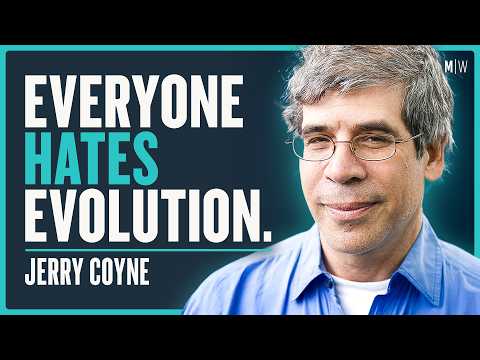
Spicy Ideas From Evolutionary Biology - Dr Jerry Coyne
Chris Williamson (host), Dr Jerry Coyne (guest), Narrator, Narrator, Narrator
In this episode of Modern Wisdom, featuring Chris Williamson and Dr Jerry Coyne, Spicy Ideas From Evolutionary Biology - Dr Jerry Coyne explores evolution, Ideology, and Human Nature: Jerry Coyne’s Spiciest Arguments Jerry Coyne discusses his life’s work on speciation, explaining how continuous evolutionary change produces the discrete 'lumps' we call species and why Darwin’s Origin of Species barely addressed that core problem. He then shifts to his role as a public defender of evolutionary theory against creationism and, more recently, against ideologically driven distortions from both political Left and Right.
Evolution, Ideology, and Human Nature: Jerry Coyne’s Spiciest Arguments
Jerry Coyne discusses his life’s work on speciation, explaining how continuous evolutionary change produces the discrete 'lumps' we call species and why Darwin’s Origin of Species barely addressed that core problem. He then shifts to his role as a public defender of evolutionary theory against creationism and, more recently, against ideologically driven distortions from both political Left and Right.
A major portion of the conversation explores evolutionary psychology, sex differences, race/ethnic variation, and behavioral genetics, and how these fields are attacked because they imply limits on human malleability. Coyne argues that ideology is eroding biological science by forcing reality to conform to political preferences, especially around sex, gender, race, and heritability.
They also touch on human evolution (Neanderthal interbreeding, island dwarfism, skin color, body shape), dysgenic mutation load in modern humans, and the broader cultural landscape of 'wokeness,' media self‑censorship, and postmodern ideas about truth. Throughout, Coyne insists on empirical reality as the non‑negotiable foundation of science, regardless of whose feelings or politics are offended.
Key Takeaways
Speciation hinges on reproductive isolation, not just visible differences.
Coyne explains that species remain distinct because of barriers that prevent gene flow—such as sterility of hybrids, mating preferences, or mismatched breeding times—so the central scientific question is how these barriers evolve in an otherwise continuous process of genetic change.
Get the full analysis with uListen AI
Evolutionary psychology is maturing from storytelling into a testable science.
While early work often relied on 'just‑so stories,' Coyne notes that leading researchers now emphasize explicit predictions, falsifiability, and empirical tests, making sweeping dismissals of the entire field increasingly untenable.
Get the full analysis with uListen AI
Most Americans reject fully naturalistic evolution, complicating science communication.
Coyne cites Gallup data showing only about 23% of Americans accept evolution as a purely material, unguided process, which means science educators must still actively teach why evolution is considered a provisional fact rather than assume public acceptance.
Get the full analysis with uListen AI
Sex is biologically binary, and that fact underpins key evolutionary explanations.
He stresses that in animals and vascular plants there are only two reproductive roles—large immobile gametes (female) and small mobile gametes (male)—and this binary is essential for understanding phenomena like sexual selection, sex differences, and many aspects of behavior.
Get the full analysis with uListen AI
Human groups show real genetic structure, even if 'race' is a fuzzy term.
Using clustering of genomes and self‑identified race in U. ...
Get the full analysis with uListen AI
Ideology is reshaping how biology is taught and discussed.
Coyne and his coauthor identify six areas—such as 'sex is a spectrum,' 'race is only a social construct,' 'men and women differ only by socialization,' and 'indigenous knowledge equals modern science'—where political commitments are driving claims that conflict with existing biological evidence.
Get the full analysis with uListen AI
Modern medicine may be allowing harmful mutations to accumulate.
They discuss the idea that by removing many selection pressures via healthcare and technology, humans may be accumulating 'mutational load'—for example, in traits like eyesight—raising long‑term questions about genetic health that could only be addressed, if at all, via complex gene‑editing strategies.
Get the full analysis with uListen AI
Notable Quotes
“What on earth would make a continuous evolutionary process give rise to entities that are absolutely discontinuous?”
— Jerry Coyne
“It’s a touchstone of ignorance to deny that evolution is a scientific fact.”
— Jerry Coyne
“There are more than two sexes—that sex is a spectrum and not binary—that’s one of the hottest, most misguided statements, and it’s ideologically motivated.”
— Jerry Coyne
“People believe what makes them feel good, what gives them consolation, rather than what the evidence shows.”
— Jerry Coyne
“In science, we have such a thing as empirical truth, and it comes to knock up against what many people want to be true.”
— Jerry Coyne
Questions Answered in This Episode
How can evolutionary biologists communicate uncomfortable empirical findings about sex and race without being dismissed as ideological or bigoted?
Jerry Coyne discusses his life’s work on speciation, explaining how continuous evolutionary change produces the discrete 'lumps' we call species and why Darwin’s Origin of Species barely addressed that core problem. ...
Get the full analysis with uListen AI
Where should the line be drawn between respecting people’s identities and insisting on biologically accurate language in education and policy?
A major portion of the conversation explores evolutionary psychology, sex differences, race/ethnic variation, and behavioral genetics, and how these fields are attacked because they imply limits on human malleability. ...
Get the full analysis with uListen AI
What specific methodological standards should evolutionary psychology adopt to further distance itself from its 'just‑so story' past?
They also touch on human evolution (Neanderthal interbreeding, island dwarfism, skin color, body shape), dysgenic mutation load in modern humans, and the broader cultural landscape of 'wokeness,' media self‑censorship, and postmodern ideas about truth. ...
Get the full analysis with uListen AI
If modern medicine is enabling accumulation of harmful mutations, is any form of genetic intervention ethically defensible—or is that inevitably eugenics by another name?
Get the full analysis with uListen AI
To what extent has postmodern skepticism about objective truth directly influenced how universities teach and regulate topics in biology?
Get the full analysis with uListen AI
Transcript Preview
How do you describe the central thread of your work over the years?
Well, I'm retired now, so the thread has sort of changed direction. But when I was a scientist, I call myself a superannuated scientist now, but when I was working in the lab, I worked on the problem of speciation or the origin of species, which is, of course, the title of Darwin's 1859 book. And it's a problem that Darwin didn't solve, (laughs) so that's why I took it up when I was a graduate student. I think we know a lot more now. We certainly... Darwin knew almost nothing about speciation, so to call his book the Origin of Species is a bit of a misnomer. He should call it the Origin of Adaptations-
Hmm.
... which might be a natural selection. But in terms of species, there is a lumpiness of nature. The fact that creatures are not a spectrum, but they're discrete, more or less discrete. It's, these, that's a problem that Darwin didn't solve, and that's the problem I was working on.
Right. How do you... What's the layman's description of speciation?
Well, are you talking about them, how it happens or what, how I define it?
Give us both.
Well, the definition is simply the... Speciation is the origin of species, and if you look at nature, as I said, you don't find that it's a continuum all the way from bacteria to, you know, humans. It, but that's not a, a hierarchy, that's just what people perceive as a hierarchy. It's lumpy. So if you look at a bird out your window, you're gonna know what it is instantly. You're not gonna say, "I don't know. It looks like a half black bird and a half robin or whatever." No. They come in pretty discrete packages. And that is the problem of speciation. What on earth would make a continuous evolutionary process give rise to entities that are absolutely discontinuous? And that's the, that's really the problem of the origin of species-
Right.
... that Darwin made almost no inroads on it whatsoever.
Why was it a difficult circle to square for him?
Well, because it, in order to attack the problem with speciation, you have to know what species are. And although we say nature is lumpy and these lumps are species, that, that's not really the problem. The question is, well, why do we get those lumps? And it was in about the 1930s that people realized that those lumps are kept separate by what we call reproductive isolated barriers. That is, barriers that keep the genes from one species from mixing with those of another species. For example, those barriers could be, um, that the hybrids are sterile or inviable, so even if they mate, you don't get any intermixing, or they, they couldn't like each other. I mean, w- like a lion and a tiger, they'll mate in the zoo and produce things like ligers or tiglons, uh, which they have, but where they co-occur or where they used to co-occur, in, let's say the Gir forests of India, they don't interbreed. And in nature there's a lot of animals that just simply don't like the way they look, they don't like the, um, mating behavior of the species, they don't like the pheromones of the other species, or in the case of plants, they produce pollen and eggs at different times. That's called temporal isolation. So there's all these barriers that keep members of different species apart. Now that immediately raises the problem that you wanna solve, which is how do these barriers come about to keep species separate in a continuous evolutionary process? So that's what I was working on.
Install uListen to search the full transcript and get AI-powered insights
Get Full TranscriptGet more from every podcast
AI summaries, searchable transcripts, and fact-checking. Free forever.
Add to Chrome