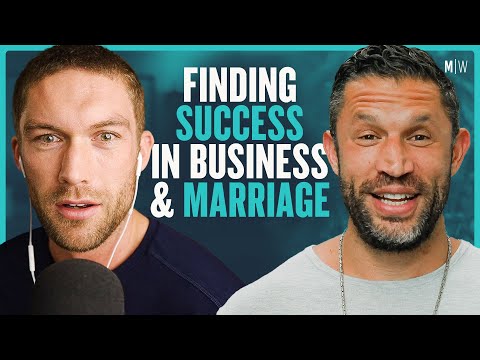
Succeeding In Life, Business & Marriage - Aubrey Marcus | Modern Wisdom Podcast 375
Aubrey Marcus (guest), Chris Williamson (host)
In this episode of Modern Wisdom, featuring Aubrey Marcus and Chris Williamson, Succeeding In Life, Business & Marriage - Aubrey Marcus | Modern Wisdom Podcast 375 explores aubrey Marcus On Purpose, Polyamory, Plant Medicine, And Self-Worth Aubrey Marcus reflects on succeeding in business, love, and personal growth while confronting a lifelong fear of “not doing enough,” even after selling Onnit and marrying his dream partner.
Aubrey Marcus On Purpose, Polyamory, Plant Medicine, And Self-Worth
Aubrey Marcus reflects on succeeding in business, love, and personal growth while confronting a lifelong fear of “not doing enough,” even after selling Onnit and marrying his dream partner.
He and Chris Williamson explore how chasing external validation—money, success, relationships—never resolves inner insecurity, and how shifting identity from persona to “life itself” is the deeper work.
Marcus unpacks lessons from polyamory, jealousy, and intense plant medicine work, describing them as forging practices that prepared him for marriage and leadership in a chaotic world.
They conclude by emphasizing radical honesty, learning to love yourself for who you are rather than what you do, and intentionally doing hard things to become the person your future family and mission need.
Key Takeaways
External achievements never silence an internal belief of “not enough.”
Marcus describes how selling Onnit and gaining wealth intensified, rather than resolved, his pressure to do more, showing that inner fears cannot be permanently soothed by external wins.
Get the full analysis with uListen AI
Love yourself for who you are, not just what you do.
The pair highlight how many people crave unconditional love from others while only loving themselves conditionally based on recent performance, creating fragile self-worth that swings with every win or loss.
Get the full analysis with uListen AI
Radical honesty and clear communication are non‑negotiable in complex relationships.
In polyamory, any distortion or withholding of truth becomes explosive, forcing blisteringly honest communication—a skill Marcus sees as both brutal and profoundly formative.
Get the full analysis with uListen AI
Intentionally doing hard things forges the capacity to carry future responsibility.
Whether through non‑monogamy, cold plunges, demanding business crises, or plant medicine, Marcus argues that voluntarily entering difficult experiences prepares men to be anchors for families, teams, and communities.
Get the full analysis with uListen AI
Identity should be held lightly—your persona is a useful but limiting suit.
Marcus aims to be “life expressed through the Aubrey suit,” not trapped by being ‘Aubrey Marcus, founder of Onnit,’ recognizing that tightly clung identities create pressure, resistance, and suffering.
Get the full analysis with uListen AI
Psychedelics are powerful tools, not shortcuts, and should be approached progressively.
He advises starting with deeper breathwork, then careful, low‑dose work with ketamine or psilocybin and only later, if truly called, moving into serious ayahuasca work with top-tier facilitators.
Get the full analysis with uListen AI
Polyamory can be a path of intense growth but isn’t for everyone long-term.
Marcus frames his eight years of non‑monogamy as ‘the ayahuasca of jealousy’—an extreme exposure therapy that liberated him from many fears and helped prepare him for monogamy with his wife, while acknowledging he couldn’t sustain it forever.
Get the full analysis with uListen AI
Notable Quotes
“I don’t want to go to the end of my life and say, ‘I did a lot of good stuff, but I never really enjoyed any of it.’”
— Aubrey Marcus
“You’re expecting other people to do something that you haven’t done. You’re like, ‘I wish they would just love me for who I am. Meanwhile, I’m gonna love myself for what I do.’”
— Aubrey Marcus
“There’s no satisfaction to this drive to do more and this fear that I’m not doing enough. I have to go inside; nobody can satisfy internal fears with external realities.”
— Aubrey Marcus
“Identity is useful, but it’s also a trap. I don’t like being the Aubrey that much—it’s a lot more fun for me to be life expressed through the Aubrey suit.”
— Aubrey Marcus
“We suffer until we get sick of suffering.”
— Aubrey Marcus
Questions Answered in This Episode
How can someone practically begin shifting from loving themselves for what they do to loving themselves for who they are?
Aubrey Marcus reflects on succeeding in business, love, and personal growth while confronting a lifelong fear of “not doing enough,” even after selling Onnit and marrying his dream partner.
Get the full analysis with uListen AI
What are healthy, non‑psychedelic ways to experience the kind of ego loosening and perspective shifts Aubrey describes from plant medicine?
He and Chris Williamson explore how chasing external validation—money, success, relationships—never resolves inner insecurity, and how shifting identity from persona to “life itself” is the deeper work.
Get the full analysis with uListen AI
How do you distinguish between productive, forging ‘hard things’ and self‑destructive levels of stress or suffering?
Marcus unpacks lessons from polyamory, jealousy, and intense plant medicine work, describing them as forging practices that prepared him for marriage and leadership in a chaotic world.
Get the full analysis with uListen AI
If identity is a ‘suit’ we should wear lightly, how can public figures responsibly manage brand and persona without becoming trapped by them?
They conclude by emphasizing radical honesty, learning to love yourself for who you are rather than what you do, and intentionally doing hard things to become the person your future family and mission need.
Get the full analysis with uListen AI
For people drawn to non‑monogamy, what concrete signs suggest it’s genuine alignment versus simply chasing validation or avoiding intimacy?
Get the full analysis with uListen AI
Transcript Preview
... that question, the first person you ask that question to is yourself. Do I love myself for who I am, or do I love myself for what I do? You're expecting other people to do something that you haven't done, most of the time, right? You're like, "I wish they would just love me for who I am. Meanwhile, I'm gonna love myself for what I do." (laughs)
(wave crashes) Aubrey Marcus, welcome to the show.
Thanks, Chris. Happy to be here again, man.
I know, dude. Congratulations on the marriage.
Yeah, that's the big one, right? (laughs) I mean, I was expecting on it to come out of that, but the big one is the marriage. I got, I got my dream relationship. I mean, it's stunning. Just layers and layers of beautiful complexity. And, uh, I'm really, really so, so happy.
Man, that's amazing. Like, it's... Especially to do it during a pandemic as well?
Yeah, I mean, I, I think the pandemic is a bit subjective. You know, everybody had their own pandemic experience. Um, you know, for me it was... I've known Veilana for many years, so it was actually like, I don't know if our actions would've been that different. I mean, maybe a few more dinners out rather than cooking at home, but- (laughs)
(laughs)
... nonetheless, when you get into this kind of, uh, you know, passionate union, we were just gonna be spending a lot of time together anyways. (laughs)
Dude, I love it, man. It makes me happy to see you happy, and it really does look like you are.
Yeah. No doubt, man. No doubt.
There's a video that I saw of yours a little while ago, and I'm just gonna read out a transcript that I pulled from it. "I spent so much of my life terrified of what I was going to become and whether I was going to be right here, right now. God, how much time did I waste afraid I wasn't going to be right here, right now? If I could change, the only thing I'd change about my whole life would be fearing less that I wouldn't get here, the place that I was going anyway. I wouldn't change all those mistakes and mishaps. I needed those. But all the constant worry that I wasn't going to make it, that took me out of enjoying the moment, it took me out of enjoying these experiences, smiling or eating my lunch or doing whatever I was doing. Know your mission, have faith you're going to get there. Wherever you go, it's going to be all right. Just find ways to get out of your head." What's that mean to you?
Hm. This is the constant, ever-present reminder, advice that I give to myself. And as many times as I say it, I need to say it one more time, because this is, this is the task, this is the challenge. You know, I don't want to go to the end of my life and say, "Ah, I did a lot of good stuff, but I never really enjoyed any of it, because I was always worried about the next thing that I did," and that's how I've lived so much of my life. It was always been about projecting my mind into the future, solving future problems, figuring out what I was gonna do next, at the cost of really being present with what I was doing in the moment. Now, a lot of people might think that there's a trade-off, like it's one or the other. You're either just enjoying the moment and you're just blissed out, like, you know, somebody who's high looking at daffodils in a fucking field or something (laughs) like that, you know? Or, you're really focused. But there's a way to be really present in the actions that you're doing, and I've been able to touch that thing and experience it in small doses. But I wanna live that way. I wanna still... Of course I'm gonna be thinking about the future, thinking about what I can build, thinking about how I can contribute to the world. The world certainly needs it now more than ever, it feels like. But can I do that with my heart full and, you know, really present with what I'm doing, rather than in anxiousness or fear or concern about whether it's gonna work, whether I'm doing enough, all of these thoughts in the mind, and just move forward with this kind of confident knowing that I'm here, I'm doing my best, and that's all that matters. And, uh, it's going to, it's going to happen as it happens, which it always has. That's the thing. Like, I'm batting 1,000. Like, I've never struck out, you know? Like, I'm, uh, I've always... Whatever. Even if I've made a mistake, even if I've fallen on my face, I've learned from it, it's all been perfect. But nonetheless, I look ahead to the future with this anticipation of, "Maybe this time I'm gonna fail and the failure's gonna be the worst thing that's ever gonna happen." It never is. So it's like getting out of these patterns. And that's my, um, you know, that's my prayer. That's my daily constant reminder and prayer, and I have to go back to it all the time.
Install uListen to search the full transcript and get AI-powered insights
Get Full TranscriptGet more from every podcast
AI summaries, searchable transcripts, and fact-checking. Free forever.
Add to Chrome