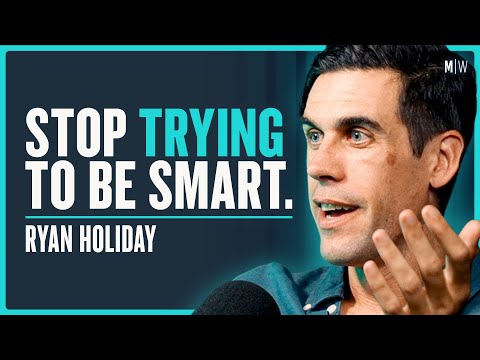
Why Most Smart People Become Stupid - Ryan Holiday
Chris Williamson (host), Ryan Holiday (guest)
In this episode of Modern Wisdom, featuring Chris Williamson and Ryan Holiday, Why Most Smart People Become Stupid - Ryan Holiday explores why Intelligence Isn’t Enough: Ryan Holiday On Cultivating Real Wisdom Ryan Holiday and Chris Williamson explore why raw intelligence and success often fail to translate into wisdom, and how ego, poor information diets, and unexamined trauma can make smart people act stupid. They discuss wisdom as a lifelong loop of learning, applying, and revisiting ideas and experiences, emphasizing humility, empathy, and negative capability (holding opposing ideas) as core traits. Holiday shares stories from Stoicism, history, and his own career—from speaking mishaps and canceled Naval Academy talks to James Stockdale’s POW ordeal—to show how real wisdom is stress‑tested in adversity, not built from hacks or shortcuts. The conversation closes on emotional regulation, relationships, and the hidden costs and responsibilities that come with becoming wiser.
Why Intelligence Isn’t Enough: Ryan Holiday On Cultivating Real Wisdom
Ryan Holiday and Chris Williamson explore why raw intelligence and success often fail to translate into wisdom, and how ego, poor information diets, and unexamined trauma can make smart people act stupid. They discuss wisdom as a lifelong loop of learning, applying, and revisiting ideas and experiences, emphasizing humility, empathy, and negative capability (holding opposing ideas) as core traits. Holiday shares stories from Stoicism, history, and his own career—from speaking mishaps and canceled Naval Academy talks to James Stockdale’s POW ordeal—to show how real wisdom is stress‑tested in adversity, not built from hacks or shortcuts. The conversation closes on emotional regulation, relationships, and the hidden costs and responsibilities that come with becoming wiser.
Key Takeaways
Deliberately practice doing hard things the unfamiliar way to build resilience.
Holiday’s note‑free talks and last‑minute, slide‑less keynote showed that forcing yourself out of your preferred method reveals capabilities you didn’t know you had and makes you less fragile when plans inevitably fall apart.
Get the full analysis with uListen AI
Treat ideas you dislike as vital training material, not threats.
Using examples from banned books at the Naval Academy and James Stockdale’s Marxism course, Holiday argues that engaging opposing viewpoints—‘reading like a spy in the enemy camp’—strengthens your defenses and judgment instead of weakening them.
Get the full analysis with uListen AI
Pursue wisdom as a loop: learn, apply, then revisit and revise.
Wisdom isn’t book smarts versus street smarts; it’s the ongoing cycle of studying what others have learned, testing it in your own life, and coming back to the material with new experiences so deeper layers of meaning emerge.
Get the full analysis with uListen AI
Use stories, quotes, and myths as compressed “WinZip files” of insight.
Short aphorisms and historical anecdotes (Cincinnatus, Stockdale, Odysseus, Plutarch’s ‘lives’) act as portable mental hooks that quickly unpack complex lessons in the moment, even if the stories are only figuratively rather than literally true.
Get the full analysis with uListen AI
Beware the specific ways intelligence plus ego turns you stupid.
Overconfidence after a big contrarian win, consuming only confirming information, never addressing childhood wounds, or lacking empathy for others’ perspectives all distort judgment, making very clever people catastrophically wrong in new domains.
Get the full analysis with uListen AI
Invest in emotional regulation and repair skills before crisis hits.
Stoic practice is less about numbing feelings and more about noticing them without being ruled by them—developing the ability to close open loops, de‑escalate conflicts, and return to ‘equanimity’ in relationships and leadership.
Get the full analysis with uListen AI
Focus on avoiding “multiply by zero” mistakes in life.
Drawing on the idea that one catastrophic error (a DUI, unprotected sex, not wearing a seatbelt) can negate years of good decisions, they argue that wisdom often looks like systematically avoiding ruinous choices rather than optimizing everything.
Get the full analysis with uListen AI
Notable Quotes
“You think you need it to go a certain way, and then when you’re forced to do it the way you didn’t want to, you find out not only can you do it, it might actually be better.”
— Ryan Holiday
“We don’t ban books because it’s stupid. A free society requires the free transmission and publication of ideas.”
— Ryan Holiday
“As the island of knowledge grows, so does the shoreline of ignorance.”
— Ryan Holiday (quoting John Wheeler)
“Any fool can learn by experience. I prefer to learn from the experiences of others.”
— Ryan Holiday (quoting Otto von Bismarck)
“One of the signs you’re making progress toward wisdom is that you get in fewer arguments.”
— Ryan Holiday (paraphrasing Epictetus)
Questions Answered in This Episode
How can someone practically distinguish between genuine conviction and ego-driven stubbornness when others disagree with them?
Ryan Holiday and Chris Williamson explore why raw intelligence and success often fail to translate into wisdom, and how ego, poor information diets, and unexamined trauma can make smart people act stupid. ...
Get the full analysis with uListen AI
In an age of information overload, what does a “wise” information diet actually look like on a daily basis?
Get the full analysis with uListen AI
Where is the line between useful, figuratively true stories and harmful myths that should be discarded?
Get the full analysis with uListen AI
How should institutions like military academies balance political pressure with their duty to cultivate independent thinkers?
Get the full analysis with uListen AI
What concrete practices best help intelligent, achievement‑oriented people develop empathy and emotional regulation without losing their drive?
Get the full analysis with uListen AI
Transcript Preview
How did the live shows go? The last time we were talking-
Oh.
... we were discussing your upcoming live shows.
Yeah, I think it was, uh, I was doing two in Australia, and you gave me this advice. You were like... Well, y- you told me that you'd d- done it with no notes (laughs) . And, uh, usually, like, when you do talks at events, like, they, they don't want you to just go up and give a speech. They want, like, a presentation. But these were... This was different. So yeah, I had to figure out how to do it with no, no notes, which was, um... It was int- Like, it, I, it's good to pick arbitrary challenges and take something that you're good at, that you've done a lot of times, and just figure out a way to do it the hard way.
Yeah. What's new?
Yeah. And so I had to sort of reinvent it from scratch, and it was challenging but good. It's, uh, it's actually funny. In Marcus Aurelius Meditations, he talks about practicing holding the reins with your non-dominant hand.
Mm-hmm. Mm-hmm.
And so, just, like, what, what's the way that you're comfortable doing it? What's the way you normally do it? And then how do you force yourself to do it not the way that you like to do it?
Hmm.
And to force yourself to do it in front of, uh, the way that you're not comfortable doing it in front of 2,000 people-
A huge fucking audience.
... is a, is a... You know, it's a whole thing.
Difficulty plus, yeah.
Yeah.
I've always thought about doing a podcast episode with a guest that s- somebody had organized for me-
Yes.
... and sat down opposite me, and I didn't know who it was.
Yes.
And I had to try and do an episode without breaking the fourth wall that I didn't know who they were and see if I could excavate what the fuck is going on here. Who is this psychologist, athlete, coach-
Yeah.
... trainer, like you motherfucker and do it without, like, destroying the episode. I always thought that would be, like, a fun challenge.
Well, and, and the reason you challenge yourself artificially is that, uh, life doesn't really care about your plans.
Doesn't play by your rules.
So I, I had a talk I was supposed to do in Kentucky, like, a couple weeks ago, and so I was supposed to fly in. Uh, I had all day, and then I would do the talk at night. And then, you know, I get to the airport at 9:00, and it's like 30 minutes delayed, 30 minutes delayed, 30 min- It's starting to get crazy. And some incredibly complicated, very expensive travel adjustments later, (laughs) I land, and I'm in the car. Like, it's... I'm already late, so they've pushed it. They've s- they've been stalling.
Install uListen to search the full transcript and get AI-powered insights
Get Full TranscriptGet more from every podcast
AI summaries, searchable transcripts, and fact-checking. Free forever.
Add to Chrome