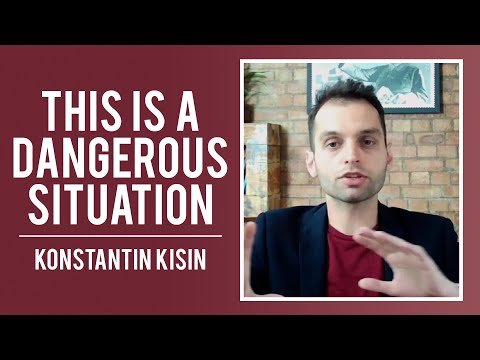
Approval To Speak Freely | Konstantin Kisin | Modern Wisdom Podcast 235
Konstantin Kisin (guest), Chris Williamson (host), Narrator
In this episode of Modern Wisdom, featuring Konstantin Kisin and Chris Williamson, Approval To Speak Freely | Konstantin Kisin | Modern Wisdom Podcast 235 explores comedian warns of identity politics, speech policing and fragile democracy Chris Williamson and Konstantin Kisin discuss the Darren Grimes–David Starkey case as a pivotal moment for free speech, exploring whether podcasters should be legally liable for what their guests say and how police involvement chills independent media.
Comedian warns of identity politics, speech policing and fragile democracy
Chris Williamson and Konstantin Kisin discuss the Darren Grimes–David Starkey case as a pivotal moment for free speech, exploring whether podcasters should be legally liable for what their guests say and how police involvement chills independent media.
They broaden the conversation to identity politics, ‘weaponized empathy’, and the BBC’s and wider media’s cultural bias, arguing that current trends threaten individualism and the foundations of multiethnic societies.
Kisin draws on his Russian upbringing and his co‑host’s Venezuelan background to frame COVID-19, lockdowns, and economic upheaval as part of recurring historical shocks that simultaneously destroy and create opportunities.
They close by examining rising political polarization, potential post‑election unrest in the US, and the long‑term dangers of normalizing violence and delegitimizing democratic processes.
Key Takeaways
Independent hosts may face broadcaster-level liability without broadcaster-level support.
The Grimes–Starkey case shows police willing to treat bedroom podcasters like regulated TV networks, potentially holding them legally responsible for guests’ speech despite lacking legal departments or compliance training.
Get the full analysis with uListen AI
Free speech norms erode via many small, selective enforcement cases.
Examples like Count Dankula, Harry Miller, and others illustrate a ‘death by a thousand cuts’ approach where offensive but legal expression is investigated or prosecuted, encouraging self-censorship even among people far from the original cases.
Get the full analysis with uListen AI
Media silence and bias on cultural controversies deepen public distrust.
Kisin argues that the BBC’s decision not to cover the Grimes story, despite wide coverage elsewhere, signals a cultural bias on free speech issues and undermines their claim to impartiality, especially on so-called ‘culture war’ topics.
Get the full analysis with uListen AI
Identity politics leverages empathy to normalize divisive group thinking.
By framing politics primarily in terms of race, gender, or sexuality, activists can guilt well‑meaning people into accepting dubious claims; Kisin warns this ‘weaponizing empathy’ undermines individualism and fosters grievance industries.
Get the full analysis with uListen AI
Multiethnic societies only remain stable if shared identity overrides race.
He contends that successful multiethnic countries require people to see themselves first as ‘British’ or ‘American’, not as racial blocs; sustained racialization of politics risks pushing societies back toward ethno-tribal conflict.
Get the full analysis with uListen AI
Crises like COVID-19 expose systemic fragility but also create openings.
Drawing on Russian and Venezuelan experience, Kisin notes that stable systems can flip overnight; those who adapt quickly—such as ramping up online content—can thrive even as others lose jobs, income, and security.
Get the full analysis with uListen AI
Escalating political delegitimization normalizes violence as a tool.
With roughly a third of Democrats and Republicans now believing political violence can be justified, and both sides questioning election integrity, the hosts warn that contested results plus street unrest is a highly volatile mix.
Get the full analysis with uListen AI
Notable Quotes
“Principles like this always require you to defend people that you don't agree with and don't like, and that's just an inevitability.”
— Konstantin Kisin
“Without being able to speak freely you can't think freely. And if you can't think freely, well, we're all fucked.”
— Konstantin Kisin
“You take that…and you use people's empathy against them.”
— Konstantin Kisin (on weaponizing empathy in identity politics)
“The only way a multiethnic society remains peaceful is if people set aside their racial categories and actually don't say, 'Well, I'm a Black person,' or 'I'm a white person.' No, you say, 'I'm British.'”
— Konstantin Kisin
“A principle isn't a principle until it costs you.”
— Chris Williamson
Questions Answered in This Episode
Where should the legal line be drawn between platform responsibility and guest autonomy in long-form conversations?
Chris Williamson and Konstantin Kisin discuss the Darren Grimes–David Starkey case as a pivotal moment for free speech, exploring whether podcasters should be legally liable for what their guests say and how police involvement chills independent media.
Get the full analysis with uListen AI
How can societies protect against hate and incitement without creating a chilling effect on legitimate debate and comedy?
They broaden the conversation to identity politics, ‘weaponized empathy’, and the BBC’s and wider media’s cultural bias, arguing that current trends threaten individualism and the foundations of multiethnic societies.
Get the full analysis with uListen AI
What practical steps can individuals and institutions take to resist ‘weaponized empathy’ while remaining genuinely compassionate?
Kisin draws on his Russian upbringing and his co‑host’s Venezuelan background to frame COVID-19, lockdowns, and economic upheaval as part of recurring historical shocks that simultaneously destroy and create opportunities.
Get the full analysis with uListen AI
If identity politics continues on its current trajectory, what realistic ‘endgames’ do you foresee for multiethnic democracies?
They close by examining rising political polarization, potential post‑election unrest in the US, and the long‑term dangers of normalizing violence and delegitimizing democratic processes.
Get the full analysis with uListen AI
How can citizens reinforce trust in democratic processes when both political camps increasingly view elections and institutions as illegitimate?
Get the full analysis with uListen AI
Transcript Preview
If you allow politicians to, to conduct themselves in this way and to delegitimize the democratic process, which both, uh, sides have done, uh, but particularly in my opinion, the, the Democrats in America and the left in this country as well, then what you end up with is a situation where we are now, where 36% of both Democrats and Republicans feel, uh, that violence is justified to achieve your political ends. So a third of both supporter groups are quite happy to use violence, which has gone up from 8% about two years ago. So if you've got that situation, the election is in dispute, both parties are undermining the democratic process and encouraging their followers essentially to feel like violence is a way of resolving this issue, not a good recipe.
(wind blows) The stakes have been raised now, haven't they, based on the Darren Grimes incident? I'm now culpable for what you say, so please go gently on me or I'm gonna be in prison, and that, and you'll be in a gulag.
Well, I'm gonna struggle to say anything now, aren't I?
(laughs)
Because I, because I apparently am so ridiculously controversial with my very mainstream opinions that, uh, yeah, we're both in trouble.
If we sit in silence for the next hour, that is one surefire way that we can't get in trouble.
That could offend people who really wanted to listen to us talk though, and they might report us to the police, and, uh, yeah, you never know, man. But if you remember, you came to see my show in Edinburgh last year, and this is exactly what I was talking about. Should it be illegal to have offensive opinions? And here we are, and essentially the police are investigating people, not even for their own opinions, for stuff someone else said on their show that they broadcast. Um, and, uh, you know, you add to that the response to the pandemic and how that's affecting our civil liberties as well, uh, it, it's not a great time.
No, not at all. So can you give us a brief overview and take us through what we've learned from the Darren Grimes situation, in your opinion?
Well, so for people who don't know, Darren Grimes is a, a conservative right-wing commentator. He, I think is, uh, rather hated by, uh, many people on my side of the referendum de- debate, people who voted Remain, as I did. Uh, a lot of people who are sort of very, uh, obsessed with that issue, in a way that I'm not, uh, felt that because he was part of the campaign to make that happen, he was investigated three times by the Electoral Commission for his involvement in that. Uh, so he's got a lot of enemies. Uh, I think that's part of it, for sure. Uh, but basically, he had Dr. David Starkey, controversial historian, who made some what I thought were ill-judged comments. And I know David, we've had him on the show, he didn't say anything like that on our show. Uh, but on Darren's, he did make some, uh, controversial comments, which I, as I say, I thought were all ill-judged. Um, and this happened a few months ago. There was a big furore. Dr. David Starkey was properly canceled for it. Um, he apologized. Eventually, Darren apologized for, for not challenging him on what he said. And that was sort of the end of the matter. Uh, I think a lot of people felt that e- even though I th- I think many people felt that he, it was appropriate that David Starkey suffered some consequences for what he said, uh, equally, many people felt that maybe the consequences were quite harsh. Uh, whe- wherever you sit on that, I respect both views on that personally. Um, uh, and, uh, that was sort of the end of the matter for, for most people, I think, until we found out last week as we record this, that the police had invited... Initially, we learned that it was Darren Grimes and then also then Darre- uh, David Starkey had both been invited for what is euphemistically called a voluntary interview. Uh, interesting it's called that, because if you don't attend, you get arrested.
Install uListen to search the full transcript and get AI-powered insights
Get Full TranscriptGet more from every podcast
AI summaries, searchable transcripts, and fact-checking. Free forever.
Add to Chrome