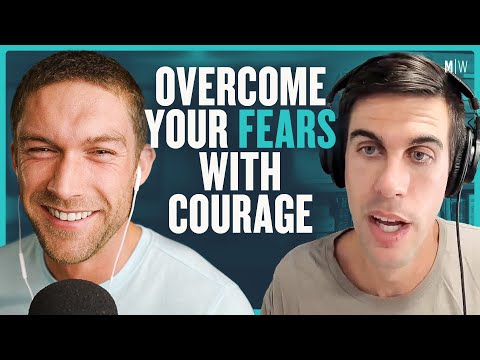
Finding Courage & Overcoming Fear - Ryan Holiday | Modern Wisdom Podcast 378
Ryan Holiday (guest), Chris Williamson (host)
In this episode of Modern Wisdom, featuring Ryan Holiday and Chris Williamson, Finding Courage & Overcoming Fear - Ryan Holiday | Modern Wisdom Podcast 378 explores ryan Holiday Redefines Courage: Beyond Fear, Recklessness, and Ego Ryan Holiday and Chris Williamson explore courage as a nuanced virtue that sits between cowardice and recklessness, drawing heavily on Stoic philosophy and historical examples. Holiday argues that real courage is evidence-based risk-taking—putting your “ass on the line” with incomplete information, guided by wisdom and justice rather than blind faith or ego. They distinguish physical courage from moral courage, emphasize restraint and timing as courageous acts, and show how fear is inevitable but being “afraid” is a choice to let fear become a lasting state. The conversation also covers audience capture, speaking unpopular truths, personal moral failures, and the responsibility to cultivate courage in oneself and others.
Ryan Holiday Redefines Courage: Beyond Fear, Recklessness, and Ego
Ryan Holiday and Chris Williamson explore courage as a nuanced virtue that sits between cowardice and recklessness, drawing heavily on Stoic philosophy and historical examples. Holiday argues that real courage is evidence-based risk-taking—putting your “ass on the line” with incomplete information, guided by wisdom and justice rather than blind faith or ego. They distinguish physical courage from moral courage, emphasize restraint and timing as courageous acts, and show how fear is inevitable but being “afraid” is a choice to let fear become a lasting state. The conversation also covers audience capture, speaking unpopular truths, personal moral failures, and the responsibility to cultivate courage in oneself and others.
Key Takeaways
Ground courage in evidence, not blind faith.
Holiday rejects “faith in yourself” in favor of evidence-based confidence: look at past hard things you’ve done, your preparation, and your track record, then act knowing you might still be wrong. ...
Get the full analysis with uListen AI
Distinguish fear from being afraid and act anyway.
Feeling fear is an unavoidable biological reaction; being afraid is letting that feeling harden into a lasting state that governs your choices. ...
Get the full analysis with uListen AI
Aim for courage, not recklessness or cowardice.
Drawing on Aristotle’s golden mean, courage lies between under-reacting (cowardice) and over-reacting (recklessness). ...
Get the full analysis with uListen AI
Filter courage through wisdom and justice.
Courage in service of ignorance or injustice (e. ...
Get the full analysis with uListen AI
Use “stress-testing” to dismantle vague fears.
Most fears are amorphous and exaggerated. ...
Get the full analysis with uListen AI
Act before you feel 100% ready; 51/49 decisions are normal.
Holiday notes that many of his biggest life decisions (dropping out, leaving a job, writing books) were made with only slight confidence, not certainty. ...
Get the full analysis with uListen AI
Resist social pressure and audience capture to stay authentic.
Both as a citizen and a writer, Holiday insists on saying what he believes, even when it costs fans or money. ...
Get the full analysis with uListen AI
Notable Quotes
“I don't have faith in myself, I have evidence.”
— Ryan Holiday
“Courage is about putting your ass on the line.”
— Ryan Holiday
“Be scared, you can't help that. Don't be afraid.”
— William Faulkner (quoted by Ryan Holiday)
“Justice without courage is worthless.”
— Ryan Holiday
“If you don't believe you can do something, it's impossible for you—but just because you believe you can doesn't mean you can.”
— Ryan Holiday
Questions Answered in This Episode
How can I practically differentiate, in real time, between courageous action and reckless overreach in my own decisions?
Ryan Holiday and Chris Williamson explore courage as a nuanced virtue that sits between cowardice and recklessness, drawing heavily on Stoic philosophy and historical examples. ...
Get the full analysis with uListen AI
What specific process could I adopt to systematically “stress-test” my fears before major life or career moves?
Get the full analysis with uListen AI
How do I evaluate whether the cause I'm being brave for is genuinely just and not simply aligned with my biases or tribe?
Get the full analysis with uListen AI
In what areas of my life am I allowing social pressure or “audience capture” to mute what I really think or need to do?
Get the full analysis with uListen AI
How can I turn a past failure of courage into a constructive lesson rather than an identity of seeing myself as a coward?
Get the full analysis with uListen AI
Transcript Preview
I don't have faith in myself, I have evidence. If you have faith in yourself, you're operating on some false, almost delusional level. False says like, without evidence, I believe. Evidence says like, here's the information that I have to make what I think is a good call, but I could be wrong. Like, when I wrote my first book, I didn't have faith that I could complete it; I had evidence that I've completed hard things before, that I had trained for this, that I wasn't a quitter. And so I was willing to make that leap. But the idea that I knew for certain that I would finish, that it would be a success, that I wouldn't regret walking away from a sure thing to do an unsure thing, I mean, that's, that's the whole point. (wind blows)
So I've been watching a lot of the September 11th documentaries, obviously 20th anniversary, and watching that, like, it, it genuinely doesn't feel real to me. It's shaken my worldview a lot more than I thought it would watching it back. I was 12, something, at the time. I remember my mom picking me up from school and it was on the radio, but that was kind of it. But yeah, watching that back, it seems insane that that even happened, and then watching it from the perspective of the firefighters and the police officers is ridiculous.
Yeah, it is. I was a freshman in high school, so I remember being on a, on a, on the West Coast time zone, I remember waking up and it was on the radio and sort of getting the sense that life wouldn't be the same again. I think looking, you know, at it with 20 years distance, you, I think, uh, especially pertaining to the new book, sort of two, two big themes emerged to me. One was the sort of quiet, ordinary heroism that you're talking about, whether it's firefighters or policemen, or just people who were in the buildings, like, uh, working. You know, some people just ran away and some people said, "I'm not leaving until I get all of my people out with me." Right? People who had no sort of real legal or professional obligation, they were just office colleagues sort of reacting with e- extraordinary courage and compassion and, and, uh, selflessness. And then I think you contrast that, 'cause I've been thinking a lot about this too, obviously it coincides with the withdraw from Afghanistan, the, there's sort of two kinds of courage, right? There's the courage that, uh, charges ahead into a burning building, but there's also, uh, I think, courage in restraint, in sort of seeing a provocation within its context. And so, you know, the, the, the terrible tragedy of 9/11 is not just what happens on that day, but then the immense, uh, and mistaken, uh, foreign policy that comes after, not just, uh, you know, uh, uh, y- I think the, the entrance into Afghanistan makes sense. What we sort of do there over the next 20 years makes a lot less sense. What we do, what the United States does in Iraq makes almost no sense in retrospect. Um, and then, and then you look at these successive presidents and prime ministers who lacked the courage to be able to say, like, "What the hell are we doing here? What are we spending all this money and this manpower and this energy on? What are, w- what does this have to do with the, the tragic events that brought us there in the first place?" So w- in the book, I'm talking about courage. It's not just can you run into a building in the middle of a, a terrorist attack and, and save people, although that's really important, but also can you have the courage to, uh, both stick with your convic- convictions and question your convictions? Can you, um... There, there was an expression about Lyndon Johnson in the Vietnam War that he lacked the courage to be seen as a coward to withdraw from Vietnam, right? And, uh, so, so courage is an immensely complicated topic, but I think 9/11 brings all of its various forms to the forefront, for sure.
Install uListen to search the full transcript and get AI-powered insights
Get Full TranscriptGet more from every podcast
AI summaries, searchable transcripts, and fact-checking. Free forever.
Add to Chrome