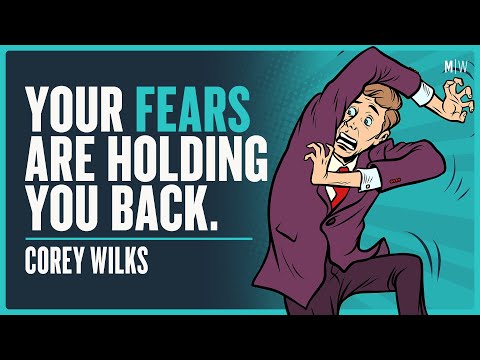
How To Identify Your Internal Fears - Corey Wilks
Corey Wilks (guest), Chris Williamson (host)
In this episode of Modern Wisdom, featuring Corey Wilks and Chris Williamson, How To Identify Your Internal Fears - Corey Wilks explores conquering the Four Fears Quietly Sabotaging Your Life Ambitions Chris Williamson and psychologist-turned-coach Corey Wilks explore why so many people reach the end of their lives regretting the chances they never took, despite having the potential to do far more.
Conquering the Four Fears Quietly Sabotaging Your Life Ambitions
Chris Williamson and psychologist-turned-coach Corey Wilks explore why so many people reach the end of their lives regretting the chances they never took, despite having the potential to do far more.
Wilks outlines his "four horsemen of fear"—fear of failure, uncertainty, ridicule, and success—and explains how these show up as self‑sabotaging behaviors like perfectionism, procrastination, and complacency.
They discuss the difference between therapy and high-performance coaching, the limits of advice without action, and how personal narrative and upbringing (especially working-class scarcity mindsets) shape what people believe they deserve.
The conversation closes with practical strategies for fear inoculation, building accountability and community, and intentionally designing a life that avoids deathbed regret.
Key Takeaways
Most self-sabotage is fear in disguise, not a character flaw.
Behaviors like perfectionism, procrastination, and chronic "research" are often strategies to avoid feared outcomes—especially ridicule, failure, or making the wrong choice—rather than genuine quality control or lack of discipline.
Get the full analysis with uListen AI
The four horsemen of fear quietly limit even high achievers.
Fear of failure, uncertainty, ridicule, and success don’t disappear with external success; they evolve. ...
Get the full analysis with uListen AI
Your personal narrative determines your ceiling of possibility.
Repeated self-talk like "I’m broken," "I’m a victim," or "people like me don’t do that" becomes a lived “truth” that constrains what you attempt, what you believe you deserve, and how you interpret every opportunity or setback.
Get the full analysis with uListen AI
Iteration beats perfection: ship at 95% and learn from reality.
High-leverage creators focus on producing many "good enough" versions instead of polishing one thing from 95% to 100%, because the marginal gain in quality rarely justifies the lost opportunity to ship more, learn faster, and build momentum.
Get the full analysis with uListen AI
Accountability and cadence are powerful antidotes to perfectionism.
Fixed publishing schedules, external expectations (audience, clients, coaches), and gradually increasing frequency help override fear-based delays by making "not shipping" more uncomfortable than releasing imperfect work.
Get the full analysis with uListen AI
You can inoculate yourself against fear by pre-planning your worst case.
Assume your fear comes true—failure, ridicule, the wrong decision, or destabilizing success—then deliberately map how you would recover, course-correct, or stay grounded; once the unknown becomes knowable, the fear loses much of its power.
Get the full analysis with uListen AI
Lack of positive role models can be offset by anti-role models and online community.
If you don’t see people like you succeeding locally, you can still learn what not to do from negative examples and build a virtual circle of peers and mentors who model the mindset and behaviors you want.
Get the full analysis with uListen AI
Notable Quotes
“Up to 76% of people lay on their deathbeds with the same regret: they lived in mediocrity.”
— Corey Wilks
“Perfectionism is procrastination masquerading as quality control.”
— Chris Williamson (paraphrasing a common idea/Tiago Forte)
“Most self-sabotaging behaviors are actually rooted in fear.”
— Corey Wilks
“You’re not a perfectionist. That’s an excuse to not hit publish.”
— Corey Wilks
“There is no way to expedite believing something.”
— Chris Williamson
Questions Answered in This Episode
Which of the four horsemen of fear—failure, uncertainty, ridicule, or success—shows up most strongly in your own life, and how does it manifest in your behavior?
Chris Williamson and psychologist-turned-coach Corey Wilks explore why so many people reach the end of their lives regretting the chances they never took, despite having the potential to do far more.
Get the full analysis with uListen AI
What elements of your personal narrative (“people like me don’t…”) might be silently capping your ambitions or sense of what you deserve?
Wilks outlines his "four horsemen of fear"—fear of failure, uncertainty, ridicule, and success—and explains how these show up as self‑sabotaging behaviors like perfectionism, procrastination, and complacency.
Get the full analysis with uListen AI
If your absolute worst-case scenario happened in a project you care about, what concrete steps could you take to recover and iterate rather than quit?
They discuss the difference between therapy and high-performance coaching, the limits of advice without action, and how personal narrative and upbringing (especially working-class scarcity mindsets) shape what people believe they deserve.
Get the full analysis with uListen AI
Where in your life are you chasing perfection instead of setting a cadence, shipping at 90–95%, and letting the feedback loop teach you?
The conversation closes with practical strategies for fear inoculation, building accountability and community, and intentionally designing a life that avoids deathbed regret.
Get the full analysis with uListen AI
How could you deliberately build a more supportive ecosystem—role models, anti-role models, peers, or groups—that normalizes the risks you’re currently afraid to take?
Get the full analysis with uListen AI
Transcript Preview
Up to 76% of people, they lay on their deathbeds with the exact same regret. They lived in mediocrity. They're like, "I wish I would have taken certain chances. I wish I would have faced my fears and went left instead of right, but I chose to be complacent. I chose to let fear stop me from living the life that I wanted to live and knew I was capable of doing. It just was too scary for me to do."
For the people that are watching, you will see that I'm back in my usual, uh, setting. I'm back in the UK. Uh, you'll also notice that I'm handholding a USB microphone, uh, and everything's just a little bit different. That's because I've been slowly fisted by British Airways over the last 24 hours. I left Austin about 24 hours ago. Um, two hours late, got to London Heathrow, that flight left another hour and a half late. Neither of my bags arrived, and then I've just got one bag and thankfully in that one bag is this USB microphone. Uh, like, I, I've been able to sort of piece together this very sort of rough-hewn way of putting stuff, but the show goes on, Corey. That's what we're fucking doing, okay? Uh, extracting-
'Cause you're a fucking professional. (laughs)
Correct. I've extracted British Airways from my, my back passage and now we're gonna record a podcast.
(laughs) I'm glad your rectum is clear. Let's fucking go.
Yes. Let's fucking go, man. So, you are somebody that's transitioned from, uh, being a therapist to now being a coach, and one of the things that I find that's interesting about that is the fact that you've obviously dealt with people that was, uh, subclinical, I think is the term, so people that were suffering with, uh, issues, getting them from, um, illness to wellness rather than wellness to high performance. Um, and what I'm very, very interested about is what the common challenges are that you found that high performers deal with that you were never dealing with with your previous clients when you was working clinically and you were getting people from some sort of, um, social anxiety disorder, depression, whatever it might be, to get them back to the normal world. What is it that the high performers are dealing with that you didn't see and also what are the similarities between the two?
Yeah, so back when I did therapy, you know, therapy's all about dysfunction, right? So, helping somebody overcome clinical depression or panic attacks, things like that. So before you can really flourish or start to tap more into your potential, you have to deal with that baseline functioning level of shit first, right? Because if you are, you know, acutely suicidal or, like I said, if you're having panic attacks so bad you can't leave your house, there's... I mean, your, your ceiling for potential is, is, is pretty low, right? So that's where a lot of therapy is about is how can we just help you function, period, to get you out the door and to just go to like a regular nine-to-five or just do, you know, just basic functioning shit, right? With a lot of high performers, they may, may struggle with like mood symptoms occasionally, right? Or they may have anxiety, everybody has anxiety to some extent in some situations, but it isn't necessarily crippling, right? So with a lot of the people that I work with and with coaching in general, it, it's much more about the assumption is you, you already function pretty well. What you need is these small tweaks to really optimize, okay? So, you know, sleep, diet, and exercise, those are probably pretty dialed in. Your stress management is probably relatively dialed in. So at this point it's like, okay, what do you need that, just that little bit extra, that edge, to really go further faster? That's really the, the main distinction is that there's just, they're at a higher level of functioning overall
Install uListen to search the full transcript and get AI-powered insights
Get Full TranscriptGet more from every podcast
AI summaries, searchable transcripts, and fact-checking. Free forever.
Add to Chrome