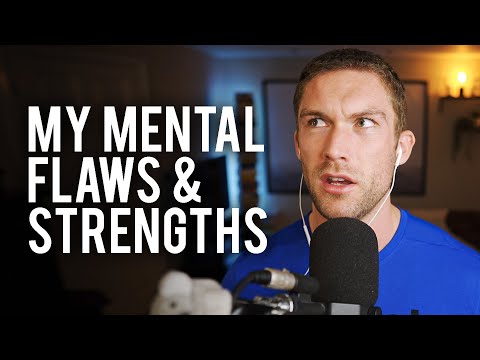
Reflecting On My Mental Flaws & Strengths | Modern Wisdom Podcast 263
Chris Williamson (host), Charlotte Fox-Weber (guest), Narrator
In this episode of Modern Wisdom, featuring Chris Williamson and Charlotte Fox-Weber, Reflecting On My Mental Flaws & Strengths | Modern Wisdom Podcast 263 explores embracing Weirdness, Curiosity, and Vulnerability: Inside Chris Williamson’s Mind Chris Williamson and psychotherapist Charlotte Fox Weber explore Chris’s psychological landscape, focusing on his compulsive curiosity, his evolution as a podcaster, and how asking questions relates to avoidance and self-disclosure.
Embracing Weirdness, Curiosity, and Vulnerability: Inside Chris Williamson’s Mind
Chris Williamson and psychotherapist Charlotte Fox Weber explore Chris’s psychological landscape, focusing on his compulsive curiosity, his evolution as a podcaster, and how asking questions relates to avoidance and self-disclosure.
They discuss the value of embracing personal ‘weirdness’ and childhood ‘flaws’ as adult strengths, the hidden costs of trying to be normal, and the tension between self-acceptance and relentless self-improvement.
Chris opens up about depression, envy of his ‘ideal self,’ unexpected resilience after injury, and the shame of unremarkable modern depression without a clear external cause.
Charlotte uses a set of probing questions—about trauma, jealousy, fragility, and old-age hindsight—to help Chris (and listeners) reflect on identity, inner criticism, and what truly constitutes a successful life.
Key Takeaways
Curiosity can be disciplined into a powerful relational skill.
Chris describes ‘weaponizing’ curiosity into the art of asking good questions, which yields deeper friendships, richer conversations, and better podcasting—especially when you genuinely want to discover what others know that you don’t.
Get the full analysis with uListen AI
Your weirdness and childhood ‘flaws’ are often your competitive advantage.
Traits once labeled nosy, overly sensitive, or ‘outsider’ can become strengths when refined and accepted; both guests argue that rounding off these edges to appear ‘normal’ sacrifices the very qualities that can make you uniquely valuable.
Get the full analysis with uListen AI
You can’t be both maximally normal and extraordinarily exceptional.
Chris stresses that ‘normal people get normal results,’ and figures like Elon Musk or the Kardashians have extreme outcomes because they accept extreme inputs—trying to be universally liked while also wildly exceptional is an unrealistic double demand.
Get the full analysis with uListen AI
Silence is not a conversational failure but a tool.
Learning to tolerate and use silence—rather than anxiously filling every gap—can deepen thinking, allow more authentic responses, and create space for others to surface what genuinely matters to them.
Get the full analysis with uListen AI
Self-development can mask self-rejection if it lacks acceptance.
They note that many people pursue endless growth because they secretly dislike who they are, hoping a future improved self will be ‘worthy’—yet real change tends to require some degree of self-acceptance, not just constant fixing.
Get the full analysis with uListen AI
Unremarkable, ‘contextless’ depression is real and often shrouded in shame.
Chris describes episodes of being unable to get out of bed despite having no obvious external crisis, and how secondary self-loathing—‘I have no right to feel this way’—often becomes heavier than the original emotion itself.
Get the full analysis with uListen AI
You’re likely more resilient than you think when true crises hit.
His Achilles rupture revealed an unexpected ‘bunker’ of inner resilience, challenging his assumption that he was fragile and suggesting that latent robustness often appears only when genuinely tested.
Get the full analysis with uListen AI
Notable Quotes
“No one can beat you at being you.”
— Chris Williamson
“If you're trying to be normal, by definition, you're regressing to the mean. Normal people get normal results. Extraordinary people get extraordinary results.”
— Chris Williamson (via George McGill)
“Curiosity is a huge energy source.”
— Charlotte Fox Weber
“Depression feels like you're drowning under the weight of your own consciousness.”
— Chris Williamson
“What would you say to the most fragile part of yourself?”
— Charlotte Fox Weber
Questions Answered in This Episode
Which childhood ‘weaknesses’ or labels might actually be the raw material for my adult strengths, if I chose to embrace and refine them?
Chris Williamson and psychotherapist Charlotte Fox Weber explore Chris’s psychological landscape, focusing on his compulsive curiosity, his evolution as a podcaster, and how asking questions relates to avoidance and self-disclosure.
Get the full analysis with uListen AI
Am I pursuing self-improvement from a place of genuine curiosity and growth, or from an underlying belief that who I am now is unworthy?
They discuss the value of embracing personal ‘weirdness’ and childhood ‘flaws’ as adult strengths, the hidden costs of trying to be normal, and the tension between self-acceptance and relentless self-improvement.
Get the full analysis with uListen AI
Where in my life am I regressing to the mean—choosing to be ‘normal’—even though I secretly want non-normal, extraordinary results?
Chris opens up about depression, envy of his ‘ideal self,’ unexpected resilience after injury, and the shame of unremarkable modern depression without a clear external cause.
Get the full analysis with uListen AI
How comfortable am I with silence in conversations, and what does my need to fill every gap say about my anxieties or sense of self-worth?
Charlotte uses a set of probing questions—about trauma, jealousy, fragility, and old-age hindsight—to help Chris (and listeners) reflect on identity, inner criticism, and what truly constitutes a successful life.
Get the full analysis with uListen AI
If I spoke directly to the most fragile part of myself today, what would I honestly say—and what would my 102-year-old self say back to me about that conversation?
Get the full analysis with uListen AI
Transcript Preview
No one can beat you at being you. And as I've embraced-
Mm-hmm.
... my weirdness and the fact that I don't necessarily fit into an archetype, as-
Mm-hmm.
... tons and tons and tons of people do. They all feel this, and they nerf the edges, they round off the edges of the interesting stuff that they do in life, to try and make themselves fit into the bell curve of what normal is. If you're trying to be normal, by definition, you're regressing to the mean.
Mm-hmm.
Normal people get normal results. Extraordinary people get extraordinary results. We all want, somehow, everybody wants to both be the most popular, most liked person on the planet, and also Elon Musk or Conor McGregor, or one of the Kardashians or something.
Mm-hmm.
And you think y- you don't get it both ways. Those people have ridiculous outcomes because they have ridiculous inputs. You can choose one, but you can't choose both. This year's been a year of living kind of Groundhog Day over and over again. It doesn't matter how varied your life is, everyone, in one form or another, has had the guardrails brought in on variety in life.
Mm-hmm.
And I think what that can cause you to do is probably get into, in the same way as you get into lifestyle patterns habitually, you get into thought patterns as well. And-
Hm.
... that includes narratives around how you see things going, just how you perceive stuff. I walked back-
Yeah.
... into my house when I got here, and I looked at the kitchen, and the kitchen looked different. Like, it actually looked like the dimensions of things were different. I was like, "Has something been moved in here?" And it worked out-
Hm.
... that it hadn't, but I'd been the best part of four weeks since I'd seen it.
Mm-hmm.
And there's a concept that the SAS use called a break point, and it's the moment before they will breach a door. So, they'll get, stack up outside of the door, and that break point there is where they kind of rest, reset, and plan to go in. And, uh, I kinda considered that trip out to Dubai as a little bit of a break point. Um-
I like that.
It's a cool concept, isn't it?
I'm very jealous. Yeah.
But anyway, we're rolling. So-
Really like that.
... Charlotte Fox Webber, welcome-
Okay.
... welcome back. You are so much less super pregnant than the last time that we spoke.
(laughs) It's a pleasure to be here, and I'm, I'm happy to not be pregnant. Although, I have a beautiful baby from it, so-
You got a, you got a baby out of it, yeah, but you're just-
Yeah.
... like now half the size.
Install uListen to search the full transcript and get AI-powered insights
Get Full TranscriptGet more from every podcast
AI summaries, searchable transcripts, and fact-checking. Free forever.
Add to Chrome