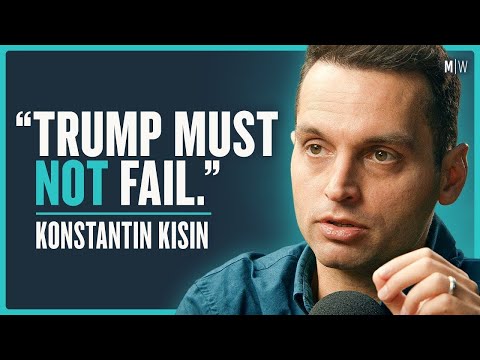
The Political Earthquake That No One Is Ready For - Konstantin Kisin (4K)
Chris Williamson (host), Konstantin Kisin (guest), Chris Williamson (host)
In this episode of Modern Wisdom, featuring Chris Williamson and Konstantin Kisin, The Political Earthquake That No One Is Ready For - Konstantin Kisin (4K) explores konstantin Kisin Warns West: Trump’s Win Is Last Wake-Up Call Konstantin Kisin and Chris Williamson explore how political labels, media incentives, and social-media dynamics distort public debate and policy in the West.
Konstantin Kisin Warns West: Trump’s Win Is Last Wake-Up Call
Konstantin Kisin and Chris Williamson explore how political labels, media incentives, and social-media dynamics distort public debate and policy in the West.
Kisin argues that many once-universal values—free speech, national pride, merit—have been rebranded as “right-wing” to discredit them, while politics optimizes for optics, emotion, and moral posturing over outcomes.
They use Hungary, Trump’s victory, immigration, energy policy, and UK decline as case studies in how incentives, debt, demographics, and culture interact.
Kisin contends that Trump’s success could catalyze a pro-growth, anti-woke reset across the Western world—but if he fails, trust in democracy and the liberal order may collapse, pushing people toward authoritarian alternatives.
Key Takeaways
Treat “right-wing” labeling as a rhetorical tactic, not an argument.
Kisin notes that positions like free speech or national pride were once mainstream but are now smeared as “right-wing” primarily to discredit critics’ motives instead of engaging their ideas. ...
Get the full analysis with uListen AI
Judge policies by measurable outcomes, not moral-sounding slogans.
Using Thomas Sowell’s idea that we replaced things that work with things that sound good, Kisin contrasts “Diversity is our strength” or net zero rhetoric with hard realities like crime, energy prices, and stagnant wages. ...
Get the full analysis with uListen AI
Recognize how social media rewards drama over solutions.
Both hosts describe an incentive system where tantrums, stunts (like throwing soup at art), and hyper-partisan clips get more reach than careful, outcome-focused discussion. ...
Get the full analysis with uListen AI
Energy policy is economic policy; cheap energy underpins growth.
Kisin argues that “GDP is energy transformed” and that making energy expensive via net-zero orthodoxy raises the price of everything, hollowing out industry and wages. ...
Get the full analysis with uListen AI
Trump’s administration is a high-stakes test of democratic efficacy.
With the presidency, Congress, Senate, judiciary, money, and tech allies, Kisin says Trump now has a rare alignment of power. ...
Get the full analysis with uListen AI
Structural decline requires structural fixes, not just personal mindset shifts.
Using northern English towns as an example, they argue that anger, antisocial behavior, and riots are downstream of decades of deindustrialization, housing dysfunction, crime, and lack of meaningful work. ...
Get the full analysis with uListen AI
Civilizations and democracies are contingent; they can fail.
Drawing on his Soviet background, Kisin stresses that no society has lasted forever and that sustained high debt, unmanaged immigration, rising crime, and institutionalized ideological capture are not indefinitely sustainable. ...
Get the full analysis with uListen AI
Notable Quotes
“We’ve replaced things that work with things that sound good.”
— Konstantin Kisin (summarizing Thomas Sowell)
“If you can’t vote your way out of this, is that democracy or is that a fake democracy?”
— Konstantin Kisin
“All you really have to do is make energy cheap and an economy will grow.”
— Konstantin Kisin
“What happens if Trump fails to deliver change? Then there’s literally no way out of this.”
— Konstantin Kisin
“Our civilization is like a big Jenga block—you can pull some pieces out and it stays standing, but if you pull out the core, it can collapse.”
— Konstantin Kisin
Questions Answered in This Episode
If Trump’s administration does deliver growth, border control, and a rollback of DEI, how might that practically reshape politics and policy agendas in countries like the UK, Canada, and Australia?
Konstantin Kisin and Chris Williamson explore how political labels, media incentives, and social-media dynamics distort public debate and policy in the West.
Get the full analysis with uListen AI
What institutional or technological changes would be required to realign social media incentives away from outrage and towards constructive, outcome-focused political discourse?
Kisin argues that many once-universal values—free speech, national pride, merit—have been rebranded as “right-wing” to discredit them, while politics optimizes for optics, emotion, and moral posturing over outcomes.
Get the full analysis with uListen AI
How can Western countries realistically balance climate goals with the need for cheap, abundant energy so that working-class communities regain meaningful work and upward mobility?
They use Hungary, Trump’s victory, immigration, energy policy, and UK decline as case studies in how incentives, debt, demographics, and culture interact.
Get the full analysis with uListen AI
If voters choose systemic change and the system proves resistant even under a unified government, what non-authoritarian reforms (constitutional, bureaucratic, or electoral) could restore faith in democracy?
Kisin contends that Trump’s success could catalyze a pro-growth, anti-woke reset across the Western world—but if he fails, trust in democracy and the liberal order may collapse, pushing people toward authoritarian alternatives.
Get the full analysis with uListen AI
Given Kisin’s view that no civilization lasts forever, what early warning indicators should ordinary citizens watch for that suggest their society is approaching a point of serious instability or decline?
Get the full analysis with uListen AI
Transcript Preview
So are you right-wing?
No, (laughs) I'm still not right-wing. I think you're referring to an article in- in a video I did saying, the title of which was Fine, Call Me Right-Wing. And it's basically just me saying I'm tired of, like, defending myself against this allegation. Uh, I'm still not right-wing but if- if it's- it's really important for people to frame me in that way, that's- that's fine, they can do it.
Why is right-wing a disparaging, uh, marker?
I think we, um, the political realm in which we operate is- is the framing is, I think deep down if people are honest, is like the- the caricature of the left is that they're wrong but well-meaning, and of the right is that they're, like, factually more correct but evil.
Callous.
Callous and evil and cruel and nasty.
Mm-hmm.
Um, and so even if you're right, you're still wrong kind of. (laughs) That- that's kind of the- the way people seem to think-
Morally.
Morally wrong, exactly.
Mm-hmm.
Um, and I think that- that's why, that's what I noticed, right? Because my journey into all of this world, as you know, was like, "Hey guys, maybe free speech is quite impor- oh, right-wing." I was like, "What?" And- and then I just gradually discovered that, you know, thinking that you should be allowed to speak freely makes you right-wing, which when I was in my early 20s, you know, George Carlin and Bill Hicks, these were my heroes when I was growing up, these great comedians who were getting arrested like George Carlin for routine, like, the seven words you can't say on TV or whatever, whatever it was. So, um, that flipped without me realizing that it happened. It was a left-wing thing or maybe universal thing.
Mm-hmm.
Um, and then it became a right-wing thing. Then, you know, thinking your country's not all bad became right-wing. Uh, and we can go down the list of- of all of those things. So, it, I just, I think that it- it's basically what a lot of people call you if what they want to do is discredit the things that you're saying 'cause they don't actually have a counterargument to what it is that you're saying.
Mm, and we can't really be fully aware of somebody's intentions, so castigating, lambasting the, uh, moral foundation that it's based on and saying, "Oh, y- y- y- it's- it's coming from a place of judgment, or impoliteness, or uncouthness, or callousness, or whatever," is kind of a easy slime to throw at someone maybe.
Yeah, and- and I, uh, it- it makes people question people's motives. And we, a lot of people find people's motives more interesting than the results of the things that they're advocating. So if you go and, you know, try to create this beautiful utopia in which everyone's equal and you end up killing 50 million people in the process, well, you know, that wasn't real communism. You- you were just, you were well-intentioned but you didn't quite live up to the ideals of this great philosophy. Whereas if you actually do things that work but you have the wrong intentions or you're a bad person, then people don't seem as interested in that. And I find that quite an interesting thing because I was in Hungary earlier this year and they have a very actually right-wing government, uh, under Viktor Orbán. And one of the things that I- I found out is they were very keen to deal with abortion in some way. Uh, they wanted to reduce the number of abortions in Hungary. But they looked around the world and they realized that abortion as a political issue doesn't work. It's- it's an issue that actually loses votes for the right. Even if people tend to agree with the position, somehow it still ends up being a vote loser and it's a bad thing to do. So what they've been doing is, uh, you probably know, is pursuing very pro-family policies more generally. If you have X number of kids, you get this tax break, if you have this number of kids...
Install uListen to search the full transcript and get AI-powered insights
Get Full TranscriptGet more from every podcast
AI summaries, searchable transcripts, and fact-checking. Free forever.
Add to Chrome