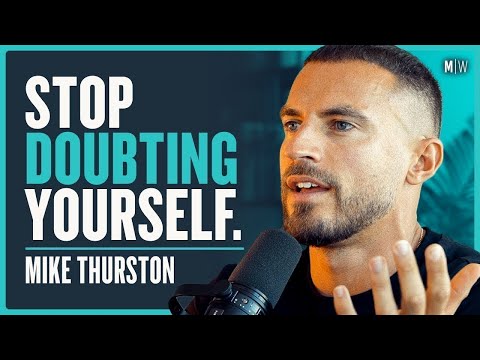
How Social Media Fuels Our Insecurities - Mike Thurston
Chris Williamson (host), Mike Thurston (guest), Narrator
In this episode of Modern Wisdom, featuring Chris Williamson and Mike Thurston, How Social Media Fuels Our Insecurities - Mike Thurston explores social Media, Body Dysmorphia, And The Search For Real Confidence Chris Williamson and Mike Thurston explore how social media intensifies male body dysmorphia, comparison, and insecurity, particularly in fitness culture. They discuss aging, shifting standards of attractiveness, and how men increasingly compare themselves both to others and to their own past physiques. The conversation widens into social media’s psychological toll on creators: criticism, anonymity, algorithm-driven exposure, and how audiences can unconsciously steer content. They finish by examining confidence, ambition, “enoughness,” relationships, and the trade-offs required to build a successful life, career, and future family.
Social Media, Body Dysmorphia, And The Search For Real Confidence
Chris Williamson and Mike Thurston explore how social media intensifies male body dysmorphia, comparison, and insecurity, particularly in fitness culture. They discuss aging, shifting standards of attractiveness, and how men increasingly compare themselves both to others and to their own past physiques. The conversation widens into social media’s psychological toll on creators: criticism, anonymity, algorithm-driven exposure, and how audiences can unconsciously steer content. They finish by examining confidence, ambition, “enoughness,” relationships, and the trade-offs required to build a successful life, career, and future family.
Key Takeaways
Curate who you follow to protect your mental health.
Following the top 0. ...
Get the full analysis with uListen AI
Recognize that even “perfect” bodies are often edited and staged.
Many already-jacked influencers still Photoshop their physiques after using optimal lighting, pumps, tans, and cameras, creating standards that are literally unattainable for anyone—even themselves.
Get the full analysis with uListen AI
Avoid using your peak self as your constant comparison point.
Chris and Mike note that comparing everyday shape or performance to competition-condition or younger selves leads to chronic dissatisfaction; aging gracefully requires decoupling self-worth from looks alone.
Get the full analysis with uListen AI
Limit direct exposure to online criticism and anonymous hate.
Mike stopped reading comments and outsourced parts of his social media because steroid accusations and appearance-based attacks were distorting his content choices and mental state.
Get the full analysis with uListen AI
Use the gym as a foundation for confidence, not an obsession.
Both describe starting lifting to feel safer, more masculine, and more attractive; consistent, moderate training (e. ...
Get the full analysis with uListen AI
Develop confidence across multiple domains—physique, finances, skills, and relationships.
Mike only felt truly confident around 27–28 when he combined a body he liked, financial comfort, social experience, and personal growth, rather than relying on looks alone.
Get the full analysis with uListen AI
Intentionally choose what you’ll ‘suck at’ for a season to make progress.
They discuss that you can’t maximize business, friendships, family, health, and fun simultaneously; deciding in advance which area will temporarily get less attention helps avoid guilt and focus on a primary goal.
Get the full analysis with uListen AI
Notable Quotes
“You can be that for you too—your own past body can make you feel bad about your current one.”
— Chris Williamson
“I don't understand why all men don't want to try and improve their physique, because so much of what I have achieved has come from my physique.”
— Mike Thurston
“Unspoken expectations are premeditated resentments.”
— Neil Strauss, quoted by Chris Williamson
“Having things isn't fun. Getting things is fun.”
— Andrew Tate, quoted by Chris Williamson
“The best measure of wealth is what you have minus what you want. By this measure, some billionaires are broke.”
— Morgan Housel, paraphrased by Chris Williamson
Questions Answered in This Episode
How can individuals practically rewire their relationship with social media to reduce body dysmorphia and comparison, without quitting these platforms entirely?
Chris Williamson and Mike Thurston explore how social media intensifies male body dysmorphia, comparison, and insecurity, particularly in fitness culture. ...
Get the full analysis with uListen AI
What are good early warning signs that your self-worth is becoming too dependent on your appearance, your past peak, or external validation?
Get the full analysis with uListen AI
For creators, where is the line between listening to your audience and letting them dictate your content and identity?
Get the full analysis with uListen AI
How should young men balance the positive motivations for lifting (safety, confidence, attraction) with the risk of sliding into obsession or steroid use?
Get the full analysis with uListen AI
What concrete strategies can someone use to define their own sense of ‘enough’ in terms of money, status, and achievement before it becomes an endless treadmill?
Get the full analysis with uListen AI
Transcript Preview
Male body dysmorphia-
Hmm.
... is on track to overtake female body dysmorphia within the next few decades. Does that surprise you?
No, I think it's always been a thing. But especially now, with how big social media is and how jacked so many people are, uh, I think of course it's a, it's a big problem. But did you know there's a guy who's really good at calling people out for editing their photos?
No. Who? Who?
You've seen that guy. This, oh God, I don't know his name, but he's got quite a big social media following. And basically anybody who has Photoshopped their photo or videos-
Mm-hmm.
... he gets them.
Oh, wow.
So he's doing a good job. He's making sure that people are being truthful with the things that they're posting. But that makes you think how many people are editing. Even people who are literally jacked and shredded-
Yeah.
... they are still-
Pushing it even further.
... editing their photos further to bring in their waist, bring out the lats. And just, it's crazy. So especially with women as well, imagine how bad that is for the average person who is comparing themselves to all these people.
Hmm.
And a lot of those people are actually s- still editing their photos to look even more unattainable.
You've gone, yeah, they've peaked. They've just trained, they've got a pump, they're in good lighting. They've got a good photographer, a good camera, good lens. They've got a tan, blah, blah, blah. And then on top of that, they're editing their photos as well.
Hmm.
Yeah. It- it's, you know.
I think that, th- that's, it's one thing that messed me up a little bit when I competed. So I competed twice. And obviously when you compete, that really is the best that you are going to look-
Mm-hmm.
... probably in your life. Especially for me, in terms of how low I got in my body fat percentage. So when I would look in the mirror, particularly after the show, when it was like more memorable, I'd be, "Oh, I'm pretty fat."
Because you had yourself as a previous icon.
Because I was comparing myself to the sub 10% body fat person that I was looking in the mirror. Which is like, it's-
Well, that says it all. That not only can you have other people out there in the world, the guys and girls that make them feel uncomfortable about their body, or they're taller, or more jacked, or more whatever. But you can also be that for you too.
Mm-hmm. Yeah.
You know? This is, I wanted to talk about this. Like, you know, you're 34?
33.
33? I'm 35. And we're getting to the stage where we're like, "Right, okay." You know, recovery from workouts takes a little bit longer.
Install uListen to search the full transcript and get AI-powered insights
Get Full TranscriptGet more from every podcast
AI summaries, searchable transcripts, and fact-checking. Free forever.
Add to Chrome