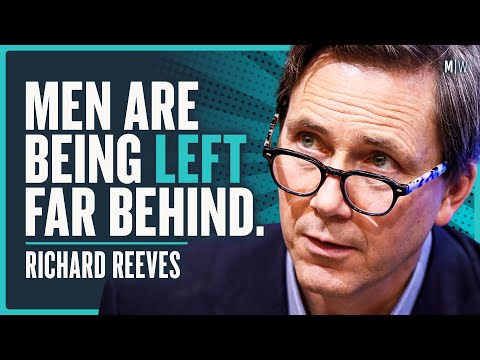
Does Anyone Care About Men’s Struggles? - Richard Reeves
Richard V. Reeves (guest), Chris Williamson (host)
In this episode of Modern Wisdom, featuring Richard V. Reeves and Chris Williamson, Does Anyone Care About Men’s Struggles? - Richard Reeves explores rethinking Men’s Struggles: Education, Work, Fatherhood, And Cultural Myths Richard Reeves and Chris Williamson explore how rapid social, economic, and educational change has left many boys and men structurally disadvantaged and culturally misunderstood. Reeves argues that the term “toxic masculinity” is counterproductive, pushing men out of vital conversations about mature masculinity. They examine male underachievement in education, the labor market’s shift from brawn to brain and care work, and the destabilization of fatherhood as women gain economic independence. Throughout, Reeves insists that supporting boys and men need not roll back women’s gains, but is now necessary for the flourishing of everyone.
Rethinking Men’s Struggles: Education, Work, Fatherhood, And Cultural Myths
Richard Reeves and Chris Williamson explore how rapid social, economic, and educational change has left many boys and men structurally disadvantaged and culturally misunderstood. Reeves argues that the term “toxic masculinity” is counterproductive, pushing men out of vital conversations about mature masculinity. They examine male underachievement in education, the labor market’s shift from brawn to brain and care work, and the destabilization of fatherhood as women gain economic independence. Throughout, Reeves insists that supporting boys and men need not roll back women’s gains, but is now necessary for the flourishing of everyone.
Key Takeaways
The term “toxic masculinity” is vague, overused, and alienates men.
Originally coined for a tiny subset of violent incarcerated men, it has become a catchall insult for any disliked male behavior, making ordinary men feel inherently suspect and pushing them away from constructive discussions about mature masculinity.
Get the full analysis with uListen AI
Boys now lag behind girls at every stage of education for structural reasons.
Girls’ earlier brain development—especially in impulse control and organization—aligns better with school systems that reward homework, planning, and compliance around age 16, while fewer male teachers and less vocational pedagogy further disadvantage boys.
Get the full analysis with uListen AI
The education system may need sex-sensitive structural reforms, not just tougher boys.
Reeves suggests starting boys in school a year later (“redshirting”), recruiting more male teachers (especially in early years and English), expanding vocational pathways, and using targeted programs to build boys’ non-cognitive skills like impulse control.
Get the full analysis with uListen AI
Economic change has eroded traditional male jobs while growth is in “feminized” sectors.
Automation and globalization hollowed out manufacturing and brawn-based work, while opportunities expanded in care, education, and services; without a cultural and policy push to normalize men in these roles, many working-class men are left economically and psychologically adrift.
Get the full analysis with uListen AI
Men’s absence from HEAL professions hurts both men and service users.
With only ~2% male kindergarten teachers and ~15% male care workers, boys lose male role models, male students often perform worse, and male patients or clients lack same-sex carers and therapists—even though targeted scholarships, incentives, and reframing could attract more men.
Get the full analysis with uListen AI
Fatherhood’s economic basis has weakened, but its relational value is still crucial.
As women gain earnings and welfare states expand, fathers risk being seen as redundant; yet evidence shows engaged dads significantly benefit children’s outcomes—especially boys—and fatherhood itself is psychologically beneficial to men.
Get the full analysis with uListen AI
Gender debates are wrongly treated as zero-sum, blocking solutions for men and boys.
Many fear that acknowledging male-specific problems undermines feminism, but Reeves argues we must “think two thoughts at once”: continue advancing women while also addressing male educational, economic, and family challenges for the good of everyone, including women and children.
Get the full analysis with uListen AI
Notable Quotes
“Nobody predicted that once girls and women caught up with boys and men, that they would keep going, and that we would now have a bigger gender gap in higher education than we did 50 years ago, just the other way around.”
— Richard Reeves
“I think [toxic masculinity] is a toxic term… it’s not just vacuous, it’s actively harmful.”
— Richard Reeves
“The left essentially says, ‘You just need to be like your sister and you’ll be okay,’ and the right says, ‘You need to be like your dad and you’ll be okay.’ And meanwhile us men… are trying to figure this out, and neither of those messages are very helpful.”
— Richard Reeves
“We haven’t really tried yet to help men make that transition, which means that for a lot of men, especially working-class men, that’s a pretty tough transition… They’ve got the male jobs disappearing, the female jobs rising, and men stuck between the two.”
— Richard Reeves
“You have to decide: are you interested in inequality, or you’re interested in girls and women? Because we can’t just look through one eye.”
— Richard Reeves
Questions Answered in This Episode
How can schools practically implement sex-sensitive reforms like redshirting boys without triggering political backlash or accusations of discrimination?
Richard Reeves and Chris Williamson explore how rapid social, economic, and educational change has left many boys and men structurally disadvantaged and culturally misunderstood. ...
Get the full analysis with uListen AI
What specific messaging and policy tools would most effectively rebrand HEAL professions so that they feel aspirational and masculine-compatible to young men?
Get the full analysis with uListen AI
In a world where women no longer need men economically, what should a modern, non-redundant ideal of fatherhood and masculinity look like?
Get the full analysis with uListen AI
How do we distinguish between normal, harmless male engagement with gaming and porn and the kind of “checking out” that meaningfully harms men’s life chances and relationships?
Get the full analysis with uListen AI
What institutional or cultural changes could make it socially and politically acceptable to invest in male-targeted programs at the same scale as past investments for women and girls?
Get the full analysis with uListen AI
Transcript Preview
Nobody predicted that once girls and women caught up with boys and men, that they would keep going, and that we would now have a bigger gender gap in higher education than we did 50 years ago, just the other way around. So we've flipped the inequality now and it's actually wider now than it was when I was born. (laughs) That's an extraordinary fact that no one predicted. (wind blows)
What do you think about the term toxic masculinity?
Uh, I think it's a toxic term. Uh, it escaped from the, the margins of academia in the, in abou- in 2016, not, not coincidentally, um, a- and just became a, a term that was used to apply essentially to any behavior by boys and men that the user disapproved of. Uh, it's rarely defined, uh, without any specificity at all. And so it's a, it in a sense is a completely vacuous term, but it's worse than that because by putting those two words right next to each other, it actually repels a lot of boys and men from a conversation about what it means to be a man, what it, what it means to be particularly mature. I think to talk about mature masculinity and immature masculinity is quite useful. But the idea of toxic, it's like puritan. It's like a, this idea, it's, it's reminds me of the idea of original sin in Christian theologies, right? And, and, and you need these exorcisms, you need someone to come and exorcise it. "If you just weren't so male, you'd be okay." And having raised three boys to adulthood, I gotta tell you, that idea that there's something toxic in them that has to be expunged is not a helpful way to raise them. And so, uh, I, if we could, if we could just consign that particular term back to the obscurity of academic journals, that would be great.
Where did it come from?
It was originally, uh, from, uh, cr- from work that was being done with incar- very violent, incarcerated prisoners. Uh, and so there were a couple of academics that were using it to talk about ways in which a very violent man, who was serving long prison sentences, how their views of masculinity had become intertwined with ideas of expressed violence and dominance and so on too. And, uh, and so it was, uh, it was a concept that was being used by a few psychologists. But, but I think it had sort of a, it was mentioned five times a year in academic journals until 2016, and then overnight, it was on the front page of every newspaper. And so it escaped. So, you know, I think it did have some value in the sense that there may be a, a, a group, very small group of men for whom actually their sense of what it means to be male has in some ways become toxic. But it was always this tiny minority of men for whom it was ever useful to apply it. And then suddenly Donald Trump got elected, MeToo, et cetera, and you know, there you go.
Install uListen to search the full transcript and get AI-powered insights
Get Full TranscriptGet more from every podcast
AI summaries, searchable transcripts, and fact-checking. Free forever.
Add to Chrome