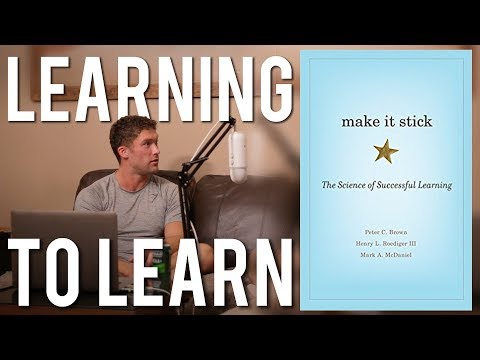
The Science Of Successful Learning Habits | Peter C Brown
Chris Williamson (host), Narrator, Peter C. Brown (guest)
In this episode of Modern Wisdom, featuring Chris Williamson and Narrator, The Science Of Successful Learning Habits | Peter C Brown explores transform Your Learning: Why Struggle, Spacing, And Testing Make Knowledge Stick Peter C. Brown, co-author of *Make It Stick*, explains what genuine learning is: knowledge and skills stored in memory that you can reliably recall and use later. He contrasts common but ineffective study habits—like rereading and highlighting—with evidence-based methods such as active recall, spaced practice, and mixed (interleaved) practice. Brown introduces the idea of “desirable difficulties,” where learning that feels harder actually produces stronger, longer-lasting mastery. He also stresses the importance of mindset, self-testing, and better teaching practices so learners and educators can both shift from “teaching” to truly fostering learning.
Transform Your Learning: Why Struggle, Spacing, And Testing Make Knowledge Stick
Peter C. Brown, co-author of *Make It Stick*, explains what genuine learning is: knowledge and skills stored in memory that you can reliably recall and use later. He contrasts common but ineffective study habits—like rereading and highlighting—with evidence-based methods such as active recall, spaced practice, and mixed (interleaved) practice. Brown introduces the idea of “desirable difficulties,” where learning that feels harder actually produces stronger, longer-lasting mastery. He also stresses the importance of mindset, self-testing, and better teaching practices so learners and educators can both shift from “teaching” to truly fostering learning.
Key Takeaways
Replace rereading with active recall to strengthen memory.
Instead of endlessly rereading notes or textbooks, close the book and ask yourself, “What were the big ideas? ...
Get the full analysis with uListen AI
Use spaced practice instead of cramming.
Study material in shorter, distributed sessions over days or weeks rather than in one big block. ...
Get the full analysis with uListen AI
Interleave similar topics or skills instead of blocking them.
Mix different but related problem types or skills in one practice session (e. ...
Get the full analysis with uListen AI
Create and use cues to make retrieval easier under pressure.
Link new information to vivid images, locations, or prior knowledge (e. ...
Get the full analysis with uListen AI
Test yourself frequently with low-stakes quizzes.
Regular self-quizzing or tools like Anki not only reveal what you actually know, they further reinforce learning through retrieval. ...
Get the full analysis with uListen AI
Embrace desirable difficulties even when they feel discouraging.
Learning that feels smooth and easy (like massed practice on one problem or rereading) is often deceptive and short-lived. ...
Get the full analysis with uListen AI
Adopt a growth mindset about your intellectual abilities.
Understanding that effort and challenge literally build new neural connections helps you pick harder problems and persist when it’s difficult. ...
Get the full analysis with uListen AI
Notable Quotes
“Learning happens when you struggle to get the learning out and apply it, not when you continue to re-expose yourself to it.”
— Peter C. Brown
“We try to make learning simple for students, but actually there are some kinds of difficulties that are desirable.”
— Peter C. Brown
“Our intuition leads us astray. It causes us to spend time in strategies that are not paying us back.”
— Peter C. Brown
“From the moment we leave the womb, children are experimenting… when we get older, we lose some of that.”
— Peter C. Brown
“If you can learn well, the first domino has fallen on everything.”
— Chris Williamson
Questions Answered in This Episode
How can I redesign my current study routine this week to incorporate more spaced and interleaved practice instead of cramming on single topics?
Peter C. ...
Get the full analysis with uListen AI
What practical ways can teachers in large lecture-based courses build in low-stakes retrieval practice without overloading themselves or students?
Get the full analysis with uListen AI
How do I distinguish between a ‘desirable difficulty’ that will lead to growth and a situation where I’m simply stuck and need a different explanation or support?
Get the full analysis with uListen AI
In my own field (academic, professional, or athletic), what would an example of interleaving look like, and how could I test whether it actually improves my performance over time?
Get the full analysis with uListen AI
How can institutions systematically teach students about learning science and growth mindset at the start of their education so these methods become default habits rather than niche techniques?
Get the full analysis with uListen AI
Transcript Preview
(wind blowing) Hello, friends. This week, I'm very happy to say that we are going to learn how to learn. Peter C. Brown is the co-author of Make It Stick. That book is about as seminal as you can get in the world of learning to learn. No matter what your area of pursuit in life, it's pretty likely that being able to expedite your capacity to intake information and then recall it at will is probably gonna be pretty useful. And that doesn't matter if it's learning a new subject or learning a new physical skill, if it's knitting or archery or (laughs) law, all of them require you to be able to remember and recall what it is that you're trying to learn. And Peter manages to lay out a really good framework for doing that today. In other news, the Modern Wisdom YouTube channel has now crossed 1,000 subscribers and has nearly hit two million watch minutes, which is pretty crazy in the first two months of it being up. So if you haven't already, please head to YouTube, search Modern Wisdom Podcast, and give it a subscribe. It would be a massive help. Also, if you haven't already, whatever platform you're on, whether it's TuneIn FM... I'm not even sure (laughs) if that's a podcast listening platform. We are everywhere, Spotify, iTunes, Stitcher. Wherever you're listening, please try and give us a five-star rating. I don't really know if it helps, but it strokes the ego a little bit, so (claps hands) do it if you can. But now we're gonna learn how to learn. Peter Brown, bring it on.
(Upbeat music playing)
Mr. Peter Brown, welcome to Modern Wisdom.
Thank you, Chris. It's great to be here.
How are you today?
I'm doing just dandy.
(laughs)
It's, uh, middle of summer here in Minnesota. It's a nice time to be here.
Lovely. I've recently, uh, recently returned from the States, and the, uh, the weather was fantastic, but apparently I've missed the one warm week that we get in the UK as well while I was away.
(laughs)
So I should've doubled down, I should've doubled down and just stayed home.
I guess. (laughs)
I understand. So, uh, I wanna get straight into it. Can you define to me what learning means?
Yes. Uh, (laughs) uh, f- for me, I define learning as, uh, picking up knowledge or skill, uh, that resides in your memory and is available to you when you need it later to solve a problem or take advantage of an opportunity.
Okay. That sounds like a very, a very curated definition. Was that something that you came upon easily, or is that something that you had to develop through a lot of, um, a lot of thinking, a lot of conceptual, uh, deconstruction?
(laughs) No, I just made it up. But it's, uh, becau- I made it up when I started working on writing the book, Make It Stick, because I felt that I owed the reader a definition of what we're talking about with learning, and I figured, "Well, I'll just try that and see if it holds up." And it held up fine.
Install uListen to search the full transcript and get AI-powered insights
Get Full TranscriptGet more from every podcast
AI summaries, searchable transcripts, and fact-checking. Free forever.
Add to Chrome