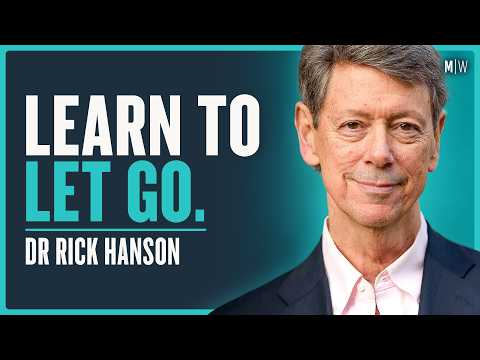
You Can’t Change Without Breaking The Loop - Dr Rick Hanson
Dr. Rick Hanson (guest), Chris Williamson (host)
In this episode of Modern Wisdom, featuring Dr. Rick Hanson and Chris Williamson, You Can’t Change Without Breaking The Loop - Dr Rick Hanson explores break the Rumination Loop: Letting Go, Change, and Real Courage Chris Williamson and Dr. Rick Hanson explore why humans struggle with change, letting go, and emotionally charged memories despite living in an impermanent universe. They link our fear of change and clinging—both to possessions and identities—to evolution, culture, and the brain’s ‘ruminator’ that obsessively time-travels through past and future. Hanson explains how rumination reinforces a rigid sense of self, fuels suffering, and blocks genuine emotional processing, then offers practical methods to transform it into productive reflection. They also discuss interpersonal courage, small “mundane victories,” playfulness, and authenticity as pathways to a freer, more resilient relationship with life’s uncertainty.
Break the Rumination Loop: Letting Go, Change, and Real Courage
Chris Williamson and Dr. Rick Hanson explore why humans struggle with change, letting go, and emotionally charged memories despite living in an impermanent universe. They link our fear of change and clinging—both to possessions and identities—to evolution, culture, and the brain’s ‘ruminator’ that obsessively time-travels through past and future. Hanson explains how rumination reinforces a rigid sense of self, fuels suffering, and blocks genuine emotional processing, then offers practical methods to transform it into productive reflection. They also discuss interpersonal courage, small “mundane victories,” playfulness, and authenticity as pathways to a freer, more resilient relationship with life’s uncertainty.
Key Takeaways
Letting go is directly correlated with happiness.
Hanson cites Ajahn Chah’s teaching that letting go a little brings a little happiness, letting go a lot brings a lot, and complete letting go brings complete happiness—framing surrender not as defeat but as a route to inner freedom.
Get the full analysis with uListen AI
Rumination is a survival mechanism gone rogue.
Our unique human ability to mentally time-travel was designed to learn from the past and forecast the future, but it often becomes repetitive, tight mental looping that amplifies negative emotions, reinforces a rigid sense of ‘me,’ and rarely yields real solutions.
Get the full analysis with uListen AI
You can’t truly let go until you fully let in.
Emotionally charged memories keep resurfacing because parts of the experience were never fully felt or integrated; facing the pain directly, with enough inner resources, allows it to move through you instead of remaining stuck as unfinished business.
Get the full analysis with uListen AI
Transform rumination by going wide, going deep, and extracting a takeaway.
Hanson suggests three steps: broaden awareness to the whole body and context (engaging more holistic brain networks), feel what’s underneath the mental noise (hurt, shame, fear), and deliberately arrive at a concrete lesson or plan so the mind can release.
Get the full analysis with uListen AI
Interpersonal courage grows by risking and surviving dreaded experiences.
Expanding your ‘window of tolerance’ for rejection, embarrassment, or defeat—then noticing you’re still okay—gradually pushes back the “bars of the cage” and makes bolder, more sincere self-expression possible.
Get the full analysis with uListen AI
Playfulness and ‘don’t-know mind’ loosen attachment to outcomes.
Approaching conflicts, goals, and even faith with a lighter, more humorous attitude—and a willingness to say “maybe so, I don’t know”—reduces rigidity, keeps the nervous system more regulated, and paradoxically often leads to better results.
Get the full analysis with uListen AI
Small, mundane victories are spiritually and psychologically important.
Reframing success as simple wins—like not making a situation worse, handling uncertainty with more grace, or resisting one old pattern today—counterbalances achievement-obsession and turns everyday life into a meaningful practice of growth.
Get the full analysis with uListen AI
Notable Quotes
“If you let go a little, you’ll have a little happiness. If you let go a lot, you’ll have a lot of happiness. And if you let go completely, you will be completely happy.”
— Ajahn Chah (quoted by Dr. Rick Hanson)
“We can’t let go until we let in fully.”
— Dr. Rick Hanson
“Rumination is like a dog chained to a stick. It can orbit the stick, but it never gets free.”
— Dr. Rick Hanson
“I think a problem people have is that letting go can often feel like giving up.”
— Chris Williamson
“Winning mundane victories and boring successes is a lovely redress to the hungry ghost that sits inside all of us.”
— Chris Williamson
Questions Answered in This Episode
How can I recognize in real time when I’ve slipped from productive reflection into unhelpful rumination?
Chris Williamson and Dr. ...
Get the full analysis with uListen AI
What specific practices could I use daily to cultivate ‘don’t-know mind’ and become more comfortable with uncertainty?
Get the full analysis with uListen AI
When I revisit painful memories, what might be the ‘non-experienced experience’ I’ve been avoiding, and how can I safely feel it?
Get the full analysis with uListen AI
In which areas of my life am I still playing a persona instead of showing up with vulnerable sincerity—and what small interpersonal risk could I take next?
Get the full analysis with uListen AI
How might redefining success around mundane, everyday victories change my relationship to achievement, ambition, and self-worth?
Get the full analysis with uListen AI
Transcript Preview
In Buddhism, there's this, um, view th- in early Buddhism especially, that life is neh, (laughs) you know, very unsatisfactory, because everything keeps ending. Well, wait a second. First of all, if you're not attached to what's happening, the fact that it's endlessly changing is not itself a problem. And meanwhile, there's the endless arising. And so there's some physics about that. Why is there time at all? And, uh, one of the leading theories comes from this Professor, uh, Muller, M-U-L-L-E-R, at UC Berkeley, that the Big Bang universe is a four-dimensional spacetime universe. Space is expanding. There's evidence for that. And we don't notice it 'cause it's so big. We're continually being stretched just a tiny, tiny, wee bit. But time is the other dimension of the expanding bubble of the Big Bang universe. So maybe the next moment is simply what's occurring as the temporal expansion of the universe proceeds. So we are always, uh, in creation at the leading edge of now in the temporal expansion of the Big Bang universe. Whoa. And so things are ending because there's the endless expanding into the next moment. And isn't that the coolest way to kind of relate to-
It's-
... what up?
It's so funny that you decided to start your soliloquy-
(laughs)
... uh, uh, with that, because I wanted to talk about change. I wanted to talk about letting go today and, um, there's a ... I think a lot of people like the idea of being someone who can deal with change well, and I think a lot of people probably are. You know, if they were to look at their past, they actually probably did deal with change well-
Mm-hmm.
... when the change happened, but maybe not so well in advance of it occurring. Fear of change is a, a, a real source of pain for a lot of people. And it's interesting that, you know, you're right, the perfect cocktail is going to be drained at some point. You know, the dinner is going to finish. The friends are going to move to a different country. The parents are going to pass away. The career is going to end. The passions are going to become less enthusing than they were in the past and (clears throat) with that, needs two things. You need to be prepared to let go and I think the techniques of letting go, what that means, whether it's letting go of something that you still aren't 100% certain about, a relationship, a friendship, a career, uh, or something that's completely ended. This is, you know, uh, a, a person who's passed. This is a situation which no longer exists. Uh, that's one side, and then the other side is, okay, how do we step into the future more hopefully? So I think, uh, lots of fertile ground for us to get into here. It's nice that we, we came in and our, our astral minds had, yeah, had been linked before we even started talking.
Install uListen to search the full transcript and get AI-powered insights
Get Full TranscriptGet more from every podcast
AI summaries, searchable transcripts, and fact-checking. Free forever.
Add to Chrome