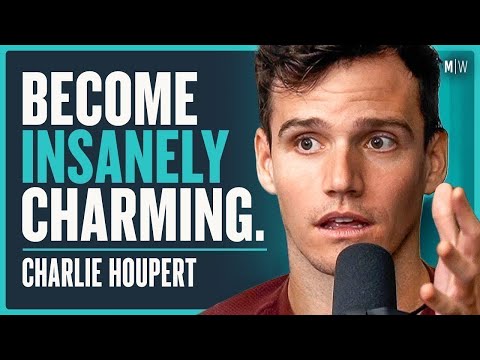
What Socially Confident People Do That You Don’t - Charlie Houpert
Charlie Houpert (guest), Chris Williamson (host)
In this episode of Modern Wisdom, featuring Charlie Houpert and Chris Williamson, What Socially Confident People Do That You Don’t - Charlie Houpert explores transforming Shyness Into Charisma, Confidence, and Deeper Human Connection Chris Williamson and Charlie Houpert (Charisma on Command) explore how charisma actually works, arguing it’s a trainable set of habits rather than a fixed personality trait. They break charisma into distinct styles (conviction, authenticity, humor, energy, empathy) and show how small behavioral tweaks massively improve social impressions because almost no one deliberately practices them.
Transforming Shyness Into Charisma, Confidence, and Deeper Human Connection
Chris Williamson and Charlie Houpert (Charisma on Command) explore how charisma actually works, arguing it’s a trainable set of habits rather than a fixed personality trait. They break charisma into distinct styles (conviction, authenticity, humor, energy, empathy) and show how small behavioral tweaks massively improve social impressions because almost no one deliberately practices them.
The conversation covers overcoming shyness, building conversational skills, flirting and dating dynamics, and the dangers of hustle culture, success addiction, and perpetual dissatisfaction. Charlie shares his own evolution from socially anxious introvert to charisma coach, and how later in life he’s shifting focus from external validation to inner fulfillment and spirituality.
They also examine how early conditioning, family dynamics, and unconscious drives shape our social behavior, culminating in Charlie’s powerful story of doing MDMA-assisted therapy with his entire family. Throughout, they emphasize progressive exposure, honest self-examination, and aligning social skills with one’s authentic values rather than becoming a social “performer.”
Key Takeaways
Charisma is a trainable skill, not a fixed personality trait.
Houpert defines charisma as personality- and character-based influence (excluding beauty and talent) and shows that because almost no one consciously trains it, small deliberate improvements can put you in the “elite tier” quickly.
Get the full analysis with uListen AI
You’re not “being yourself”; you’re acting out old conditioning.
Many people resist change as a ‘self-betrayal,’ but Houpert notes most of our current personality was shaped by adolescent traumas and successes, not conscious choice—meaning you can safely update it without losing your true core.
Get the full analysis with uListen AI
Use everyday questions as opportunities to lead the vibe.
Instead of killing conversations with literal, one-word answers (“I’m a consultant,” “From Philadelphia”), treat questions like “What do you do? ...
Get the full analysis with uListen AI
Overcoming shyness requires lowering your internal filter and practicing courage in small doses.
Shy people usually have thoughts but reject them as ‘not worth saying’; Houpert recommends progressive exposure—adding one extra sentence to low-stakes interactions, finishing sentences without trailing off, and gradually taking more conversational space.
Get the full analysis with uListen AI
Attraction comes from genuine standards and managed sexual tension, not just interest.
Houpert breaks flirting into three parts: being interesting enough to keep talking, signaling real (non-looks-based) standards so attention feels earned, and tolerating/building sexual tension instead of joking it away or rushing from zero to a doorstep kiss.
Get the full analysis with uListen AI
Hustle culture often masks inner emptiness and can erode happiness.
Both note that many hyper-driven, “grindset” high achievers are less happy; relentless work and goal-chasing frequently serve to avoid self-reflection, with each success merely resetting the baseline rather than delivering lasting fulfillment.
Get the full analysis with uListen AI
Lasting change often requires addressing unconscious patterns, not just external skills.
Houpert’s MDMA-assisted session with his family revealed deep role confusion (being a third parent instead of son/brother) and released a lifelong burden; he now sees psychedelics and inner work as crucial complements to outward charisma training.
Get the full analysis with uListen AI
Notable Quotes
“It’s like if you lived in a world where no one worked out. How quickly could you go to the gym before your body made you exceptional? That’s the world we live in with charisma.”
— Charlie Houpert
“The personality that you’re showcasing today is not intrinsic to who you are. It’s often the traumas and successes of 13‑year‑old you.”
— Charlie Houpert
“Self-esteem is your reputation with yourself.”
— Charlie Houpert (summarizing Nathaniel Branden)
“People need to understand how teleologically wired humans are… dissatisfaction is not a bug, it is a feature.”
— Chris Williamson
“I no longer can delude myself into believing that the more people that like me, enjoy my stories, laugh at my jokes, is going to improve my subjective experience of life at all.”
— Charlie Houpert
Questions Answered in This Episode
If most of my ‘personality’ is old conditioning, how do I discern which parts are my true essence versus patterns I should intentionally change?
Chris Williamson and Charlie Houpert (Charisma on Command) explore how charisma actually works, arguing it’s a trainable set of habits rather than a fixed personality trait. ...
Get the full analysis with uListen AI
What is one specific conversational habit I could implement this week that would most dramatically change how others experience me?
The conversation covers overcoming shyness, building conversational skills, flirting and dating dynamics, and the dangers of hustle culture, success addiction, and perpetual dissatisfaction. ...
Get the full analysis with uListen AI
How can I tell whether my ambition and self-improvement efforts are healthy growth versus a way of avoiding deeper emotional issues or emptiness?
They also examine how early conditioning, family dynamics, and unconscious drives shape our social behavior, culminating in Charlie’s powerful story of doing MDMA-assisted therapy with his entire family. ...
Get the full analysis with uListen AI
In my dating life, what do my actual standards signal about my self-worth, and how might clarifying them change who I attract and how I behave?
Get the full analysis with uListen AI
What unresolved family or childhood dynamics might still be silently shaping my social confidence and relationship patterns today—and how could I start addressing them?
Get the full analysis with uListen AI
Transcript Preview
It's- it's like if you lived in a world where no one worked out. How quickly could you go to the gym before your body made you exceptional? Like, it wouldn't take very long, and that's the world that we live in with regards to charisma, is nobody's working on it. So all you have (laughs) to do is- is this very small amount before people are gonna start to notice that you're in an elite tier. (whooshing sound)
Charlie Hooper in the building. How are you doing, man?
Excellent. In my own building on the other side of the ocean, but happy to be here nonetheless.
Yeah, man. Me too. Me too. What does a morning- what does a Charlie Hooper morning routine look like?
So there's no routine. I wake up, uh, around 11:00. I let my dog outside. (laughs) Sometimes he's gone inside, so I try to do that for him. Uh, and then I have some calls related to Charisma on Command, exercise around 1:32 PM, sauna. I have like a ba- barrel sauna in the backyard which is fucking awesome. Best- best, uh, four-figure purchase I've ever made in my life. I love that thing. And then in the evening I'll play League of Legends and scream at the computer with my friends.
(laughs)
It's the most toxic, it is the most toxic hobby, and that's the- the- definitely the one thing I don't recommend from my schedule for anyone else.
(laughs)
Do not pick up League of Legends if you've- if you've avoided it thus far.
Why?
So I am medium competitive in normal life, but League of Legends brings out my most vicious, cruel, whiny, complain-y, it's your fault side. And then I, uh-
This is fucking bullshit side.
I truly believe that there is something in the game, and of course something inside of me, but there is something in the structure of the game where one person can just destroy and melt down f- 15 to 30 minutes of hard work and me feeling like I'm better than the person I'm playing against, and I just fucking lose my mind every time I play.
(laughs)
But it's- it's the worst addiction that I have, uh, but I, like every addiction, I just derive some sense of satisfaction from it so I don't stop.
Yeah, yeah, yeah. I've just got back from doing a walk. This is my equivalent of getting mad at League of Legends things. Uh, I just got back from a walk and there is a running club that does a run on my- my walk route, and-
Yeah.
... sometimes the people that are running, they just get in my way. So that's like my equivalent, that I'm there on my walk, I'm moving slower-
(laughs)
... than them, but sometimes... Dude, I saw a woman. Have you ever s- This is definitely an LA thing. People that have a special sort of belt that they attach a dog lead to so that the dog can run with the person?
Install uListen to search the full transcript and get AI-powered insights
Get Full TranscriptGet more from every podcast
AI summaries, searchable transcripts, and fact-checking. Free forever.
Add to Chrome