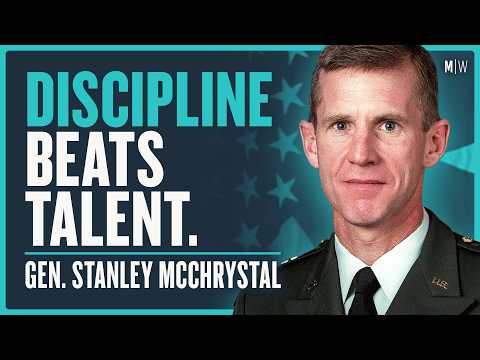
How To Actually Build Discipline - Gen. Stanley McChrystal
Chris Williamson (host), Gen. Stanley McChrystal (guest)
In this episode of Modern Wisdom, featuring Chris Williamson and Gen. Stanley McChrystal, How To Actually Build Discipline - Gen. Stanley McChrystal explores general McChrystal Reveals How True Discipline Builds Character And Leadership General Stanley McChrystal recounts nearly being expelled from West Point, using that experience to illustrate how discipline, character, and conviction develop over time rather than appearing fully formed. He and Chris Williamson explore why self-discipline and persistence are the real differentiators in elite military units, and how standards in small, high-discipline groups like the Rangers can reset an entire institution. They discuss the psychology of redemption stories, the loneliness and moral courage of command, and the tension between obsession, ambition, humility, and enjoying the journey. The conversation ultimately frames life as a long-term project of building convictions and the discipline to live by them, ideally within a team and community rather than as a solitary “lone wolf.”
General McChrystal Reveals How True Discipline Builds Character And Leadership
General Stanley McChrystal recounts nearly being expelled from West Point, using that experience to illustrate how discipline, character, and conviction develop over time rather than appearing fully formed. He and Chris Williamson explore why self-discipline and persistence are the real differentiators in elite military units, and how standards in small, high-discipline groups like the Rangers can reset an entire institution. They discuss the psychology of redemption stories, the loneliness and moral courage of command, and the tension between obsession, ambition, humility, and enjoying the journey. The conversation ultimately frames life as a long-term project of building convictions and the discipline to live by them, ideally within a team and community rather than as a solitary “lone wolf.”
Key Takeaways
Self-discipline is the primary predictor of sustained success.
McChrystal defines self-discipline as doing what you’ve decided you should do, especially when tired, angry, or impatient; he argues that most people know what good leadership or good living looks like, but few consistently act on it.
Get the full analysis with uListen AI
Persistence, not superhuman talent, is what elite selection really tests.
In units like Army Rangers or SEALs, most candidates quit rather than fail standards; the process is designed to identify who refuses to give up, because that trait shows up later under real pressure.
Get the full analysis with uListen AI
High, visible standards in a small group can lift an entire system.
Abrams’ decision to form Ranger battalions with extreme standards after Vietnam created a ‘gravitational pull’ that gradually raised haircuts, fitness, and discipline norms across the Army, amplified as ex-Rangers spread through the force.
Get the full analysis with uListen AI
We undervalue the power of team camaraderie in doing hard things.
Both men note that elite units and even personal training become far more sustainable and meaningful when shared with a committed group, and that the lone-wolf ideal often becomes toxic if clung to for too long.
Get the full analysis with uListen AI
Life is a character-building journey of convictions plus discipline.
McChrystal frames character as a ‘mathematical equation’: deeply examined convictions multiplied by the discipline to live up to them, arguing that most people borrow beliefs instead of pressure-testing what they truly stand for.
Get the full analysis with uListen AI
Moral courage is harder than physical courage and often lonely.
Decisions like forcing a team to remain in danger for mission success, or Shackleton and Stockdale’s leadership in desperate situations, illustrate that leaders must face brutal reality internally while projecting believable optimism outward.
Get the full analysis with uListen AI
Ambition and obsession can be virtues if bounded by values and humility.
They argue that great achievements usually require obsession and high personal ambition, but those drives must be balanced with self-awareness, humility, and relationships that ‘round you out’ so you don’t blindly climb the wrong ladder.
Get the full analysis with uListen AI
Notable Quotes
“If there are things that really matter, value ’em.”
— Gen. Stanley McChrystal
“Self-discipline is the ability to get yourself to do those things which you believe you should do and you decide to do.”
— Gen. Stanley McChrystal
“The only thing worse than being in the Rangers was not being in the Rangers.”
— Gen. Stanley McChrystal
“Life is a journey for character, towards character, because you are trying to find out exactly what you believe and you are trying to develop the discipline to live to that.”
— Gen. Stanley McChrystal
“Without being trite, it is the journey, not the destination.”
— Gen. Stanley McChrystal
Questions Answered in This Episode
How can someone who hasn’t had a ‘Ranger school’–style crucible practically build more persistence and self-discipline in everyday life?
General Stanley McChrystal recounts nearly being expelled from West Point, using that experience to illustrate how discipline, character, and conviction develop over time rather than appearing fully formed. ...
Get the full analysis with uListen AI
Where is the line between healthy obsession in pursuit of excellence and unhealthy fixation that blinds you to regret later?
Get the full analysis with uListen AI
What concrete steps can organizations take to create Ranger-like ‘gravitational pull’ standards without burning people out?
Get the full analysis with uListen AI
How should leaders decide which doubts and fears to share with their teams versus which to keep to themselves?
Get the full analysis with uListen AI
What process can an individual use to turn inherited beliefs into true ‘convictions’ they’ve pressure-tested for themselves?
Get the full analysis with uListen AI
Transcript Preview
I didn't know that you nearly got expelled from West Point.
I did. I, uh, I had two problems my first two years at West Point. The first was, I wasn't as academically prepared as some students and I didn't have good study habits, so I had a very low grade point average. But that wasn't really what threatened me. I had a discipline problem. So starting my first summer, I got what they call a slug, and that was for disrespect toward a cadet superior. Uh, they actually called it disapprobation. I had to look up, up the word. I didn't know what it meant. And I got that, and then a few months later, I got caught drinking. Well, I didn't get caught drinking, I got caught drunk. And so I got in significant trouble for that, and they put you on the area to walk punishment tours. You might've seen that, where you walk out on this per- it's a, a courtyard in the middle of the barracks, and you have your rifle and you walk back and forth for an hour at a time. And you are awarded those punishment tours in hours. So like, if you get convicted of an offense, you would get a certain number of demerits, a certain number of punishment tours, and then a certain number of months of special confinement. And that meant that when you weren't walking punishment tours or in class or something like that, you were in your room. You couldn't go out. It was like being in prison. So I got my first big one, I got a three-month, uh, slug. And then I got off on a Friday. I walked my last tours on a Friday in the fall. And, you know, you gotta celebrate. So I actually had a date with a young Italian girl from North, uh, from New Jersey, and she came up. And so on Saturday we went to the football game, my friend and I, and she and her friend. And so we go to the football game and that was great. And then the idea was they would go back to the Thayer Hotel where they had rooms, and they would change and get ready for the formal that night. It was gonna be a formal dance. So we went up to our room, theoretically to get ready, but we had more time than we needed, so we started drinking. And we started drinking 151-proof rum, mixing it with some cola out of the Coke machine. And sort of the last thing I remember is getting caught again.
(laughs)
Literally the night I was ... You know, the day I was just off my first one and I get a second one in. And I'm about to get thrown out for that 'cause I go into this commandant's board, where a colonel is the president of the board. And he was a, you know, obviously an older Vietnam veteran, real mature guy. And I thought they were gonna throw me out because based upon how much the punishment would be. It would either put me over demer- demerits and throw me out then or not. But when I walked in, he goes, "I don't get it." He says, "You just got off this other one, and now we're about to hit you with another big slug." And as soon as he said that, I knew I wasn't gonna get thrown out, because he just said, you know, "We're dismissing you." I knew I was gonna get under the wire. So it was another big slug. It was another 44 hours on the area, another two months of special confinement. And so it was pretty painful, but I didn't get thrown out, which was a positive.
Install uListen to search the full transcript and get AI-powered insights
Get Full TranscriptGet more from every podcast
AI summaries, searchable transcripts, and fact-checking. Free forever.
Add to Chrome