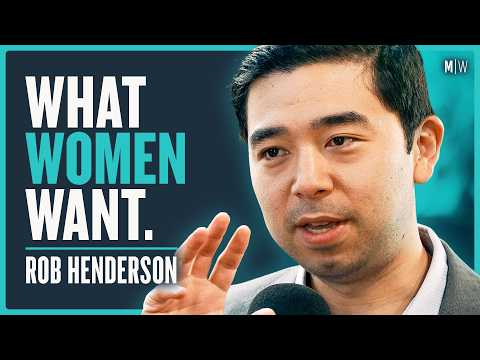
Why Women Say They Want One Thing But Date Another - Rob Henderson
Chris Williamson (host), Rob Henderson (guest), Chris Williamson (host)
In this episode of Modern Wisdom, featuring Chris Williamson and Rob Henderson, Why Women Say They Want One Thing But Date Another - Rob Henderson explores why Dating Disappoints: Politics, Sex Ratios, and Relationship Red Flags Chris Williamson and Rob Henderson explore the gap between what women say they want in partners and the men they actually date, tying it to traits like masculinity, status, and political alignment. They dissect phenomena such as “wokefishing,” sneaky sexual strategies, and online outrage toward figures like Harry Sisson and Leonardo DiCaprio through an evolutionary psychology lens.
Why Dating Disappoints: Politics, Sex Ratios, and Relationship Red Flags
Chris Williamson and Rob Henderson explore the gap between what women say they want in partners and the men they actually date, tying it to traits like masculinity, status, and political alignment. They dissect phenomena such as “wokefishing,” sneaky sexual strategies, and online outrage toward figures like Harry Sisson and Leonardo DiCaprio through an evolutionary psychology lens.
The conversation then critiques the Netflix series *Adolescence* as a misrepresentative, politicized portrayal of incel radicalization and male violence, contrasting it with data on real-world male behavior, incels, and the surprising absence of widespread incel violence. Finally, they pivot to evidence-based guidance on choosing romantic partners: assortative mating, personality traits, red and green flags, and why timing, authenticity, and emotional regulation matter more than looks alone.
A recurring theme is how cultural narratives, media, and political priors distort our understanding of mating markets, male struggle, and relationship dynamics—often to the detriment of both men and women.
Key Takeaways
Women’s stated political preferences often conflict with the traits they find attractive.
Traits strongly associated with conservative men—higher self-rated masculinity, income, status, confidence, social dominance orientation—are also traits many women (including progressive women) reliably find attractive, creating a gap between expressed political ideals and actual dating choices.
Get the full analysis with uListen AI
Wokefishing and “sneaky” strategies emerge when political signaling becomes a mating tool.
Some men, especially on the right, present themselves as highly progressive, feminist, or emotionally soft to lower perceived threat and increase appeal to left-leaning women; this camouflage works well enough that it’s become a recurring pattern (e. ...
Get the full analysis with uListen AI
Outrage toward promiscuous high-status men is itself evolutionarily functional.
High-status men dating much younger women (e. ...
Get the full analysis with uListen AI
*Adolescence* dramatizes a rare, atypical scenario yet is being treated as documentary truth.
The show centers on a non-representative white working-class boy allegedly radicalized by incel/manosphere content into stabbing a girl, despite data showing different demographic patterns for knife crime and Tate fandom, and very low actual rates of incel violence relative to the number of frustrated young men.
Get the full analysis with uListen AI
Media and politics often frame male failure as personal defect and female impact as the true problem.
Henderson notes a pattern where male underperformance (education, income, mental health) is treated as men’s fault, while the narrative emphasis falls on how women suffer from a shortage of eligible men, reinforcing stereotypes that historically “dominant” groups deserve blame, not help.
Get the full analysis with uListen AI
Similarity matters, but key traits like conscientiousness, low neuroticism, and authenticity matter more.
Couples tend to be modestly similar in politics, education, and personality, but what predicts long-term satisfaction is less about perfect similarity and more about partners being kind, emotionally stable, conscientious, and honest—traits that also boost each other’s career and life outcomes.
Get the full analysis with uListen AI
How partners handle low points is a stronger predictor of success than how good the highs feel.
Emotional regulation, clear communication, curiosity about each other’s feelings, and avoiding “guessing games,” character attacks, and silent treatment are crucial; experts recommend watching how someone behaves under stress (e. ...
Get the full analysis with uListen AI
Notable Quotes
“Most women would rather share John F. Kennedy than have Bobo the Clown all to themselves.”
— Rob Henderson (quoting Steven Pinker)
“This isn’t a bug in the system. This is the system.”
— Rob Henderson
“Where are all of the incel stabbings?”
— Chris Williamson
“Do not mistake side quests for the main story.”
— Chris Williamson (summarizing an argument from Rob Henderson’s writing)
“For most people, living a conventional life is actually your best shot at happiness.”
— Rob Henderson (paraphrasing Jordan Peterson’s view)
Questions Answered in This Episode
If women reliably prefer traits clustered on the political right, how should we interpret claims about wanting progressive men?
Chris Williamson and Rob Henderson explore the gap between what women say they want in partners and the men they actually date, tying it to traits like masculinity, status, and political alignment. ...
Get the full analysis with uListen AI
To what extent should deceptive political signaling in dating (wokefishing) be considered unethical versus adaptive?
The conversation then critiques the Netflix series *Adolescence* as a misrepresentative, politicized portrayal of incel radicalization and male violence, contrasting it with data on real-world male behavior, incels, and the surprising absence of widespread incel violence. ...
Get the full analysis with uListen AI
Are media portrayals like *Adolescence* likely to increase support for online censorship, and what are the risks of that?
A recurring theme is how cultural narratives, media, and political priors distort our understanding of mating markets, male struggle, and relationship dynamics—often to the detriment of both men and women.
Get the full analysis with uListen AI
How can individuals distinguish between a “high-value” partner they can realistically retain and one who will constantly trade up?
Get the full analysis with uListen AI
What practical steps can young people take to avoid over-investing in ‘side quests’ (career, lifestyle) at the expense of building a strong relationship and family life?
Get the full analysis with uListen AI
Transcript Preview
"Left-wing women are learning to love right-wing men. Political division has become a sexual fetish. Today, in online political fandoms, people behind enemy lines are often seen as potential sexual conquests. Right-wing men want a liberal art ho, whereas some leftist women," (laughs) "lust after the right-wing anon. It's hard to pin down discourse like this sometimes, but this trend is also substantiated in studies about the dating patterns of progressive women." What do you think about that?
Yeah. I, uh, you know, I, I wonder about these sort of media trends, these headlines, um, because often the reason why they get, uh, so much interest is because they're sort of at odds with our intuitions, right? And I know you've, you've spoken w- with plenty of people about this idea of assortative mating. We tend to be attracted to people who are somewhat similar to ourselves, so then when you have this flashy headline, you know, "Right-wing men want the left-wing art ho. The left-wing art hos want the Republican MAGA bro," or something, you know, it's, it's a little edgy. It's a little... Catches us off guard. But I think there's, you know, to, to the extent that it might be true, you know, if, if you think about what are the qualities that women find attractive in men, sort of self-sufficiency, ambition, income, uh, you know, you... All, all the kinds of qualities that, that are associated with sort of an, a masculine guy. Um, and then you look at sort of the voting patterns of men, and you find that the predictors of, of voting for the conservative parties are, a- also tend to be the traits that women tend to find attractive. So if you look at, um, uh, self-identified, uh, if you ask men, you know, "How, how masculine do you feel?" versus "How feminine do you feel?" The higher men rate themselves as masculine, the more likely they are to support a conservative political candidate, uh, and the more, uh... Or the less masculine they feel, th- the more likely they are to su- support a left-wing candidate.
Mm-hmm.
And then, um, and you can ask other questions about, uh, income. There was a really funny study a few years ago, um, in the UK about height, that, uh, there's a sort of a small but significant correlation between height and voting for conservative political parties.
(laughs)
Uh, I don't know if that would hold up today. This was, like, 2016, 2017, that period.
Yeah.
But, uh, you know, and, and then there's, like, interesting work around, um, attitudes around, like, social dominance orientation and, you know, men who are sort of, uh, uh, sure of themselves, confident, go out into the world, achieve something. They also tend to like things like low taxes, and they tend to like things like, you know, a strong military, police. All those kinds of things kind of cluster together. And so it would make sense, I think, that women, regardless of political orientation, even if they explicitly, when you ask them about politics, they're gonna say, "I don't like this or that party," but then they start to list out the qualities that they enjoy, you know, those just tend to cluster more on the right side of the political spectrum.
Install uListen to search the full transcript and get AI-powered insights
Get Full TranscriptGet more from every podcast
AI summaries, searchable transcripts, and fact-checking. Free forever.
Add to Chrome