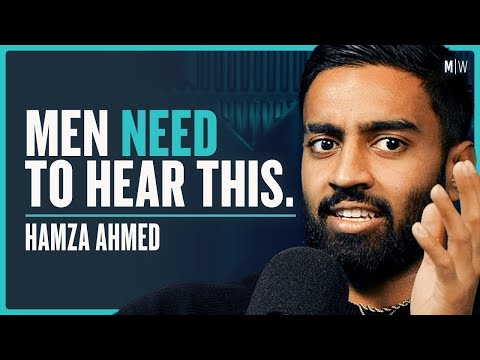
The Unspoken Pain Most Men Carry In Silence - Hamza Ahmed
Chris Williamson (host), Hamza Ahmed (guest), Narrator
In this episode of Modern Wisdom, featuring Chris Williamson and Hamza Ahmed, The Unspoken Pain Most Men Carry In Silence - Hamza Ahmed explores monk Mode’s Hidden Traps, Male Emotions, and Authentic Masculinity Online Chris Williamson and Hamza Ahmed unpack the unintended downsides of “monk mode,” arguing that hyper‑individual self‑improvement can stunt social skills, emotional integration, and real‑world growth. They contrast retreating into disciplined routines with deliberately re‑engaging in messy, social, and romantic experiences that create genuine transformation.
Monk Mode’s Hidden Traps, Male Emotions, and Authentic Masculinity Online
Chris Williamson and Hamza Ahmed unpack the unintended downsides of “monk mode,” arguing that hyper‑individual self‑improvement can stunt social skills, emotional integration, and real‑world growth. They contrast retreating into disciplined routines with deliberately re‑engaging in messy, social, and romantic experiences that create genuine transformation.
A major arc explores how young men relate to emotions and relationships: whether vulnerability is weak or powerful, how to communicate needs in partnerships, and why repression and over‑expression are both problematic. They also dive into red‑pill culture, casual sex, looks‑obsession, and why many former pickup figures eventually seek monogamy and therapy.
Later, the conversation turns inward to Hamza’s own audience capture, online persona, and early fame, with Chris challenging him to question his convictions, define success beyond money and status, and pursue a more authentic, uncertain public identity. They close by discussing aging, family, gratitude, and how to deliberately practice clear, precise communication.
Key Takeaways
Monk mode without social exposure creates ‘self‑improvement autists.’
Extended isolation to optimize routines (gym, meditation, diet) can stunt social development, producing men who are disciplined but awkward, unable to hold eye contact, read body language, or navigate real‑world interactions.
Get the full analysis with uListen AI
Real growth requires reintegration into messy social and romantic life.
Books, routines, and controlled environments produce linear gains, but nights out, conflicts, relationships, and breakups create non‑linear ‘black swan’ lessons about pressure, jealousy, and emotional regulation you cannot learn at a desk.
Get the full analysis with uListen AI
Healthy masculinity honors feelings without being ruled by them.
Men don’t need to suppress emotions or overshare them; the skill is noticing anger, fear, or jealousy, expressing it non‑violently and constructively (to a partner or in a gym, breathwork, etc. ...
Get the full analysis with uListen AI
Vulnerability in relationships is a compatibility filter, not weakness.
Openly saying, “This situation makes me uncomfortable” from a grounded place helps couples co‑regulate and expose incompatibilities early; partners who get the ‘ick’ from honest emotion are probably not a good long‑term fit.
Get the full analysis with uListen AI
Self‑stories often mask insecurity by turning weakness into virtue.
Concepts like monk mode, ‘women aren’t worth it,’ or “money/beautiful women don’t matter” can become inner citadels—philosophies built after failure or fear that reframe avoidance and resentment as moral superiority.
Get the full analysis with uListen AI
Looksmaxxing reflects deeper anxiety about status and desirability.
Teen boys obsessing over ‘cute’ TikTok aesthetics, hair and selfies show how dating apps and social media push male body dysmorphia; for older women, more traditionally masculine, ‘caveman’ traits and character often matter more.
Get the full analysis with uListen AI
Creators must guard against audience capture and false certainty.
Hamza’s viral, high‑dopamine, hyper‑confident persona brought success but left him unsure who he really is; Chris urges him to treat advice as experiments, question his own stories, and close the gap between public certainty and private doubt.
Get the full analysis with uListen AI
Notable Quotes
“Self‑improvement can become this recursive cycle where you never actually bother to reintegrate, and you go, ‘I’ve just created myself a new prison I feel a bit more comfortable in.’”
— Chris Williamson
“People retreat into their inner citadels all the time: if you can’t get what you want, you teach yourself to want what you can get.”
— Chris Williamson
“You don’t want to be bottling that up till it either comes out in a bad way or just in the monk mode way where it’s only on the heavy bag.”
— Hamza Ahmed
“You will never connect with the things that you do or the successes that you have, because they’re not real. The persona you made did those things.”
— Chris Williamson
“I feel like I don’t really even know who I am… even the way I sit or I walk has been crafted for the image.”
— Hamza Ahmed
Questions Answered in This Episode
How do you personally balance structured ‘monk mode’ time with deliberate reintegration into chaotic, social, and romantic experiences?
Chris Williamson and Hamza Ahmed unpack the unintended downsides of “monk mode,” arguing that hyper‑individual self‑improvement can stunt social skills, emotional integration, and real‑world growth. ...
Get the full analysis with uListen AI
Where in your life might you be building an ‘inner citadel’—reframing avoidance or failure as a moral stance instead of confronting fear?
A major arc explores how young men relate to emotions and relationships: whether vulnerability is weak or powerful, how to communicate needs in partnerships, and why repression and over‑expression are both problematic. ...
Get the full analysis with uListen AI
What does a healthy expression of anger or jealousy look like for you, and how would you communicate that to a partner without becoming needy or explosive?
Later, the conversation turns inward to Hamza’s own audience capture, online persona, and early fame, with Chris challenging him to question his convictions, define success beyond money and status, and pursue a more authentic, uncertain public identity. ...
Get the full analysis with uListen AI
If money, followers, and appearance were removed from the equation, how would you redefine success and what would you actually spend your days doing?
Get the full analysis with uListen AI
In what ways might your online persona or self‑image be pulling you away from who you really are, and what experiments could you run to move closer to authenticity?
Get the full analysis with uListen AI
Transcript Preview
Talk to me about the dangers of monk mode that you've discovered.
Mm. So monk mode is an intensive period of self-improvement that loads of young guys have been on recently. It's where basically you'll cut off everyone, even you will start spending less time with your family, your friends, and you'll go hard on self-improvement, going to the gym, meditating, eating clean, journaling. You can grow a lot during that time, but the danger is that then self-improvements becomes detached from social skills, and then you become what I call a self-improvement autist, which is these guys who are, you know, doing the Huberman morning sunlight routine, and they're meditating 15 minutes a day, and they're doing the zone two cardio, but they're just fucking weird. They don't know how to interact with other people, they can't hold eye contact, they can't h- shake a hand, they've got weird body language when they're stood next to people. And I- I've realized how many guys I had actually led to that point because I had been doing those intensive monk mode periods myself, but the caveat was that I had already been like a party boy, and I had those years of social experiences first, whereas many young men have never actually had an intensive social experience like university, college before. So these days, I don't actually recommend monk mode to most young guys, because I think that being able to navigate your relationships with other people, family, friends, being able to be in the middle of like a social event, party, date, whatever, and actually navigate that in a way where you're present and charming is so important. So I recommend something which I- I created instead, which is what I call the Adonis Protocol, which is kinda like monk mode, but we add in at least one social event per week, and if you want to as well, one date with a woman as well.
Yeah. I think, uh, monk mode is a very good excuse for people that are introverted to feel-
Mm.
... noble in their introversion.
Mm.
And it turns something which is like an aversion to going out into the world, an aversion to making friends or putting yourself in uncomfortable social situations, it turns that from something which is a flaw to something which is a virtue, and you begin to get prestige for actually not doing that thing.
Mm-hmm.
And so many people... Uh, there's this idea called The Inner Citadel by Isiah Berlin, and it basically t- says that if you can't get what you want, you must teach yourself to want what you can get.
Mm-hmm.
Um, so, you injure your leg in battle, and if you try and fix it, when it doesn't work, you chop the leg off and announce that the desire for legs is misguided and-
Mm-hmm.
... must be subdued. So, so many people reverse engineer a life that puts them on a pedestal, the same thing as... How many people that are polyamorous here in Austin, uh, that have tried to make a, um, a monogamous relationship work a couple of times, got their hearts broken, and then gone, "Oh, well, this is because we're not designed to be that way." So people retreat into their inner citadels all the time, and, uh, I think monk mode in- in many ways is that. And you're right. The goal of monk mode is to be better as a human, so the retreat from distraction, from social life, or... And I've done... I did 1,000 days sober, 500 days without caffeine, 1,500 sessions of meditate... Like, I did the things, right? Very, very intensively. But that was with the goal of then reintegrating.
Install uListen to search the full transcript and get AI-powered insights
Get Full TranscriptGet more from every podcast
AI summaries, searchable transcripts, and fact-checking. Free forever.
Add to Chrome