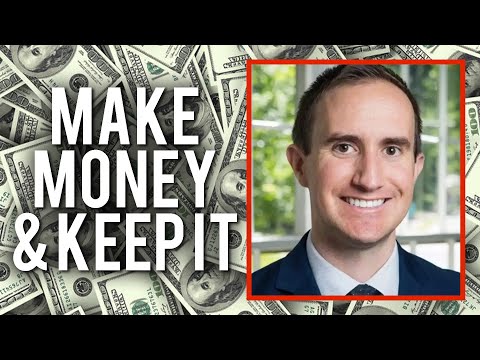
Morgan Housel | How To Become Wealthy, Stay Wealthy & Be Happy | Modern Wisdom Podcast 222
Chris Williamson (host), Morgan Housel (guest), Narrator
In this episode of Modern Wisdom, featuring Chris Williamson and Morgan Housel, Morgan Housel | How To Become Wealthy, Stay Wealthy & Be Happy | Modern Wisdom Podcast 222 explores morgan Housel Reveals Simple, Behavioral Rules For Sustainable Lifetime Wealth Morgan Housel argues that successful personal finance is driven far more by behavior and psychology than by technical knowledge or credentials. He emphasizes two core rules—live below your means and be patient—as making up “90% of finance,” and frames money primarily as a tool for freedom and control over your time, not for buying status symbols.
Morgan Housel Reveals Simple, Behavioral Rules For Sustainable Lifetime Wealth
Morgan Housel argues that successful personal finance is driven far more by behavior and psychology than by technical knowledge or credentials. He emphasizes two core rules—live below your means and be patient—as making up “90% of finance,” and frames money primarily as a tool for freedom and control over your time, not for buying status symbols.
The conversation explores how luck and risk are essentially the same force viewed from opposite sides, why getting rich and staying rich require different, often conflicting mindsets, and how long time horizons and compounding underpin extraordinary fortunes like Warren Buffett’s.
Housel also stresses the importance of setting a personal 'enough' point, resisting moving goalposts, and aligning investment strategy with one’s psychology rather than chasing complex tactics or market-beating returns. The episode closes with reflections on speculation, market manias like Tesla, behavioral pitfalls on platforms like Robinhood, and broader themes of uncertainty in politics and life.
Key Takeaways
Live below your means and be patient; that’s most of finance.
Wealth comes from the gap between income and spending plus time, not from high earnings alone. ...
Get the full analysis with uListen AI
Treat money as a tool for independence, not just consumption.
The highest return on money is the ability to control your calendar—doing what you want, when you want, with whom you want. ...
Get the full analysis with uListen AI
Recognize luck and risk as twin forces shaping outcomes.
Both are events outside your control that disproportionately affect results, but we only talk about 'risk' when things go badly and rarely admit 'luck' when they go well. ...
Get the full analysis with uListen AI
Getting rich and staying rich require different, conflicting skills.
Building wealth often demands optimism and risk-taking, while preserving it requires paranoia, diversification, and ample cash buffers. ...
Get the full analysis with uListen AI
Time and consistency matter more than brilliance in investing.
Buffett’s extraordinary net worth is largely explained by starting to invest at 11 and continuing into his 90s; the same return over a normal 25–65 career would have produced a tiny fraction of his wealth. ...
Get the full analysis with uListen AI
Set a clear 'enough' and stop moving the goalposts.
Happiness with money is the gap between what you have and what you expect. ...
Get the full analysis with uListen AI
Choose an investing strategy that fits your psychology, not your ego.
Index funds and simple, low-maintenance portfolios may underwhelm thrill-seekers but give most people the best odds of long-term success because they’re easier to stick with. ...
Get the full analysis with uListen AI
Notable Quotes
“Live below your means and be patient. That’s 90% of finance.”
— Morgan Housel
“I have no desire to get rich. I just always wanted a glorious independence.”
— Charlie Munger (quoted by Morgan Housel)
“The most important financial skill is getting the goalpost to stop moving.”
— Morgan Housel
“If you risk something that is important to you in order to gain something that is unimportant to you, that is foolish.”
— Warren Buffett (quoted by Morgan Housel)
“Personal finance is more personal than it is finance.”
— Morgan Housel
Questions Answered in This Episode
How can I practically define and enforce my own 'enough' so that my lifestyle doesn’t expand with every income increase?
Morgan Housel argues that successful personal finance is driven far more by behavior and psychology than by technical knowledge or credentials. ...
Get the full analysis with uListen AI
What specific behaviors or habits undermine my ability to be patient with investments and stick to a long-term plan?
The conversation explores how luck and risk are essentially the same force viewed from opposite sides, why getting rich and staying rich require different, often conflicting mindsets, and how long time horizons and compounding underpin extraordinary fortunes like Warren Buffett’s.
Get the full analysis with uListen AI
In my past financial successes and failures, where did luck and risk actually play a bigger role than my skill or judgment?
Housel also stresses the importance of setting a personal 'enough' point, resisting moving goalposts, and aligning investment strategy with one’s psychology rather than chasing complex tactics or market-beating returns. ...
Get the full analysis with uListen AI
Given my temperament and tolerance for stress, what investing style would I realistically be able to maintain for 30–50 years?
Get the full analysis with uListen AI
How much of my current pursuit of money is really about freedom of time, and how much is driven by status and comparison to others?
Get the full analysis with uListen AI
Transcript Preview
If you were to write a golden rule of becoming wealthy, what do you think it would be?
Live below your means and be patient. That's it. That's 90% of finance. That is 90% of finance.
(laughs)
That's not even, that's not even like the simplified version. If you can actually do that, you have a, you have a PhD in finance.
(laughs)
That's, that's 90% of finance.
If the people of the internet want to watch me and you mud wrestle for money-
(laughs)
... there is a, there is a pay-per-view audience out there.
There's a, there's, I, I, I have a price for everything.
(laughs)
There's a price.
There's a price on everyone's head. Oh, come on. Let's get started. So this is the third time on the show this year. So to everyone on the internet who is wondering, things are getting pretty serious between me and Morgan now. Welcome back, mate.
Thanks for having me. I'm happy to be here. I always enjoy our conversations, so I'm happy to come back for a third and hopefully more times after this. We'll see if I don't screw it up here for the third time, and hopefully there'll be a fourth, uh, forthcoming later this year.
That's the plan, man. That's the plan. So before we get started, you got a new book out, Psychology of Money. Why should anyone listen to you on finances? What are your credentials?
Well, here's, here's the thing about money. I don't think that credentials necessarily move the needle. That's not true in a lot of fields. If I wrote a book about medicine or aerospace engineering or dentistry, you should not listen to anything that I have to say. Finance though is very different because finance, what matters in finance is not necessarily what you know. It's not about how smart you are or the education that you have or the, the sophistication, the credentials that you have. Doing well with finances, whether it's investing or personal finances, is overwhelmingly, overwhelmingly has to do with how you behave. It has to do with just your relationship with greed and fear, how you think about long-term thinking and your, you know, who you trust, how gullible you are. Those kind of soft topics that is not necessarily what you know. It doesn't matter if you went to Harvard and you worked at Goldman Sachs. If you lose your head during March of 2020 or in 2008, none of that stuff matters anymore. So what's important about investing, I'll give you my credentials. I have been a full-time investing analyst and writer for 13 years. I've been researching and focusing on kind of the intersection of investing history and behavioral finance. The history of how we think about money, what we can learn from those lessons and how we can think about finances in a more productive way. That's what I've done, and this book is kind of a culmination of the 20 most important things that I learned during that period. I try to wrap it in with a bunch of stories that have nothing to do with investing, but they all have a, a really important takeaway about how we can think about risk with our money in a more coherent way.
Install uListen to search the full transcript and get AI-powered insights
Get Full TranscriptGet more from every podcast
AI summaries, searchable transcripts, and fact-checking. Free forever.
Add to Chrome