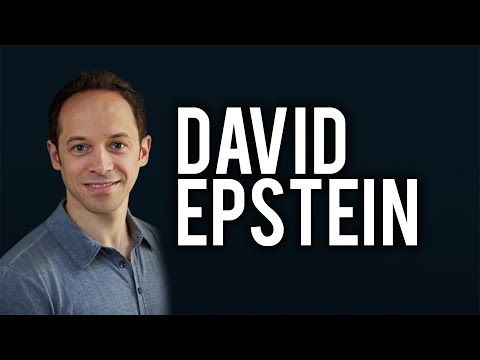
Specialisation Is For Insects | David Epstein
David Epstein (guest), Chris Williamson (host), Narrator
In this episode of Modern Wisdom, featuring David Epstein and Chris Williamson, Specialisation Is For Insects | David Epstein explores why Generalists Win: David Epstein Challenges Early Specialization Dogma David Epstein discusses his book *Range*, arguing that cultivating breadth of skills and experiences often outperforms early, narrow specialization, especially in complex, changing environments.
Why Generalists Win: David Epstein Challenges Early Specialization Dogma
David Epstein discusses his book *Range*, arguing that cultivating breadth of skills and experiences often outperforms early, narrow specialization, especially in complex, changing environments.
He contrasts icons like Tiger Woods and Roger Federer, shows how most elite performers follow a Federer-like sampling path, and extends this logic from sports into careers, science, technology, and medicine.
Epstein introduces ideas like kind vs. wicked learning environments, match quality, polymath inventors, and outside problem-solving platforms to show how cross-domain thinking fuels innovation.
He emphasizes that society needs both “frogs” (specialists) and “birds” (generalists), but that current systems over-push specialization, leaving a lot of human potential and creativity untapped.
Key Takeaways
Early specialization is overrated in most fields; sampling first is powerful.
Outside of a few ‘kind’ domains like chess and golf, elite performers more often follow a Federer-style path: they sample many activities, build broad skills, and specialize later, which leads to better long-term development and fit.
Get the full analysis with uListen AI
Aim for match quality by iterating, not by sticking to a rigid plan.
We discover who we are by doing, not by thinking alone; small experiments, side projects, and career zigzags help you find work that fits your abilities and interests, which then accelerates growth and motivation.
Get the full analysis with uListen AI
Breadth plus depth beats depth alone in complex, changing problems.
Research on inventors and scientists shows that ‘polymaths’—people grounded in one area who expand into adjacent fields—produce more impactful innovations, especially where the next steps are unclear or the domain is rapidly evolving.
Get the full analysis with uListen AI
Leverage outside perspectives to solve hard problems.
Platforms like Innocentive and Kaggle demonstrate that outsiders from entirely different domains can crack problems experts are stuck on, because they bring different mental models and are not bound by the field’s standard assumptions.
Get the full analysis with uListen AI
Over-specialization can create blind spots and even harm.
In medicine, highly specialized surgeons perform procedures very well—but also keep doing many that evidence shows are unnecessary or ineffective, illustrating how ‘when all you have is a hammer, everything looks like a nail.’
Get the full analysis with uListen AI
Structured experimentation beats vague dabbling.
Using ‘experiments’—time-bound, goal-defined trials like taking a class or trying a new role—lets you test interests and skills without blowing up your life, and then reflect deliberately on whether to double down or move on.
Get the full analysis with uListen AI
You can maintain (and even grow) openness by trying new things.
Openness to experience tends to decline with age, but studies show you can slow or reverse this by deliberately engaging in new activities, which keeps you more creative, adaptable, and able to connect ideas across domains.
Get the full analysis with uListen AI
Notable Quotes
“We learn who we are in practice, not in theory.”
— David Epstein (quoting Herminia Ibarra)
“We need frogs and birds… The problem is we’re telling everybody to become frogs.”
— Freeman Dyson (as recounted by David Epstein)
“He said, ‘I’ve conflated two ideas… that you need a lot of practice to become good, with the idea that in order to become good at X, you should do only X starting as early as possible. One of those is true and the other is not.’”
— Malcolm Gladwell (as quoted by David Epstein)
“Difficulty in trying some new thing isn’t a sign that you aren’t learning, but ease is.”
— David Epstein
“When evidence says no and doctors say yes.”
— David Epstein (describing his article on medical over-treatment)
Questions Answered in This Episode
How can an individual practically balance gaining breadth with developing enough depth to avoid becoming a dilettante?
David Epstein discusses his book *Range*, arguing that cultivating breadth of skills and experiences often outperforms early, narrow specialization, especially in complex, changing environments.
Get the full analysis with uListen AI
In your own career, what concrete signs should you look for that it’s time to ‘zigzag’ into a new role or domain?
He contrasts icons like Tiger Woods and Roger Federer, shows how most elite performers follow a Federer-like sampling path, and extends this logic from sports into careers, science, technology, and medicine.
Get the full analysis with uListen AI
How can organizations redesign hiring and promotion to better value polymathic paths instead of linear specialization?
Epstein introduces ideas like kind vs. ...
Get the full analysis with uListen AI
Where is early, intense specialization still the clearly superior strategy, and how can people tell if they’re in one of those ‘kind’ domains?
He emphasizes that society needs both “frogs” (specialists) and “birds” (generalists), but that current systems over-push specialization, leaving a lot of human potential and creativity untapped.
Get the full analysis with uListen AI
What are some low-risk, high-learning experiments someone could run in the next 6–12 months to improve their match quality in work or life?
Get the full analysis with uListen AI
Transcript Preview
Yeah, it's really interesting, and that's not to- that is absolutely not to say that specialists aren't important, right? Absolutely not. In fact, I like to highlight the NPR, you know, our public radio did a review of Range, and they- they say that I spend a lot of time giving credit to dissenters, which- which I like because not even dissenters, like I agree we need specialists also. I- I like the way that- that the physicist and mathematician Freeman Dyson, uh, and- and great writer, uh, framed it. He said, "We need frogs and birds. Frogs are down in the mud looking at all the little details. Birds are up above, they can't see those details, but they can integrate the information of frogs." And he said, "The problem is we're telling everybody to become frogs." And- and when the- when, you know, when disciplines and science changes that- that becomes a big problem. And that's sort of how I- I think of it. And so- so I think you need... Like, these problems that stumped the people at Lilly, obviously they were solving a lot of problems on their own, they were posting the ones that they got stuck. So, I think with the combination of that, of the indocentive approach and those specialists, that's where you get the best of both worlds, and you have this healthy problem-solving ecosystem.
I am joined by David Epstein all the way from the opposite side of the Atlantic, and we're talking about Range today. How are you, David?
I'm well. Thanks for having me.
You're, uh, all over the place at the moment, right? You're a busy guy.
Yes. Uh, uh, quite honestly, I'm getting sick a little bit of my own voice. (laughs)
Oh. (laughs) Yeah, yeah. Well, I, uh, thankfully for the listeners, I don't think that they will be. So, we're gonna, uh-
(laughs)
... we're gonna dig into your new book today, Range, right? Talking about generalists and specialists.
Yeah, absolutely.
Why, uh, why did you write the book, first off?
Y- you know, it- it sort of- it sort of came- the genesis of it came in sort of two parts, one of which was, uh, I wrote a book before this called The Sports Gene, um, about genetics and athleticism. And I, as- well, as Malcolm Gladwell would say, I devoted several pages to criticizing his work. That's how he puts it, to basically criticizing the science underlying the 10,000 hour rule. And so we got invited to this conference here called the MIT Sloan Sports Analytics Conference. It's founded by the general manager of the Houston Rockets. Um, and we were invited there to debate, 10,000 hours versus The Sports Gene. And it- so it's on YouTube, you can see it.
Oh, wow.
And he's- he's very clever and I didn't want to get embarrassed (laughs) . So- so I did my homework, tried to anticipate what he would argue, you know, and thinking, all right, well, he's got to argue for early specialization. It's- it's kind of implicit in some of the things he's written. Um, and so I went and looked at- at science of athletic development and saw that, in fact, in most sports and in most places of the world, athletes who go on to become elite have a so-called sampling period where they play a variety of sports, they gain these broad general skills, they, uh, learn about their interests and abilities, and they actually delay specializing until later than peers who plateau at lower levels. And I sort of brought that up in the debate and he said, "Ah, you know what you-" later, "You know what you kind of got me on was that thing. You should- you should write more about that." And I sort of filed it away in the back of my head, um, and didn't think about it much more for, you know, more than a year. And then I was doing some work with a foundation here in the- I was giving a talk to some military veterans who'd been given scholarships by this foundation called the Pat Tillman Foundation to aid them in new career trajectories, and I talked a little bit about late specialization in sports. And since they weren't athletes, I sort of tacked on a little bit of research about the work world. And they were so enthusiastic about it because they were all career changing and they'd been told they were behind and all these things, um, that it was like, you know, they just wanted more and more and more, and they all wanted to follow up and keep in touch. And I sort of said, these people have had these incredible experiences, you know, some of them are former Navy SEALs and all this kind of stuff, and they're being told like that they're behind, you know, instead of how they can wield those experiences. And so I sort of thought, all right, there's- there's something worth doing here.
Install uListen to search the full transcript and get AI-powered insights
Get Full TranscriptGet more from every podcast
AI summaries, searchable transcripts, and fact-checking. Free forever.
Add to Chrome