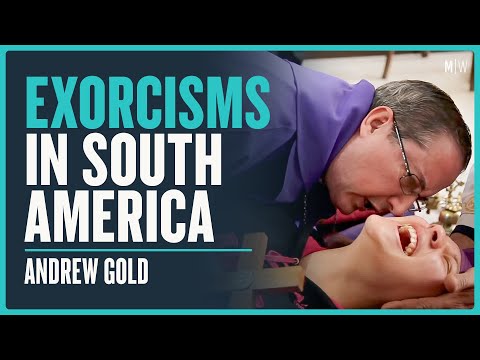
Exorcisms, Rockstar Priests & Dangerous Taboos - Andrew Gold | Modern Wisdom Podcast 355
Andrew Gold (guest), Chris Williamson (host)
In this episode of Modern Wisdom, featuring Andrew Gold and Chris Williamson, Exorcisms, Rockstar Priests & Dangerous Taboos - Andrew Gold | Modern Wisdom Podcast 355 explores inside Exorcisms, Pedophiles, and Media Taboos with Andrew Gold Andrew Gold, a documentary journalist and podcaster, recounts his career documenting fringe subcultures, from South American exorcists and abortion activists to pedophiles in German treatment programs and Amazon warehouse workers.
Inside Exorcisms, Pedophiles, and Media Taboos with Andrew Gold
Andrew Gold, a documentary journalist and podcaster, recounts his career documenting fringe subcultures, from South American exorcists and abortion activists to pedophiles in German treatment programs and Amazon warehouse workers.
He describes a harrowing confrontation with a celebrity exorcist in Argentina, the ethical and psychological complexities of exorcisms, and how belief and placebo can temporarily relieve genuine mental health conditions.
Gold also details systemic issues in UK broadcasting—especially diversity-driven casting and risk aversion—that have blocked his progress despite a successful BBC film, arguing that on-screen diversity has become a performative substitute for deeper structural change.
The conversation closes with his ongoing investigation into non-offending pedophiles, the moral minefield around prevention, stigma, and treatment, and why society must talk about such taboos to reduce real-world harm.
Key Takeaways
Sensational religious practices often mask untreated mental illness.
Gold’s Argentine exorcist was ‘treating’ women with schizophrenia and eating disorders by performing dramatic exorcisms, highlighting how lack of education and medical access allows charismatic figures to hijack faith and exploit vulnerable people.
Get the full analysis with uListen AI
Belief and context can produce powerful, but fragile, placebo effects.
Exorcisms and historical cases (e. ...
Get the full analysis with uListen AI
UK broadcasters’ diversity strategies can be performative and distort meritocratic commissioning.
Gold repeatedly heard that his stories would be commissioned only if fronted by a minority presenter, regardless of his language skills and years of research, suggesting a focus on visible on-screen diversity rather than structural change or journalistic ownership.
Get the full analysis with uListen AI
Industrial giants like Amazon can thrive in regulatory blind spots.
The undercover Amazon account describes intense physical strain, punitive point systems, and underpayment in a supposedly well-regulated country, raising questions about enforcement priorities and political incentives to confront major employers.
Get the full analysis with uListen AI
Non-offending pedophiles present a prevention dilemma society cannot ignore.
Clinics in Germany promise confidentiality to attract pedophiles into treatment, betting that therapy and destigmatization reduce offending, but this clashes with public instinct for punishment and zero tolerance, making policy design extremely contentious.
Get the full analysis with uListen AI
Stigmatization can increase, not decrease, the risk of offending.
Gold reports clinicians’ view that branding pedophiles as irredeemable ‘monsters’ can push some into fatalism and underground communities, whereas framing them as responsible but treatable individuals encourages them to seek help and avoid contact with children.
Get the full analysis with uListen AI
Investigative work into taboos demands emotional resilience and ethical clarity.
From breaking down after first meeting a pedophile at a public pool to navigating whether to platform such voices, Gold’s experiences show how emotionally taxing and morally complex deep-dive reporting into society’s darkest corners can be.
Get the full analysis with uListen AI
Notable Quotes
““He had posters of himself superimposed on The Exorcist and other superhero movies around the church. This was a guy who really liked the attention.””
— Andrew Gold
““The last 10 minutes are pretty insane… We realized my microphone had been recording the entire time he was screaming at us backstage.””
— Andrew Gold
““Every single meeting they’d say, ‘We love the ideas, but we just need someone from a minority ethnic background to be the onscreen presence, and you behind the camera.’””
— Andrew Gold
““One percent of men are thought to be exclusive pedophiles… That’s more men in most countries than you have people in the army.””
— Andrew Gold
““If you say to someone enough, ‘You are evil, you are a monster,’ they just sort of give up and go, ‘Well, okay, I’m a monster then.’””
— Andrew Gold
Questions Answered in This Episode
How should societies balance public safety with confidentiality when offering therapy to non-offending pedophiles?
Andrew Gold, a documentary journalist and podcaster, recounts his career documenting fringe subcultures, from South American exorcists and abortion activists to pedophiles in German treatment programs and Amazon warehouse workers.
Get the full analysis with uListen AI
Are current diversity and representation policies in media helping or hindering the production of risky, important investigative journalism?
He describes a harrowing confrontation with a celebrity exorcist in Argentina, the ethical and psychological complexities of exorcisms, and how belief and placebo can temporarily relieve genuine mental health conditions.
Get the full analysis with uListen AI
What ethical line should documentarians draw between observing harmful practices (like exorcisms) and intervening in real time?
Gold also details systemic issues in UK broadcasting—especially diversity-driven casting and risk aversion—that have blocked his progress despite a successful BBC film, arguing that on-screen diversity has become a performative substitute for deeper structural change.
Get the full analysis with uListen AI
Could robust, destigmatized prevention programs for pedophiles meaningfully reduce child abuse rates, and what trade-offs would the public need to accept?
The conversation closes with his ongoing investigation into non-offending pedophiles, the moral minefield around prevention, stigma, and treatment, and why society must talk about such taboos to reduce real-world harm.
Get the full analysis with uListen AI
In an age of information overload and ‘luxury suffering,’ how can individuals better discern which social issues genuinely deserve their attention and outrage?
Get the full analysis with uListen AI
Transcript Preview
... where there are still thousands and thousands of these people all on the floor, screaming, crazy, and his voice I can hear booming through a microphone. He's now come out. They've lost their minds, and he's going, "The devil is in this church today, and he's trying to leave now." And we're going, "Oh my God, oh my God, they're all gonna kill us."
Andrew Gold, welcome to the show.
Thanks. Thanks for having me.
How would you describe what you do for work?
I am (sighs) ... so the quick way of describing it, I would say, is like a, a, a, a much less famous and less talented Louis Theroux. Uh, for those who don't know who Louis Theroux is, or, or Lewis Theroux in America, uh, I like to document sort of weird and wonderful people and subcultures, quite strange, controversial people, nothing, uh, is too controversial, everything's on the table, uh, and trying to get to know why people think differently from, from why I do and from why we do, whether that's in video form, audio form or, or writing.
Didn't you manage the Page 3 girls for The Sun at one point?
That is the best thing I've ever done, yes. That was when I started out, so I was like 21 or 22. Who got... I got in trouble for that recently, didn't I? Somebody was tweeting at s- (laughs) Oh yeah, somebody reviewed my podcast recently. They said, "I've really enjoyed the first tw- ten episodes. Then I heard he worked at The Sun. Not for me." And he'd just completely quit.
(laughs)
And I thought, "How can you enjoy, you know, hours of stuff?" And then he found out I worked at a place he didn't li- obviously he was from Liverpool, and they've got a bit of a thing with The Sun. Um, (laughs) yeah, so it was my first job in journalism, um, and it w- I was working nights and, you know, the stuff I was writing was just so tedious and it was all like, "Rihanna poses without makeup," and I didn't even know who any of these people were. I knew who Rihanna was. And my- I was responsible at the end of the night for making sure the Page 3 girl, who, for those who don't know, that's the- they don't do it anymore, it was a woman on Page 3 of The Sun newspaper who had her breasts out. Um, and I had to make sure the 3D version of her went up on the iPad every night, which was, which was complicated because I had to- I was having these calls at 4:00 or 5:00 in the morning with, like, uh, customer support or whoever it is off- or somewhere in South Asia-
Titty support.
Uh, (laughs) titty support and I was just going like, "Look, the- it's not working and I can't go home for a bit."
Install uListen to search the full transcript and get AI-powered insights
Get Full TranscriptGet more from every podcast
AI summaries, searchable transcripts, and fact-checking. Free forever.
Add to Chrome