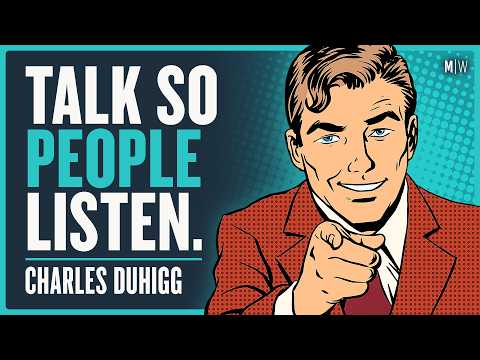
The Invisible Rules Of Social Success You Were Never Taught - Charles Duhigg
Chris Williamson (host), Charles Duhigg (guest), Narrator
In this episode of Modern Wisdom, featuring Chris Williamson and Charles Duhigg, The Invisible Rules Of Social Success You Were Never Taught - Charles Duhigg explores mastering Hidden Communication Skills To Become A Super Communicator Charles Duhigg explains that great communication is not an innate talent but a learnable set of skills that anyone can practice and master. He introduces the concept of “super communicators” who consistently connect deeply with others by asking better questions, proving they’re listening, using real vulnerability, and matching the type of conversation someone is in. Drawing on neuroscience and social science, he describes how aligned conversations literally synchronize people’s brains and improve understanding, trust, and likability. The discussion spans introverts vs. extroverts, small talk, online discourse, romantic conflict, and why our evolving technologies force us to learn new communication habits.
Mastering Hidden Communication Skills To Become A Super Communicator
Charles Duhigg explains that great communication is not an innate talent but a learnable set of skills that anyone can practice and master. He introduces the concept of “super communicators” who consistently connect deeply with others by asking better questions, proving they’re listening, using real vulnerability, and matching the type of conversation someone is in. Drawing on neuroscience and social science, he describes how aligned conversations literally synchronize people’s brains and improve understanding, trust, and likability. The discussion spans introverts vs. extroverts, small talk, online discourse, romantic conflict, and why our evolving technologies force us to learn new communication habits.
Key Takeaways
Treat communication as a skill you can deliberately practice.
Excellent communicators usually became that way by studying and practicing how people talk and connect, not by relying on natural charm; seeing communication as trainable makes improvement possible instead of threatening your “true self.”
Get the full analysis with uListen AI
Identify and match the type of conversation: practical, emotional, or social.
Miscommunication often happens when one person is in an emotional mode and the other responds practically, or when social status/relationship issues are mixed into logistical talks; consciously diagnosing and matching the other person’s mode lets you actually be heard.
Get the full analysis with uListen AI
Ask more and deeper questions that invite people’s stories and values.
Super communicators ask 10–20 times more questions, especially ‘deep’ ones about experiences, beliefs, and feelings (e. ...
Get the full analysis with uListen AI
Prove you’re listening using ‘looping for understanding.’
Effective listening isn’t silence; it’s asking a question, then restating what you heard in your own words and asking if you got it right, which calms the suspicion that you’re just waiting to talk and dramatically increases mutual openness.
Get the full analysis with uListen AI
Use authentic, reciprocal vulnerability to build trust quickly.
Sharing something that could be judged—and then not being judged, or having the other person share something equally vulnerable—triggers evolved neural responses that increase liking and trust, whereas humblebrags or faux vulnerability are detected and discounted.
Get the full analysis with uListen AI
Avoid ‘kitchen sinking’ in conflict; control the situation together, not each other.
Healthy couples (and online discussants) resist turning one disagreement into a fight about everything; instead they co‑manage boundaries (topic, timing, environment), which puts them on the same team and prevents toxic escalation.
Get the full analysis with uListen AI
Leverage curiosity to escape small talk and improve online and offline conversations.
Starting from genuine curiosity (e. ...
Get the full analysis with uListen AI
Notable Quotes
“The thing about communication is, it's just a set of skills… Anyone can become a super communicator.”
— Charles Duhigg
“If two people are having different kinds of conversations at the same time, they literally can't hear each other.”
— Charles Duhigg
“Super communicators ask a lot more questions, and they ask deep questions… Instead of asking about the facts of someone's life, they ask how they feel about their life.”
— Charles Duhigg
“When I tell you something that you could judge, it creates a sense of vulnerability in me… Our brains literally have evolved to use vulnerability as a signal as to whether we should trust other people.”
— Charles Duhigg
“The best couples, it's not that they don't fight. It's that they fight and there's no lasting consequences.”
— Charles Duhigg
Questions Answered in This Episode
How can I quickly recognize whether someone is in a practical, emotional, or social conversation mode in real time?
Charles Duhigg explains that great communication is not an innate talent but a learnable set of skills that anyone can practice and master. ...
Get the full analysis with uListen AI
What are some concrete deep questions I could safely use with colleagues or acquaintances without seeming intrusive?
Get the full analysis with uListen AI
How do I practice authentic vulnerability if I’m naturally guarded or worried about being judged or exploited?
Get the full analysis with uListen AI
In my closest relationship, where do we tend to ‘kitchen sink’ arguments, and how could we start co‑controlling the boundaries instead?
Get the full analysis with uListen AI
What small experiments could I run online—such as adding ‘please,’ ‘thank you,’ or looping for understanding—to see if they measurably change the tone of discussions?
Get the full analysis with uListen AI
Transcript Preview
What do most people get wrong when it comes to understanding communication, do you think?
I think what most people get wrong is they think that it's something that should just happen naturally, right? That it's something that, that, that the best communicators are people who don't think about communication. But what we've discovered is exactly the opposite. I- if, if you know someone who is just fantastic at connecting with people, at communicating, and you go up and you ask them, you know, "Have you always been like this?" Inevitably, what they are gonna tell you is no. They'll say something like, "When I was in high school, I had real trouble making friends, and so I really had to, like, study how kids talk to each other," or, or, "My, my parents got divorced when I was a kid, and I had to be the peacemaker between them." The thing about communication is, it's just a set of skills. It's not even particularly complicated skills. It's a set of skills that anyone can learn. Anyone can become a super communicator. But you have to realize that they're skills, and you have to practice them a little bit. And, and you have to commit to thinking about how you communicate to get better at it.
I suppose communication is quite tightly tied to our sense of self. You know, it's the-
Yeah.
... it's our expression of who we are. So when we look at somebody that's a good or a bad communicator, that's because they're a good or a bad person. What was... their sense of self-worth comes through as well.
Absolutely. I mean, th- that happens a lot. And, and of course, um, you can be a bad person and be a great communicator (laughs) . You can be a good person and not be a great communicator. Um, but you're exactly right that, like, communication is very central to not only how we think about ourselves, but, but how we move through the world. And, and what's interesting is, if you think about it, communication is so ... Communication is Homo sapiens' superpower, right? It is the thing that has allowed us to, to be... you know, do better than every other species, to build families, and villages, and towns, to pass knowledge from, from one generation to the next generation. And so our brains have evolved to be pretty good at communication. Like, like, we have all of the stuff in our head to be fantastic at it. And as a result, because it's so important to who we are as a species, you're right, we tend to judge people, like their moral worth, on whether they're a good communicator or not. And, and that, that can be a little bit dangerous, but it also means that if you want to connect with someone and you're someone who's an introvert, you're someone who has trouble connecting, it's really just a matter of learning how... learning these skills about how communication works, and you can form that bond.
Install uListen to search the full transcript and get AI-powered insights
Get Full TranscriptGet more from every podcast
AI summaries, searchable transcripts, and fact-checking. Free forever.
Add to Chrome