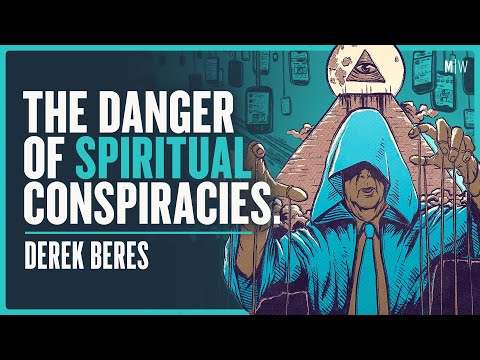
Conspiracy Theories In New Age Cults - Derek Beres
Derek Beres (guest), Chris Williamson (host)
In this episode of Modern Wisdom, featuring Derek Beres and Chris Williamson, Conspiracy Theories In New Age Cults - Derek Beres explores how New Age Wellness Became A Gateway To Conspiracy Cults Chris Williamson and Derek Beres explore “conspirituality,” the fusion of New Age spirituality and conspiracy thinking, particularly within yoga and wellness communities. Beres explains how social isolation, weak offline networks, and privileged, politically disengaged wellness cultures made these communities vulnerable during COVID and beyond. They examine how platforms like Instagram and TikTok, influencer grift, and in‑group/out‑group tribalism fuel radicalization, anti-vaccine rhetoric, and even QAnon penetration into yoga circles. The conversation also covers media trust, deplatforming, cult dynamics, and the difficulty of maintaining nuance and humility in an attention-driven online ecosystem.
How New Age Wellness Became A Gateway To Conspiracy Cults
Chris Williamson and Derek Beres explore “conspirituality,” the fusion of New Age spirituality and conspiracy thinking, particularly within yoga and wellness communities. Beres explains how social isolation, weak offline networks, and privileged, politically disengaged wellness cultures made these communities vulnerable during COVID and beyond. They examine how platforms like Instagram and TikTok, influencer grift, and in‑group/out‑group tribalism fuel radicalization, anti-vaccine rhetoric, and even QAnon penetration into yoga circles. The conversation also covers media trust, deplatforming, cult dynamics, and the difficulty of maintaining nuance and humility in an attention-driven online ecosystem.
Key Takeaways
Weak real-world social networks increase susceptibility to conspiracies.
People who lack strong offline communities or diverse friend groups are less likely to have their ideas challenged, making them more vulnerable to online indoctrination and echo chambers.
Get the full analysis with uListen AI
New Age wellness rhetoric primed communities for anti-establishment conspiracies.
Longstanding messages like “you are your own doctor” and “your brain is your pharmacy” foster distrust of public health, making anti-vaccine and anti-mask narratives feel consistent rather than radical.
Get the full analysis with uListen AI
Conspiracies offer seductive in-group identity and “secret” knowledge.
The promise of inside information and spiritual superiority creates a powerful sense of belonging and status, which can outweigh factual corrections or evidence to the contrary.
Get the full analysis with uListen AI
Feelings often trump facts in spiritual-conspiracy spaces.
Beliefs like terrain theory or “meditate for world peace” persist not because they are empirically supported but because they feel empowering, optimistic, or spiritually flattering to adherents.
Get the full analysis with uListen AI
Influencers thrive by selling certainty, purity, and products.
Conspirituality leaders typically monetize attention through supplements, courses, or memberships, projecting omniscience and bodily “purity” while rarely showing genuine doubt or correcting errors.
Get the full analysis with uListen AI
Nuanced disagreement and public correction are rare but crucial.
Beres argues for admitting mistakes, platforming critics, and bringing in domain experts, contrasting this with conspirituality figures who only engage allies and frame any critique as attack or disloyalty.
Get the full analysis with uListen AI
Deplatforming reduces broad reach but doesn’t erase hardcore influence.
When banned, influencers often retain tight-knit followings on Telegram or similar channels; they lose mainstream discoverability but can still radicalize committed in-groups.
Get the full analysis with uListen AI
Notable Quotes
“In this world that we cover, feelings will trump facts or science or research at any moment.”
— Derek Beres
“If this thing makes me feel good, then I'm going to trust that. And that's how cult leaders have gotten people to leave their families and come into their groups.”
— Derek Beres
“War only happens when you're divided internally. It's such nonsense. What does that mean?”
— Derek Beres (paraphrasing and critiquing influencer rhetoric)
“What everybody is always looking to do… is bound together by mutual distaste of an out-group more than mutual love of an in-group.”
— Chris Williamson
“As soon as you label it a cult… history shows that power dynamics always come into play at some point.”
— Derek Beres
Questions Answered in This Episode
How can individuals in wellness or spiritual circles critically assess whether their communities are drifting into conspiratorial or cult-like territory?
Chris Williamson and Derek Beres explore “conspirituality,” the fusion of New Age spirituality and conspiracy thinking, particularly within yoga and wellness communities. ...
Get the full analysis with uListen AI
What practical steps can someone take if a close friend or family member has become deeply involved in conspirituality narratives?
Get the full analysis with uListen AI
Where is the line between healthy skepticism of institutions and a slide into corrosive, all-encompassing distrust that conspiracies exploit?
Get the full analysis with uListen AI
How might emerging technologies like VR and AR amplify or change the tactics of future cults and conspirituality influencers?
Get the full analysis with uListen AI
What responsibilities should large media and tech platforms have in balancing free expression with limiting harmful conspiratorial content, especially when influencers use them as funnels to less-regulated spaces?
Get the full analysis with uListen AI
Transcript Preview
In this world that we cover, feelings will trump facts or science or research at any moment. If this thing makes me feel good, then I'm going to trust that. And that's how cult leaders have gotten people to leave their families and come into their groups, because they feel something that they weren't getting elsewhere. (wind blowing)
Derek Beres, welcome to the show.
Thanks, Chris. Appreciate you, uh, reaching out and having me on.
So, I got all happy and proud of myself, uh, over the last couple of years or so, because I'd noticed a mechanism occurring where, um, spiritual yoga moms, far left spiritual yoga moms and sort of right wing trolls appeared to be horseshoeing some of their worldviews, um, to, uh, coalesce online. And I was all sort of pleased with myself that I'd unearthed this kind of interesting dynamic that I thought was going on. And then it turns out that this is quite a well-known, um, dynamic that has been going on, a mechanism that's been occurring for quite a while, which has a term, conspirituality, which describes the overlap of conspiracy theories with spirituality, typically of new age varieties. Contemporary conspirituality became common in the 1990s, apparently.
Yes. I actually wouldn't say it was that well known. Uh, even today, I tracked the term on Twitter, and there are constantly people who are just discovering the term, so I wouldn't feel bad (laughs) about-
Thank you.
... having stepped into this world in such a manner. Uh, it was academically coined in 2011, uh, by Charlotte Ward and David Voas, but it really n- didn't get a lot of traction as a paper until the very... Just before the pandemic began actually, a philosopher from the UK named Jules Evans wrote a Medium article where he unearthed that term, and that's how I found out about it. And then I wrote a subsequent article for a publication I used to work for called Big Think, and that eventually led to the podcast of that name. So, i- it's really, it, it, and it, we can look back in reflection and trace it back to the '60s. We can tr- uh, trace it back, honestly, to the beginning of the 19th century with Emeson- Emerson and Thoreau's work, but i- it really still is a new concept that I think a lot of people are trying to wrap their heads around, although I think the precursors, you know, i- in hindsight, everything makes sense and you can trace them back from there.
Yeah. Well, I think one of the interesting things in 2022 especially is that calling something a conspiracy theory seems to be, uh, quite problematic now. So, after a few decades of using it to refer to sort of all manner of crimes, whether it's rumors or misinformation or disinformation or general fuckery by the government or corporate media that ends up being proven as true or not being proven as true, it's kind of memed and legitimated the term into a particularly weird place. And it's, it's almost a little bit useless now, as far as I can see.
Install uListen to search the full transcript and get AI-powered insights
Get Full TranscriptGet more from every podcast
AI summaries, searchable transcripts, and fact-checking. Free forever.
Add to Chrome