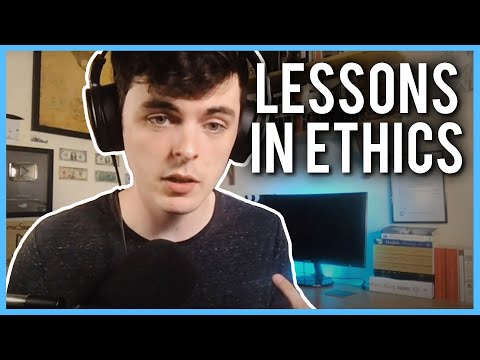
How Do We Define What Is Good & Bad? | Cosmic Skeptic | Modern Wisdom Podcast 214
Alex O'Connor (guest), Chris Williamson (host), Narrator, Narrator, Narrator, Narrator, Narrator
In this episode of Modern Wisdom, featuring Alex O'Connor and Chris Williamson, How Do We Define What Is Good & Bad? | Cosmic Skeptic | Modern Wisdom Podcast 214 explores philosopher Alex O’Connor Dissects How We Define Good And Bad Chris Williamson and Alex “Cosmic Skeptic” O’Connor explore how we define morality, moving from everyday ethical intuitions into deep metaethics. They distinguish practical ethics (what is good) from metaethics (what good is), and examine whether morality is objective or merely based on preferences.
Philosopher Alex O’Connor Dissects How We Define Good And Bad
Chris Williamson and Alex “Cosmic Skeptic” O’Connor explore how we define morality, moving from everyday ethical intuitions into deep metaethics. They distinguish practical ethics (what is good) from metaethics (what good is), and examine whether morality is objective or merely based on preferences.
O’Connor walks through major ethical frameworks—consequentialism/utilitarianism, deontology, and virtue ethics—stress‑testing each with classic and original thought experiments (trolley problems, the rash doctor, doing vs allowing harm, free will and responsibility).
They also discuss real‑world implications: veganism, effective altruism, prostitution law, charity, and personal hypocrisy between what we believe and how we act. The conversation argues that serious ethical reflection should ultimately change our behavior, not just entertain us.
Key Takeaways
Clarify whether you’re arguing about ‘what is good’ or ‘what good is’.
Practical ethics asks if specific actions (e. ...
Get the full analysis with uListen AI
Test any moral theory with extreme, clear thought experiments.
Philosophers often use reductio ad absurdum—showing that a theory implies intuitively horrific conclusions (e. ...
Get the full analysis with uListen AI
Separate the criterion of moral goodness from your decision procedure.
Utilitarianism might say ‘good = maximizing wellbeing’ (criterion) but recommend acting on what probably maximizes wellbeing, or what rules would maximize wellbeing if generally followed (decision procedure).
Get the full analysis with uListen AI
Interrogate intuitive differences between ‘doing’ and ‘allowing’ harm.
Cases like the ambulance-and-boulder or unplugging life support show how murky this distinction is, challenging the assumption that allowing harm is always morally lighter than causing harm.
Get the full analysis with uListen AI
Recognize that inaction can be as morally loaded as action.
Peter Singer’s drowning-child analogy suggests that refusing to give modest sums to effective charities is morally akin to walking past a child you could easily save, undermining our comfort with everyday omissions.
Get the full analysis with uListen AI
Accept that moral reflection should lead to lifestyle changes.
O’Connor argues that if you conclude something is wrong—factory farming, needless animal suffering, neglecting cheap life-saving aid—integrity requires bringing your actions (diet, donations) into line with that belief.
Get the full analysis with uListen AI
Be wary of appealing only to ‘common preferences’ like avoiding pain.
Simply noting that most people dislike suffering doesn’t ground objective morality; a robust moral view must explain why suffering is wrong even if some people perversely prefer others’ pain.
Get the full analysis with uListen AI
Notable Quotes
“Practical ethics answers the question of what is good, whereas metaethics answers the question of what good is.”
— Alex O’Connor
“You can be playing chess with someone who’s using the rules of rugby.”
— Alex O’Connor
“If you become ethically convinced that it’s wrong to kill animals, then stop killing animals.”
— Alex O’Connor
“For the man who does not cheat, what he determines to be true must determine his actions.”
— Alex O’Connor (quoting Albert Camus)
“Why bother doing any of this investigation if you’re not going to allow it to inform your action?”
— Alex O’Connor
Questions Answered in This Episode
If morality is not grounded in God or a supernatural authority, what kind of foundation—if any—can make moral truths genuinely objective?
Chris Williamson and Alex “Cosmic Skeptic” O’Connor explore how we define morality, moving from everyday ethical intuitions into deep metaethics. ...
Get the full analysis with uListen AI
How much day‑to‑day sacrifice (diet, money, convenience) are we really obligated to make once we accept arguments like Singer’s drowning-child analogy?
O’Connor walks through major ethical frameworks—consequentialism/utilitarianism, deontology, and virtue ethics—stress‑testing each with classic and original thought experiments (trolley problems, the rash doctor, doing vs allowing harm, free will and responsibility).
Get the full analysis with uListen AI
Is there a coherent way to preserve our strong intuition that pushing the ‘fat man’ is wrong while still endorsing some form of consequentialism?
They also discuss real‑world implications: veganism, effective altruism, prostitution law, charity, and personal hypocrisy between what we believe and how we act. ...
Get the full analysis with uListen AI
Can we truly hold people morally responsible if free will is an illusion, or must we radically rethink blame, punishment, and praise?
Get the full analysis with uListen AI
At what point does the practical difficulty or social cost of an ethical change (e.g., going vegan, pledging income to charity) legitimately excuse us, if ever?
Get the full analysis with uListen AI
Transcript Preview
Well, there's a difference between doing and allowing. There's a difference between allowing a bad thing to happen and being the cause of a bad thing to happen, but it gets even more complicated than that because, like, you've got to decide, like, how are you defining the difference between doing and allowing, like, what, what really is the difference there? For example, if I walk up to somebody who is attached to a life support machine and I unplug them, have I killed them or have I allowed them to die?
(laughs) Alex bloody O'Connor, how are you?
Chris, I am, I'm well. All the better for seeing you, as, as they say. Uh, it's been, it's been too, it's been too long. I haven't seen you in person since we went to that event in London, and I can't think how long ago that was now-
February.
... where you made me do the yoga that you seem to be telling everyone and their dog about and-
(laughs)
... uh, that photo of me, that photo of me that you keep posting is like, you know the one of Beyoncé that she wanted to disappear from the internet?
(laughs)
That's my version of that, is me trying to work out how to put my leg under the thing. Yeah, it, it was a nightmare. Um, but yeah, it's, it's a shame. It's good to be speaking to you again, even if it's a, a public conversation.
Yeah, I know, man. It is, uh, that was one hell of a weekend.
Mm-hmm.
One, one, one hell of a weekend. I've got, I've got the full-length one-hour yoga form recording both of us doing it side by side, and I'm considering offering it out to the highest bidder.
(laughs)
I'm pretty certain there's some people on the internet, some fairly sort of prominent, uh, debaters of yours that would pay good money for that kind of ammunition.
Yeah. Yeah. I, I, I, I do worry about some of the ammunition that my friends have on me and the people they could sell it to. I, I think maybe I could release it as a Patreon exclusive or something. That might be a good... Or you could release it as a Patreon exclusive. That, that's an even better idea.
And then steal all your patrons.
There you go. Yeah. (laughs)
(laughs)
Yeah, they'll, they'll jump over to you then. Yeah, I don't know. Um, we'll see. But, you know, I haven't even seen that video, so God knows what other-
Awesome.
... weird shapes I try to morph my body into.
It, it was graceful. It was, it was your first time, you know. No one's good at the first time.
No one's g- (laughs)
No, no one's good the first time.
Yeah, no one's good at the first time, as they say. Um, hmm. Well...
Install uListen to search the full transcript and get AI-powered insights
Get Full TranscriptGet more from every podcast
AI summaries, searchable transcripts, and fact-checking. Free forever.
Add to Chrome