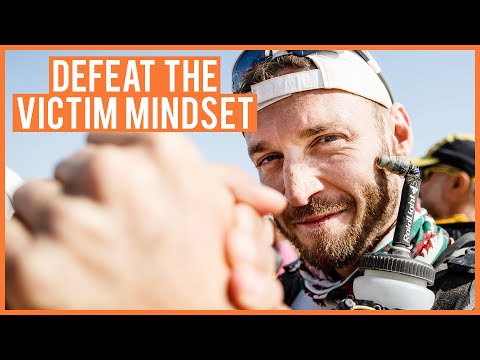
You Are Not A Victim - Tom Otton | Modern Wisdom Podcast 252
Tom Otton (guest), Chris Williamson (host)
In this episode of Modern Wisdom, featuring Tom Otton and Chris Williamson, You Are Not A Victim - Tom Otton | Modern Wisdom Podcast 252 explores ultra Endurance, Ownership, And Building A People-First Life And Business Tom Otton explains how ultra-endurance racing transformed his mindset from fragile and complaining to resilient, responsible and purpose-driven. He argues that everyone, even elite performers, experiences the same negative self-talk; the difference is how you respond, and whether you accept victimhood or take responsibility. Tom connects lessons from 250km desert ultras and a 42-hour mountain race to how he leads a fast-growing agency, structures his life around shifting priorities, and avoids a victim mindset. Central throughout is his commitment to people—at work, at home, and in his own head—as the real ‘Mars mission’ that guides his decisions.
Ultra Endurance, Ownership, And Building A People-First Life And Business
Tom Otton explains how ultra-endurance racing transformed his mindset from fragile and complaining to resilient, responsible and purpose-driven. He argues that everyone, even elite performers, experiences the same negative self-talk; the difference is how you respond, and whether you accept victimhood or take responsibility. Tom connects lessons from 250km desert ultras and a 42-hour mountain race to how he leads a fast-growing agency, structures his life around shifting priorities, and avoids a victim mindset. Central throughout is his commitment to people—at work, at home, and in his own head—as the real ‘Mars mission’ that guides his decisions.
Key Takeaways
Everyone has the same negative self-talk; the differentiator is response, not absence.
Tom stresses that even ultra-endurance athletes and figures like David Goggins experience the same internal ‘quit’ narrative you hear on a 10K. ...
Get the full analysis with uListen AI
Have a clear ‘why’ and mix internal and external motivation.
Before big races, Tom sets behavioral goals (e. ...
Get the full analysis with uListen AI
Drop the victim mindset: it’s rarely your fault, but always your responsibility.
In business, relationships, and crises like 2020, Tom distinguishes fault from responsibility. ...
Get the full analysis with uListen AI
Use ‘third-party perspective’ and identity-based rules to act like the person you want to be.
When facing hard leadership decisions, Tom imagines what the ideal leader in a book would do, designs that blueprint, then steps into it. ...
Get the full analysis with uListen AI
Plan life around shifting, intense focus blocks: micro-imbalance for macro-balance.
Rather than chasing static ‘work–life balance’, Tom cycles heavy focus: sometimes it’s ultras, sometimes a new office, sometimes marriage. ...
Get the full analysis with uListen AI
Curate your inner circle and formalize reflection, like a personal ‘AGM.’
Tom endorses auditing who you spend time with and even running structured check-ins with friends (monthly problem-solving sessions or an annual ‘life AGM’). ...
Get the full analysis with uListen AI
Build a people-first culture and ruthlessly protect it from ‘bad apples.’
At his agency, Tom prioritizes people over profit in concrete ways (no COVID pay cuts, mental health support, Deliveroo lunches, emergency plane tickets), while being uncompromising about culture: high performers who are toxic are removed quickly, because one negative person drags whole teams down.
Get the full analysis with uListen AI
Notable Quotes
“Everybody experiences that negative self-talk. It doesn't matter who you are. Whether you're David Goggins… it's the same narrative.”
— Tom Otton
“It's not your fault that the world is melting down, but it is your responsibility to do something about it.”
— Tom Otton
“You can't be half in on everything, because that just results in average.”
— Tom Otton
“If you have a clear goal, then everything else becomes so much more simple. Every decision either takes you closer to it or further away.”
— Tom Otton
“People want to feel safe. If they feel safe coming to work, then they can really bring themselves to work as humans.”
— Tom Otton
Questions Answered in This Episode
How can someone who feels stuck in a victim mindset practically start shifting toward responsibility without feeling overwhelmed or blamed?
Tom Otton explains how ultra-endurance racing transformed his mindset from fragile and complaining to resilient, responsible and purpose-driven. ...
Get the full analysis with uListen AI
What specific ‘Jedi mind tricks’ or mental scripts does Tom use in the darkest points of a race that listeners could adapt for everyday struggles?
Get the full analysis with uListen AI
How do you decide which area of life deserves your next period of ‘micro-imbalance’ without damaging other important domains like health or relationships?
Get the full analysis with uListen AI
For people without a strong support network, what are realistic first steps to building the kind of growth-focused ‘board’ or AGM Tom and Chris describe?
Get the full analysis with uListen AI
Where is the line between a people-first culture and enabling burnout, and how does a leader know when to sacrifice short-term profit to protect their team?
Get the full analysis with uListen AI
Transcript Preview
Everybody experiences that negative self-talk. It doesn't matter who you are, whether you're David Goggins. This is where a lot of people get it wrong. A lot of people think, "That person, whoever it might be, is ... must be made of something else because there's no way that they have the same narrative internally as I, as I do." And it's the same narrative. Sometime I'm on a, a 10 or 15K run and sometimes you just feel like (censored) and you want to stop. It's exactly the same narrative. I know this is hard to understand, but it's exactly the same narrative-
(laughs)
... as when you're there at, at, at, at 120 kilometers into a race. It's, "I want to stop. These are the reasons why. That all makes sense. It's okay." All of these things. So all of that will happen. And, and, you know, the listeners can experience that on a 10K run or, or it could be 120K, but it's just the same narrative. I'm a completely different person than what I was when I started the whole ultra conversation. I'm completely different human, I look at things differently, I, I approach things differently, I value things differently.
Interesting.
Like everything, everything changed.
Well, that's a good place to start.
Yeah.
So what has changed? You have done multiple ultra events. What like, and what's, what's the impact been on you?
In terms of races, um, the first, uh, the first b- the first big one for me actually went re- really badly. Um, so myself and Marcus flew across to Wales and we did a 80 kilometer, uh, run across the Brecon Beacons. First time I'd done anything like that. Um, it was a little bit last minute in terms of deciding that looks like fun, let's have a crack. Training was terrible for it, in terms of when I look back now. Um, and body kind of fell to pieces, head fell to pieces. And it was, it was one of those situations we've all been through, like, y- you have to kind of hit the bottom before you can start to realize w- wh- where you want to go. And you look back on that later in life and you realize that's exactly what needed to happen for me to then sort of evolve from there. So that, that didn't go well. Um, like I said-
What's not well?
Oh, I just, um, just body broke down, which is fine. I mean, that happens if you haven't trained for something then obviously you can't expect to, to get through it very well. Finished it, but like weak head, complaining, uh, just moaning about shit, "I'm f- I'm done with this." Just like, as I suppose you'd expect somebody that hasn't worked on any form of mental strength or, or, or tried to sort of build that side of themselves up. You j- you, you fall to pieces when you get into an environment like that, when you're however many hours we were in. So that was a first experience and it haunted me, it really stuck in my head.
Install uListen to search the full transcript and get AI-powered insights
Get Full TranscriptGet more from every podcast
AI summaries, searchable transcripts, and fact-checking. Free forever.
Add to Chrome