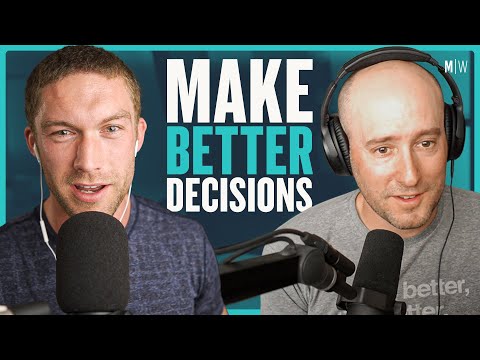
Shane Parrish - Mental Models, Good Decisions & Better Content | Modern Wisdom Podcast 334
Shane Parrish (guest), Chris Williamson (host)
In this episode of Modern Wisdom, featuring Shane Parrish and Chris Williamson, Shane Parrish - Mental Models, Good Decisions & Better Content | Modern Wisdom Podcast 334 explores shane Parrish on obsession, craft, ego, and timeless intelligent work Shane Parrish discusses how to build a meaningful body of work by prioritizing craft, timelessness, and learning over short-term metrics, dopamine hits, and growth-at-all-costs. He contrasts perfectionism with high-leverage obsession over the right details, especially when you’re near the peak of your craft. A major theme is staying close to the ‘territory’, not just the ‘map’: avoiding over-optimization on KPIs, seeking direct feedback, and updating when reality proves you wrong. He also explores ego, drive, and commitment—how to pursue improvement without a sense of insufficiency, protect your best hours, and avoid “channel-surfing life.”
Shane Parrish on obsession, craft, ego, and timeless intelligent work
Shane Parrish discusses how to build a meaningful body of work by prioritizing craft, timelessness, and learning over short-term metrics, dopamine hits, and growth-at-all-costs. He contrasts perfectionism with high-leverage obsession over the right details, especially when you’re near the peak of your craft. A major theme is staying close to the ‘territory’, not just the ‘map’: avoiding over-optimization on KPIs, seeking direct feedback, and updating when reality proves you wrong. He also explores ego, drive, and commitment—how to pursue improvement without a sense of insufficiency, protect your best hours, and avoid “channel-surfing life.”
Key Takeaways
Optimize for timeless craft, not repeated short-term hits.
Repeatedly creating whatever performs best in the moment can make you and your work irrelevant over time; focus on ideas and content that remain valuable years later, even if it means slower growth.
Get the full analysis with uListen AI
Be obsessive about the right details, but don’t let them block shipping.
Fonts, taglines, and phrasing can matter greatly to craft at the top end, but Parrish time-boxes work and separates ‘dabbling in minutiae’ from the act of publishing so progress doesn’t stall.
Get the full analysis with uListen AI
Stay close to the territory, not just the metrics map.
Dashboards, KPIs, and analytics are imperfect proxies; leaders and creators must regularly ‘touch the territory’—talk to users, staff, and readers—to check whether the numbers still reflect reality.
Get the full analysis with uListen AI
Prioritize outcome over ego, especially when feedback contradicts you.
When repeated feedback showed his audiobook narration wasn’t working, Parrish switched narrators; he emphasizes that clinging to being right distorts reality and prevents better decisions.
Get the full analysis with uListen AI
Protect your best hours each day for deep work or learning.
He blocks 9am–12pm with no meetings, using that time for his most important tasks; he suggests scheduling recurring “meetings with yourself” months ahead so deep work is guaranteed, not squeezed in.
Get the full analysis with uListen AI
Avoid ‘channel-surfing life’—commit deeply to something.
Constantly chasing new skills and hacks without committing prevents mastery; the people we admire went all‑in on their craft, repeatedly practicing even the basics rather than endlessly exploring.
Get the full analysis with uListen AI
Drive doesn’t have to come from feeling insufficient.
Parrish advises reframing motivation away from ‘I’m not enough’ toward being ‘pleased but not satisfied,’ and, if necessary, removing people who reinforce a sense of insufficiency from your life.
Get the full analysis with uListen AI
Notable Quotes
“If you're not obsessed with it, you'll never master it. Being obsessed with something won't ensure mastery, but not being obsessed will ensure you won't master it.”
— Shane Parrish
“Eventually you become irrelevant... it's the same thing rehashed over and over again and all I'm going for is that immediate dopamine hit.”
— Shane Parrish
“The map is not the territory... your job as a leader is to touch the territory on a regular basis.”
— Shane Parrish
“Outcome over ego is about putting the outcome first and your ego second.”
— Shane Parrish
“We’re channel-surfing life… we have a poverty of commitment because there are so many options.”
— Shane Parrish
Questions Answered in This Episode
How can a creator practically decide which details are ‘craft-critical’ and which are low-leverage perfectionism to drop?
Shane Parrish discusses how to build a meaningful body of work by prioritizing craft, timelessness, and learning over short-term metrics, dopamine hits, and growth-at-all-costs. ...
Get the full analysis with uListen AI
What systems can a team or solo creator put in place to reliably ‘touch the territory’ rather than over-relying on dashboards and KPIs?
Get the full analysis with uListen AI
How do you personally notice when your ego is starting to distort your perception of feedback or data, and what do you do in that moment?
Get the full analysis with uListen AI
At what point should someone stop exploring new domains and commit deeply to one path, and what signals indicate it’s time to commit?
Get the full analysis with uListen AI
How might anonymity or pseudonymity realistically change the kinds of ideas creators are willing to share—and what tradeoffs does that create for trust and connection with audiences?
Get the full analysis with uListen AI
Transcript Preview
Let's say I write an article for the website. It- it's really popular. So now I know if I write another article like that, it's going to be really popular. Well, if I do this over and over again, and- and- and on a weekly basis, it won't make a difference, on a monthly basis, it won't make a difference, but if I do this for years, eventually, I become irrelevant. And I become irrelevant not only in my knowledge and my learning and my development, but I become irrelevant to my audience because this is the same thing rehashed over and over again. And all's I'm going for is that immediate dopamine hit.
(wind blowing) So I fell in love with a tweet of yours from the other month which said, "If you're not obsessed with it, you'll never master it. Being obsessed want- with something won't ensure mastery, but not being obsessed will ensure you won't master it." What have you been obsessed with this year?
I've been obsessed with taking care of my family. I mean, it's COVID, right? So it's obsessed about taking care of all the people in my life. Um, work-wise, I'm just obsessed with little details, right? Like the font on the website and the Instagram backgrounds and, you know, people- people think that that's a little bit obsessive, but it's part of the craft. It's part of what we do. Uh, writing, I'm trying to get better at. I'm obsessed with getting better at writing and being clear and being succinct and being relatable to people. And it helps my- clarify my thinking, right? Because writing is thinking on the page. And often, I discover that through writing, that I really don't know what I'm talking about, and that's- that's a great feeling in a way. It- it's bad in a way, but it's sort of like the dawning of wisdom, right? Because, you know, you- you can't learn anything if you- you think you already know it, and when you write it down, you- you force yourself to confront the fact that maybe you don't know it as well as you did, especially when you're trying to write it down for an audience that might not have the context or might not be a domain expert in what you're writing about, so you have to simplify. And simplify doesn't mean that it's simplistic. It just means that you're using different words that everybody can relate to, so you're- now you're translating it, it's out of the domain in which you might have learned something, you're translating it to a more relatable domain for everybody else. And I think that that's so powerful for us to just calibrate our own knowledge and hone our understanding of what we know.
How do you avoid getting bogged down in little details? Tiago Forte had a tweet a couple of months ago talking about how the highest leverage people that he knows, most of their work has a rough-edged, half-assed quality to it because perfectionism is a low leverage activity. How do you avoid restricting the pace at which you ship work by focusing on the minutiae?
Install uListen to search the full transcript and get AI-powered insights
Get Full TranscriptGet more from every podcast
AI summaries, searchable transcripts, and fact-checking. Free forever.
Add to Chrome