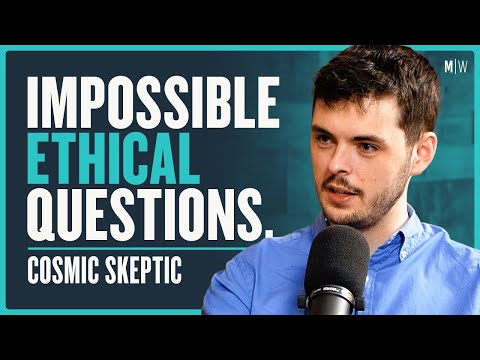
8 Impossible Thought Experiments - Cosmic Skeptic
Alex O'Connor (guest), Chris Williamson (host)
In this episode of Modern Wisdom, featuring Alex O'Connor and Chris Williamson, 8 Impossible Thought Experiments - Cosmic Skeptic explores cosmic Skeptic Explores Ethics, Free Will, and Moral Responsibility Limits Chris Williamson and Alex O'Connor (Cosmic Skeptic) use thought experiments to probe whether ethical theories like utilitarianism, rights-based views, and divine command ethics can really guide action. They argue that much of moral judgment is rooted in emotion (emotivism) and that our intuitions often clash with tidy philosophical systems. O'Connor challenges ideas of moral responsibility by questioning free will, using brain tumor cases, criminal justice, and meritocracy to show how little control we have over traits and decisions. The conversation ends by touching on religious ethics and the Euthyphro dilemma, suggesting even God-based morality faces deep conceptual problems.
Cosmic Skeptic Explores Ethics, Free Will, and Moral Responsibility Limits
Chris Williamson and Alex O'Connor (Cosmic Skeptic) use thought experiments to probe whether ethical theories like utilitarianism, rights-based views, and divine command ethics can really guide action. They argue that much of moral judgment is rooted in emotion (emotivism) and that our intuitions often clash with tidy philosophical systems. O'Connor challenges ideas of moral responsibility by questioning free will, using brain tumor cases, criminal justice, and meritocracy to show how little control we have over traits and decisions. The conversation ends by touching on religious ethics and the Euthyphro dilemma, suggesting even God-based morality faces deep conceptual problems.
Key Takeaways
Moral judgments are often emotional expressions, not factual claims.
O'Connor defends emotivism: when we say “murder is wrong,” we usually aren't stating a testable fact but expressing a distinctive moral feeling—akin to saying “Boo murder”—which underlies the rational justifications we build on top.
Get the full analysis with uListen AI
Simple utilitarianism breaks down under realistic decision-making.
Examples like the rash doctor (two pills with different risk–reward profiles) show the gap between ‘what actually maximizes pleasure’ and ‘what we can only probabilistically know,’ forcing utilitarians to introduce complex distinctions between criteria of rightness and decision procedures.
Get the full analysis with uListen AI
Rights-based ethics and utilitarianism pull in opposite directions.
Thought experiments about killing one to save many reveal a tension: strict rights (e. ...
Get the full analysis with uListen AI
Free will skepticism undermines traditional notions of moral blame.
Cases of brain tumors causing pedophilic or violent behavior illustrate that actions can flow from neural conditions outside a person’s control, suggesting all behavior may ultimately be the product of brain states and upbringing for which no one is genuinely morally responsible.
Get the full analysis with uListen AI
A rehabilitative, not retributive, justice model better fits a no–free will world.
If offenders are more like tornadoes than villains—dangerous but not ‘guilty’ in the classic sense—then confinement should aim at prevention and rehabilitation, not punishment for its own sake, even if victims’ intuitions cry out for retribution.
Get the full analysis with uListen AI
Meritocracy is morally arbitrary once you factor in luck and genetics.
The discussion of Harvard/Oxford admissions shows that rewarding ‘merit’ (intelligence, diligence) is no less rooted in unchosen advantages than rewarding family wealth, challenging the moral self-satisfaction of meritocratic systems.
Get the full analysis with uListen AI
Basing healthcare priority on lifestyle ‘desert’ leads to troubling implications.
Prioritizing nonsmokers over smokers for lung cancer care sounds intuitive, but when extended consistently (to diet, sitting time, minor habits), it becomes both epistemically unworkable and morally callous, suggesting medicine should not be rationed by perceived blame.
Get the full analysis with uListen AI
Notable Quotes
“The point of these questions is, in many ways, to demonstrate that there is no answer to these questions, or at least that if you have an answer, there's no way to really settle the question in your favor.”
— Alex O'Connor
“I subscribe to a view called ethical emotivism, that ethics is just an expression of emotion.”
— Alex O'Connor
“If somebody told me that they were about to launch every single nuclear weapon on the planet unless you kill an innocent person, would you kill the innocent person?”
— Alex O'Connor
“How much are you morally responsible for the way that your brain is made up? You didn't choose your parents. You didn't choose to be born at the time that you did.”
— Alex O'Connor
“If there's something wrong with aristocracy, there's something wrong with meritocracy as well.”
— Alex O'Connor (summarizing Michael Sandel)
Questions Answered in This Episode
If moral statements are fundamentally emotional expressions, can we ever rationally resolve deep ethical disagreements, or are we just clashing feelings?
Chris Williamson and Alex O'Connor (Cosmic Skeptic) use thought experiments to probe whether ethical theories like utilitarianism, rights-based views, and divine command ethics can really guide action. ...
Get the full analysis with uListen AI
In life-or-death scenarios, should we prioritize inviolable rights or aggregate welfare, and how would we justify that to someone who strongly disagrees?
Get the full analysis with uListen AI
What reforms to criminal justice would follow if we fully accepted that free will doesn’t exist and no one ‘could have done otherwise’?
Get the full analysis with uListen AI
Is there any non-arbitrary way to defend meritocracy once we accept that both talent and effort are heavily shaped by luck and genetics?
Get the full analysis with uListen AI
For religious believers, how convincing are the standard answers to the Euthyphro dilemma, and do they genuinely avoid making morality either arbitrary or independent of God?
Get the full analysis with uListen AI
Transcript Preview
If somebody told me that they were about to launch every single nuclear weapon on the planet unless you kill an innocent person, would you kill the innocent person? The point of these questions is, in many ways, to demonstrate that there is no answer to these questions, or at least that if you have an answer, there's no way to really settle the question in your favor.
Alex O'Connor, welcome to the show.
Chris Williamson, thank you so much for having me again, yet again.
Thank you for joining me here in Austin. How e- e- ph- philosophy graduate-
Mm-hmm.
... YouTuber, podcaster, and now wake surfing extraordinaire.
Yeah, my wrists feel as though they're about to come off. Um, I- I've, I don't think I've ever used this particular muscle before.
(laughs)
but-
That's a lie. We both know that that's a lie.
(laughs) Yeah, well, certainly not, uh, certainly not this-
Yeah, that side.
... voraciously.
Um, yesterday, you turned up to a boat trip wearing pretty similar outfit to the one that you're in today.
Yes. I- I'm- I'm trying to live out the philosophy that there is no situation in which you can't wear something resembling a suit. Maybe-
(laughs)
... you have to leave the jacket at home, maybe, at a push. I was just a little bit warm. But shirt, chinos, it's about as casual as it gets.
You- you- you did good yesterday.
I can't believe you've shown up to a philosophical conversation wearing a T-shirt and shorts.
Well, I mean, this is my uniform, you know?
Yeah. Well- well, we're hopefully, by the end of this, we're gonna be much more philosophically entwined, and you'll begin to understand how fun it is to be a bit pretentious about these matters, which includes
To always dress formally?
... dress codes. Quite right.
Okay. Uh, so the last time that we spoke on the show, we were talking about some moral quandaries and some ethical dilemmas, and I really enjoyed that. I like the opportunity to do thought experiments. It means that people can have their brains fried at home, as well as me. Problem being that I am the one that is publicly the most stupid, right? When these questions get asked and you say, "Well, what do you, wha- wha- what do you mean by kindness?" And then I have to try and think of something. Uh, so go gentle with me today, is- is my request.
I'll try my best, but there's, uh, I mean, the implication that I'm any better is- is a mistaken one. I think the point of these questions is, in many ways, to demonstrate that there is no answer to these questions, or at least that if you have an answer, there's no way to really settle the question in your favor. We don't really have a better grasp of the good or the just city than did Plato and the ancients. We haven't really progressed very much. And so, it seems a bit, uh, futile to be discussing this kind of stuff. But as they say, the wise of every generation discover the same truths. These, if there is such thing as moral truth, it seems to be something that's out there and graspable by individuals as they go throughout their life. Uh, it's not gonna put you in a better place than any of your ancestors, but it will put you in a better place than you were, uh, yourself a f- a few years ago. So, they're still worth asking and answering to see what you think about these things, but don't expect to become a moral expert. There was a wonderful question, uh, on an exam paper for, uh, wh- when I was studying philosophy and theology. Um, I can't remem- I think it was on the ethics paper. It must have been. And I can't remember the exact wording, but the question was something like, "Does studying ethics make you an expert in ethics? Does it, or does it make you a better person," or something like this. "And if not, what's the point?" Because, of course, you can study ethical theories. You can have an answer to every single ethical query. But is that going to make you a better person? In many ways, it might make you a worse person-
Install uListen to search the full transcript and get AI-powered insights
Get Full TranscriptGet more from every podcast
AI summaries, searchable transcripts, and fact-checking. Free forever.
Add to Chrome