Life Hacks 102
Chris Williamson (host), Yusef Smith (guest), Jonny Watson (guest), Jonny Watson (guest), Yusef Smith (guest), Chris Williamson (host)
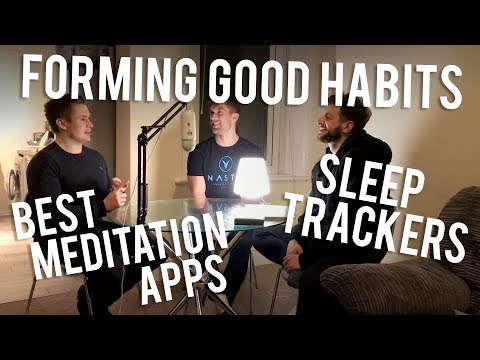
In this episode of Modern Wisdom, featuring Chris Williamson and Yusef Smith, Life Hacks 102 explores sleep, Meditation, and Habits: Tech-Driven Life Hacks That Actually Stick This episode of Life Hacks focuses on tools and tactics for improving sleep, building meditation habits, and creating reliable behavior change using technology. The hosts discuss specific apps like Sleep Cycle, Headspace, Insight Timer, and Muse, explaining how they use data and accountability to make abstract goals tangible.
Sleep, Meditation, and Habits: Tech-Driven Life Hacks That Actually Stick
This episode of Life Hacks focuses on tools and tactics for improving sleep, building meditation habits, and creating reliable behavior change using technology. The hosts discuss specific apps like Sleep Cycle, Headspace, Insight Timer, and Muse, explaining how they use data and accountability to make abstract goals tangible.
They emphasize experimenting on yourself with sleep and supplement variables, using external accountability and loss aversion to form habits, and the importance of ‘scaled’ versions of habits to avoid breaking streaks.
A major theme is that meditation and sleep improvement require more time and consistency than apps usually advertise, and that guided tools are best treated as training wheels rather than permanent crutches.
Key Takeaways
Track sleep consistently and experiment with variables that matter to you.
Using apps like Sleep Cycle with ‘sleep notes’ (caffeine timing, alcohol, stress, gym, melatonin) allows you to run long-term personal experiments and see real correlations—e. ...
Get the full analysis with uListen AI
Use external accountability and loss aversion to build or break habits.
Simple shared spreadsheets, public challenges, or money-at-stake services create social pressure and financial downside if you miss habits, which many people find far more effective than standalone habit-tracking apps.
Get the full analysis with uListen AI
Create ‘scaled’ versions of habits to protect your streaks.
Defining a minimum viable version (e. ...
Get the full analysis with uListen AI
Treat guided meditation apps as training wheels, not the destination.
Headspace, Calm, and similar tools are excellent for beginners, but long-term progress comes from moving toward less guidance, longer sits, and a single clear method, ideally supported by reading a straightforward manual like ‘Mindfulness in Plain English.’
Get the full analysis with uListen AI
Expect real meditation benefits only after substantial time investment.
The hosts argue that claims like “10 days to change your brain” are misleading; you may need 50–100 hours before confidently judging the impact, and most of the work is repeatedly returning attention after distraction, not achieving perfect focus.
Get the full analysis with uListen AI
Use biofeedback tools like Muse if you’re highly data-driven.
EEG headbands such as Muse convert brain activity into soundscapes and ‘bird’ rewards, giving quantifiable scores (calm time, recoveries) that can motivate analytic personalities and provide evidence of progress over hundreds of hours.
Get the full analysis with uListen AI
Leverage small tech tweaks to remove friction from daily routines.
Hacks like maxing trackpad speed (gradually), using Media Monster to film workouts while listening to music, and apps like Waterlogged or MyFitnessPal for easy logging can cumulatively save time and reduce cognitive load.
Get the full analysis with uListen AI
Notable Quotes
“You’re building your own data on your own sleep basically.”
— Chris
“The only thing that allows me to build any kind of habit is direct, one-on-one accountability.”
— Johnny
“Headspace is the ten-minute abs, booty-blaster home DVD workout of meditation.”
— Yousaf
“Pick one method, dig one deep hole, rather than lots of shallow holes.”
— Yousaf
“You will never get to the point where you sit down and you’re like, ‘That was incredible, I was so focused the entire time.’ The reps are bringing it back to the object each time.”
— Yousaf
Questions Answered in This Episode
How would you design your own first 30-day experiment using Sleep Cycle’s notes to isolate the impact of caffeine, bedtime, and screen use on your sleep quality?
This episode of Life Hacks focuses on tools and tactics for improving sleep, building meditation habits, and creating reliable behavior change using technology. ...
Get the full analysis with uListen AI
At what point does external accountability (money, public tracking, other people) become counterproductive or stressful rather than helpful for habit formation?
They emphasize experimenting on yourself with sleep and supplement variables, using external accountability and loss aversion to form habits, and the importance of ‘scaled’ versions of habits to avoid breaking streaks.
Get the full analysis with uListen AI
If guided meditation apps are just training wheels, how can a beginner know when it’s time to transition to unguided practice without losing motivation?
A major theme is that meditation and sleep improvement require more time and consistency than apps usually advertise, and that guided tools are best treated as training wheels rather than permanent crutches.
Get the full analysis with uListen AI
For someone skeptical about meditation, what specific changes—state or trait—would convince them that 50–100 hours of practice had actually been worthwhile?
Get the full analysis with uListen AI
How can highly analytical, data-driven people avoid turning tools like Muse and sleep trackers into obsessive score-chasing rather than supportive feedback?
Get the full analysis with uListen AI
Transcript Preview
(wind blowing) Right. Uh, so life hacks number two.
Number two.
You're waving around. What are you waving?
I don't know. Just making-
A peace sign. Peace, listeners. Peace. Um, okay, so I'm going to open up. On the last episode, I mentioned that I would be talking about Sleep Cycle, and that is going to be my first one today. So Sleep Cycle is an app that you use for tracking sleep. Um, you set an alarm last thing at night, and it presumes that that is the final thing that you do. So it calls that your sleep, uh, your going to bedtime. It then tracks when you wake up on a morning, sets an alarm off. Um, you can give it a window of time between an hour and 10 minutes during which it uses the motion sensor in your phone to detect your, your motion sensor or the microphone to detect the depth of sleep that you're in. And it tries to find a time to wake you when you are closest to light sleep. That feature, for me, I don't use an awful lot, but I know it can be pretty effective. The thing that I like the most is just tracking the amount of time that I've been asleep. I've used it for 1,200 plus nights now, so I've been doing it since 2018.
Big data collection there.
Yes.
So your correlates will be, will be very accurate now as well.
It's un- it's unbelie- Are you still using it?
Not recently.
Right. Okay, so-
Should explain what the correlates are, I suppose, as well.
Yeah. So the amount of data that it tracks to do with your sleep is unbelievable. So it associates the weather, the air temperature, the pressure, the moon's position.
(laughs)
Um, the location that, um, geographic location that you're in based on your phone's location services. It literally uses everything and then plots it against how good was your sleep. So it uses the length of time that you were asleep, plus the depth of sleep determined by either the microphone or the motion sensor, and then works out a quality of sleep that's based on a percentage. That percentage then gets plotted against all the other bits and pieces, and then it shows you an average of your time over the last week, over month, over all time. And it also tells you people in your country what their average is, so on and so forth. So if you're a bit of a, um, the sort of person who likes to drill down the data on that sort of thing, you can really get into it. And even if you don't, it tells you how long you've been asleep and what the effects on your sleep are. So I know that when it's a non-full moon, whatever the opposite is, like nonexistent moon.
Install uListen to search the full transcript and get AI-powered insights
Get Full TranscriptGet more from every podcast
AI summaries, searchable transcripts, and fact-checking. Free forever.
Add to Chrome