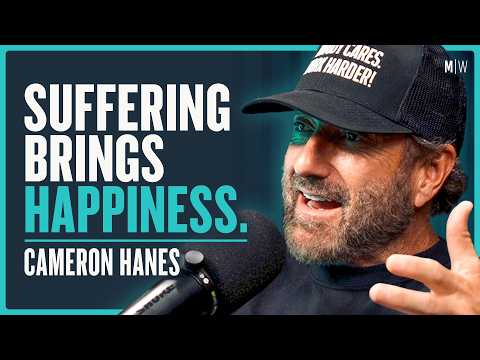
Why You Feel Like Something Is Missing - Cameron Hanes
Chris Williamson (host), Cameron Hanes (guest), Narrator
In this episode of Modern Wisdom, featuring Chris Williamson and Cameron Hanes, Why You Feel Like Something Is Missing - Cameron Hanes explores why Suffering, Consistency, And Self-Doubt Still Drive Cameron Hanes Chris Williamson and Cameron Hanes revisit their relationship two years on, exploring what truly drives Hanes to pursue extreme physical challenges and relentless consistency over four decades. They contrast the romantic appeal of intensity with the boring but decisive power of long-term consistency, tying it back to childhood instability, control, and identity. A major thread is Hanes’ parenting style—pushing his kids brutally hard, the guilt and regret that followed, and how that forged his son Truett into a world‑record‑breaking athlete who triggers as much envy as inspiration online. Underneath the talk of 250‑mile races and 10,000 pull‑ups is a deeper conversation about worthiness, success, hate as fuel, and whether high achievers ever allow themselves to feel like they’ve “made it.”
Why Suffering, Consistency, And Self-Doubt Still Drive Cameron Hanes
Chris Williamson and Cameron Hanes revisit their relationship two years on, exploring what truly drives Hanes to pursue extreme physical challenges and relentless consistency over four decades. They contrast the romantic appeal of intensity with the boring but decisive power of long-term consistency, tying it back to childhood instability, control, and identity. A major thread is Hanes’ parenting style—pushing his kids brutally hard, the guilt and regret that followed, and how that forged his son Truett into a world‑record‑breaking athlete who triggers as much envy as inspiration online. Underneath the talk of 250‑mile races and 10,000 pull‑ups is a deeper conversation about worthiness, success, hate as fuel, and whether high achievers ever allow themselves to feel like they’ve “made it.”
Key Takeaways
Consistency is more powerful than intensity, but far less glamorous.
Hanes and Williamson argue that anyone can be taught how to run a 5K or lift correctly, but almost no one can explain how to show up three times a week for 10 years—the unsexy consistency that actually builds outlier results.
Get the full analysis with uListen AI
Control through hard effort often comes from chaotic childhoods.
Hanes traces his obsession with running and training back to an unstable upbringing where the only thing he could control was his own effort—even as a five‑year‑old running solo miles before school.
Get the full analysis with uListen AI
Extreme parenting can forge excellence and deep regret at the same time.
He pushed his kids relentlessly—daily mountain runs, half‑marathons at age seven, no letting them win—believing ‘average is failing. ...
Get the full analysis with uListen AI
Ordinary‑looking high achievers threaten people because they remove excuses.
Williamson notes that figures like Truett or Hanes aren’t untouchable genetic freaks like Usain Bolt, which forces others to confront that the real gap is discipline and consistency, not some mystical talent—prompting either inspiration or resentment.
Get the full analysis with uListen AI
Hate and doubt can be potent fuel, but they come at a cost.
Hanes admits he’s more driven by hate and criticism than by support, even writing ‘poser’ and ‘must be nice’ on his training landmarks; Williamson points out this keeps an edge but also traps him in never feeling good enough or truly successful.
Get the full analysis with uListen AI
Most people overestimate talent and underestimate how boring success really is.
They discuss how even gifted people must ‘unlock’ their talent through years of repetition, while others with average genetics can become elite simply by refusing to miss—like Truett not skipping the gym for 14 years straight.
Get the full analysis with uListen AI
Winning the external game doesn’t automatically fix internal emptiness.
Williamson challenges Hanes on what it would mean to actually feel worthy of his success, suggesting that for many high achievers, the next ‘mountain’ isn’t another race or record but learning to accept their achievements and find joy, not just suffering.
Get the full analysis with uListen AI
Notable Quotes
“Either you're average or obsessed.”
— Cameron Hanes
“The key is that consistency, decade after decade after decade.”
— Cameron Hanes
“When a man can't find a deep sense of meaning, they distract themselves with pleasure… and when a man can't find a deep sense of pleasure, they distract themselves with meaning.”
— Chris Williamson
“Love makes me strong; hate makes me unstoppable.”
— Cameron Hanes
“Most people don't get there. You can look at that and say, ‘How low is the bar?’”
— Chris Williamson
Questions Answered in This Episode
If consistency is the real differentiator, what specific systems or environments make it easier to sustain for decades rather than burning out?
Chris Williamson and Cameron Hanes revisit their relationship two years on, exploring what truly drives Hanes to pursue extreme physical challenges and relentless consistency over four decades. ...
Get the full analysis with uListen AI
How can parents cultivate toughness and resilience in their kids without crossing into damaging pressure or living through them?
Get the full analysis with uListen AI
For someone who’s deeply driven by hate or doubt, what would it practically look like to shift toward being motivated by love or joy without losing their edge?
Get the full analysis with uListen AI
How should we reconcile genetic advantages with the moral weight we place on ‘hard work’ when judging others’ success or our own failures?
Get the full analysis with uListen AI
Once you’ve ‘won’ the external game—money, status, records—what concrete practices can help you start feeling worthy of it and actually enjoy your life?
Get the full analysis with uListen AI
Transcript Preview
I can't believe it's been two years.
Mm-hmm.
I can't believe that it was-
I know.
... two years since I was with you.
I know. It's, uh, we got a good, a lot of good material out of that discussion, that time-
Mm-hmm.
... that day. I still see clips-
Yeah, it was-
... everywhere.
Did anything, uh, stick with you from the few days that we s- spent together?
Um, (sighs) I like, you know, you've kind of repurposed some stuff, like so I, I love seeing that. But I think it's just that footage going up the mountain with the rock and you chosen, talking about chosen and unchosen suffering, that, that's gonna last forever for me. I mean, it's such a good, a good point, you know. And just that setting to have that message delivered at that time-
Mm.
... was just so powerful. So yeah.
Yeah. I, uh, I really appreciate how complimentary you were about me in the book. Uh-
Yeah.
... it feels like most of the first chapter is some bullshit that I've stolen or said-
Ah.
... well. Well, look, I, if, if we need to take a 72-pound rock up a hill, you carrying the rock and me spouting nonsense-
(laughs)
... that feels like we're specializing in where our skill sets lie.
Right.
You know what I mean?
Yeah. I see.
Uh-
Yeah. But you carried the rock. You also, what'd we do, 11 miles?
Too much. Too many.
Yeah.
At least, at least 10 too many.
Yeah.
So that was the, I mean, that's the farthest I've run maybe ever, uh, was that with you, and that was trail running and...
Yeah. It was great.
I actually felt great the next day. Uh, sometimes, I mean, you'll know this, or maybe you won't because you're always running, but the non-runners will know this. You've always got one body part if you've taken a big break from running and you're not conditioned, there's one body part that always hurts like fuck. And for me, it's my ankles and my calves.
Okay.
It's like just, it is always on fire. And maybe it's 'cause we were trail running, maybe it's 'cause the pace was right, maybe whatever, but I felt fine the next day.
Yeah.
What I was concerned about was whether or not you would've wrecked me so much physically on day one that when it came to, like, my bit, which was the sit down and spout nonsense-
Oh.
... stuff, that I would be sat there going, "It's so much fucking pain-"
No.
"... I can't even focus."
You were great. Yeah. And it, that, I, I, uh, I'm thankful we were able to go out to, you know, where I grew up and I could share that part with you too 'cause I, I just wanted... And I've heard you mention, like, on a few of your podcasts, you've mentioned, you know, the poser on the rock and-
Install uListen to search the full transcript and get AI-powered insights
Get Full TranscriptGet more from every podcast
AI summaries, searchable transcripts, and fact-checking. Free forever.
Add to Chrome