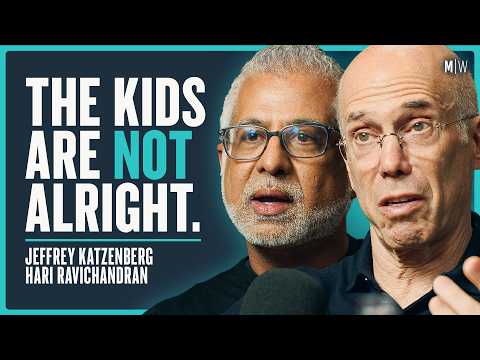
Why Movies, Tech & Mental Health Feel Broken - Jeffrey Katzenberg & Hari Ravichandran (4K)
Chris Williamson (host), Jeffrey Katzenberg (guest), Narrator, Hari Ravichandran (guest), Chris Williamson (host), Narrator, Hari Ravichandran (guest)
In this episode of Modern Wisdom, featuring Chris Williamson and Jeffrey Katzenberg, Why Movies, Tech & Mental Health Feel Broken - Jeffrey Katzenberg & Hari Ravichandran (4K) explores hollywood Legend And Tech Founder Expose Storytelling And Screen-Time Crisis Jeffrey Katzenberg and Hari Ravichandran discuss storytelling, ambition, and the evolution of film and TV alongside the disruptive rise of streaming and gaming. Katzenberg explains his core skills—spotting talent, recognizing great stories, and embracing high-risk ‘home run’ projects—while reflecting on mentorship from Walt Disney and Steven Spielberg. Ravichandran recounts how his cybersecurity company Aura pivoted into child online safety after his daughter’s mental health crisis, using AI to detect digital risk patterns. Together they outline how social media, smartphones, and post‑COVID isolation are driving a youth mental health epidemic and argue for ‘digital seatbelts’ and better parental tools rather than outright bans.
Hollywood Legend And Tech Founder Expose Storytelling And Screen-Time Crisis
Jeffrey Katzenberg and Hari Ravichandran discuss storytelling, ambition, and the evolution of film and TV alongside the disruptive rise of streaming and gaming. Katzenberg explains his core skills—spotting talent, recognizing great stories, and embracing high-risk ‘home run’ projects—while reflecting on mentorship from Walt Disney and Steven Spielberg. Ravichandran recounts how his cybersecurity company Aura pivoted into child online safety after his daughter’s mental health crisis, using AI to detect digital risk patterns. Together they outline how social media, smartphones, and post‑COVID isolation are driving a youth mental health epidemic and argue for ‘digital seatbelts’ and better parental tools rather than outright bans.
Key Takeaways
Great stories demand powerful villains and memorable endings.
Katzenberg leans on Walt Disney’s principles that a story is only as good as its ending and its villain; stronger antagonists create higher stakes, making the protagonist’s victory more meaningful.
Get the full analysis with uListen AI
Swinging for ‘home runs’ requires accepting frequent failure.
Katzenberg frames his career as deliberately choosing improbable, high-upside projects; you can’t hit big wins without aiming for them, and resilience comes from owning failures rather than dodging blame.
Get the full analysis with uListen AI
Taste and exceptional talent are largely mysterious but observable.
He argues that ‘taste’ is hard to teach and may partly be absorbed from exposure to people with exquisite judgment, citing Elton John, Spielberg, and Guillermo del Toro as examples of instinctive genius.
Get the full analysis with uListen AI
Post‑COVID, adolescent mental health issues have surged, especially for girls.
Ravichandran and Katzenberg reference hospital data and Aura’s own beta findings showing huge rises in depression, anxiety, self‑harm, and eating issues among teens, with COVID isolation and digital life acting as accelerants.
Get the full analysis with uListen AI
Smartphones and social media amplify existing adolescent vulnerabilities rather than acting as a single cause.
They emphasize that tech isn’t purely ‘evil’ but that highly optimized engagement algorithms, combined with kids’ developmental fragility and heavy time online, push them down harmful rabbit holes.
Get the full analysis with uListen AI
Parents are the frontline and need better tools, not just fear or bans.
Most parents are ‘digitally blind’ to what their kids do online; Aura aims to act like a digital seatbelt by using on‑device AI to flag sentiment shifts, risk markers (e. ...
Get the full analysis with uListen AI
Objective digital-behavior feedback can support mental health for adults too.
The same models that map teens’ app usage, typing patterns, and sleep to mood could be repurposed as a ‘wearable for your mind,’ giving adults personalized insights into how their digital habits affect wellbeing.
Get the full analysis with uListen AI
Notable Quotes
“I’m a truffle hunter. I know how to find a good idea and recognize a talented person.”
— Jeffrey Katzenberg
“There’s no such thing as a great story without a great ending. My movies are only as good as their villains.”
— Walt Disney (quoted by Jeffrey Katzenberg)
“In the modern world, your kid can be sitting across the table from you and you actually don’t know where they are, what they’re doing, or who they’re with.”
— Jeffrey Katzenberg
“When my daughter went into treatment and I finally looked at her phone, I thought, ‘How could we not know?’ It was completely invisible.”
— Hari Ravichandran
“You can’t put the thing back in the box. So instead of banning phones, we need guardrails—like teaching kids to drive with a seatbelt, not telling them never to drive.”
— Hari Ravichandran
Questions Answered in This Episode
How far should governments go in regulating children’s access to social media versus leaving it to parents and tools like Aura?
Jeffrey Katzenberg and Hari Ravichandran discuss storytelling, ambition, and the evolution of film and TV alongside the disruptive rise of streaming and gaming. ...
Get the full analysis with uListen AI
What practical steps can a parent take this week to ‘teach driving’ online—rather than just spying, banning, or giving up?
Get the full analysis with uListen AI
Could AI‑based sentiment tracking for adults meaningfully reduce burnout, anxiety, or digital addiction, or might it create new privacy and dependency issues?
Get the full analysis with uListen AI
In an era where gaming outgrosses film and TV, how should Hollywood rethink storytelling to stay culturally relevant?
Get the full analysis with uListen AI
Where is the line between helpful algorithmic personalization and manipulative ‘hacking’ of user behavior, especially for children?
Get the full analysis with uListen AI
Transcript Preview
Jeff, what made you so good at what you did? I don't actually understand what your skill set is.
(laughs)
Like, it's obvious that you're talented, but I, I don't actually know-
You're not the first person to accuse me of
(laughs)
I don't actually know what you're talented at.
I'm not sure I, I am either. Uh, let's see. Uh, certainly a good storyteller. Um, you know, I think, um, you know what? I'm a truffle hunter. I, I know how to find a good idea, recognize a good person, a talented person. Um, I think that's probably the most valuable skill set, which is having an instinct for quality, for smarts, for, you know, ambition, vision, dreams, you know. Uh, you know, I've spent, um, most of my career helping other people realize their dreams, their stories, their ideas. Um, and, you know, in order to, I think, recognize a dreamer, you need to be a bit of a dreamer yourself. You have to be an optimist. You have to believe in, you know, uh, the unknown, the, you know, unimaginable, and, uh, you have to have a lot of enthusiasm. And so I think those qualities, um, are... I'm a happy person, an, an optimist, bottomless well of optimism.
Mm-hmm. I've heard you say that you're a good home run hitter, but you don't do singles and bunts.
Well, yeah, that's sort of a different, that's, you know, (clears throat) sort of in my ambition column, you know, sort of different lanes that, you know, I like to take on things that are very, very, very challenging. And, you know, I, I, I like to say that, uh, you know, m- I'm... I, I like doing things that are, you know, improbable, if not impossible. That's kind of my home address. And, uh, you know, the outcome of that is, is that, you know, when you... One, you can't hit a home run if you don't swing for the fence. Um, and more ti- at least many times, you will swing for the fence and you won't get there, you know? So, um, you gotta accept that, you know, with success comes failure.
You mentioned, uh, being able to pick a good story, one of the core skill sets with 400 something movies, 80 animated, da da da. What, in your opinion, makes for a good story?
Um, well, there are many things. I, you know, one of... I, I've been very lucky to have many great me- mentors and teachers, um, uh, over my career. Um, one of which I actually never met 'cause he had passed away by the time, uh, I res- I arrived at the Walt Disney Company in 1984, which is Walt Disney himself, and he had this amazing (clears throat) archive of his work, his work process, his, uh, creative, uh, uh, uh, sort of blueprints. And, um, so many great lessons learned about storytelling from him, particularly around his animated movies. Um, one of my favorite ones, he says, "You know, there's no such thing, um, as a great story without a great ending." Seem pretty obvious, right? (laughs) Um, uh, there's no such thing as a great story, um... Uh, your story, uh, your story, uh, let me say it. "My movies are only as good as their villains," is one of the things that he said.
Install uListen to search the full transcript and get AI-powered insights
Get Full TranscriptGet more from every podcast
AI summaries, searchable transcripts, and fact-checking. Free forever.
Add to Chrome