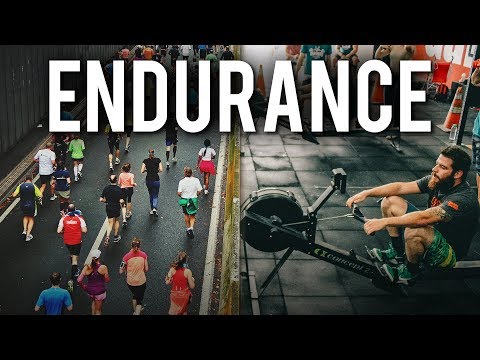
Endure; Finding The Limits Of Human Performance | Alex Hutchinson
Chris Williamson (host), Narrator, Alex Hutchinson (guest)
In this episode of Modern Wisdom, featuring Chris Williamson and Narrator, Endure; Finding The Limits Of Human Performance | Alex Hutchinson explores how Your Brain Quietly Controls — And Expands — Endurance Limits Alex Hutchinson explains that endurance is less about muscles and oxygen and more about “the struggle to continue against a mounting desire to stop.” He describes how scientific thinking has shifted from viewing the body as a machine with fixed limits to seeing effort and perception—mediated by the brain—as the true governors of performance.
How Your Brain Quietly Controls — And Expands — Endurance Limits
Alex Hutchinson explains that endurance is less about muscles and oxygen and more about “the struggle to continue against a mounting desire to stop.” He describes how scientific thinking has shifted from viewing the body as a machine with fixed limits to seeing effort and perception—mediated by the brain—as the true governors of performance.
Using research and personal stories, he shows that factors like pain, heat, thirst, oxygen, and fuel mainly limit us by increasing perceived effort, not by instantly shutting the body down. The key variable becomes RPE (Rate of Perceived Exertion), which integrates both physical and psychological states into a single ‘how hard does this feel?’ signal.
Hutchinson then explores practical tools—like motivational self-talk and mindfulness—that can measurably lower perceived effort and unlock extra performance without changing physical capacity. He also touches on dramatic examples, from mothers lifting cars to elite marathoners like Eliud Kipchoge, to illustrate how belief and brain state influence our apparent limits.
Key Takeaways
Endurance is fundamentally a mental decision, not a hard physical wall.
You almost never stop because your body is truly incapable; you stop when your brain assesses effort as ‘10/10’ and decides you can’t or shouldn’t continue, even though extra reserves usually remain.
Get the full analysis with uListen AI
Rate of Perceived Exertion (RPE) is the best single predictor of your limit.
RPE integrates heart rate, lactate, temperature, sleep, mood, stress, and more into one subjective ‘how hard is this? ...
Get the full analysis with uListen AI
Physical limiters (heat, dehydration, low fuel, low oxygen) work mainly by raising effort.
Before you reach true catastrophic failure, the brain detects rising risk (e. ...
Get the full analysis with uListen AI
Pain tolerance is trainable and athletes don’t feel less pain—they cope with it better.
Research shows athletes’ pain sensitivity is similar to non-athletes, but they’ll endure pain longer and interpret it more as information than as an emergency, a skill developed through repeated exposure in training.
Get the full analysis with uListen AI
Motivational self-talk can measurably improve performance by altering perceived effort.
Replacing automatic negative thoughts (“I can’t do this”) with practiced, believable positive phrases (“I’ve trained for this; I can hold this pace”) reduces how hard the same effort feels and lets you go longer or faster.
Get the full analysis with uListen AI
Mindfulness-style awareness helps you stay calm and effective under stress.
Elite performers (SEALs, adventure racers) maintain steady, nonjudgmental awareness of bodily sensations instead of panicking when things get hard, and mindfulness training can cultivate similar brain patterns in others.
Get the full analysis with uListen AI
Belief and expectation quietly shape how much of your capacity you can access.
Being deceived about pace or load, racing a slightly-faster ‘ghost’ of yourself, or even seeing subliminal smiling faces can all improve performance, showing that confidence and context change how hard effort feels.
Get the full analysis with uListen AI
Notable Quotes
“Endurance is the struggle to continue against a mounting desire to stop.”
— Alex Hutchinson
“The moment you fall off the back of the treadmill is fundamentally a decision you’re making.”
— Alex Hutchinson
“If you can find a way of manipulating perceived exertion, then you’ve effectively found a way of changing your physical limits.”
— Alex Hutchinson
“Athletes don’t feel less pain. They feel the same pain, but they’re willing to sit there and endure it for much longer.”
— Alex Hutchinson
“Motivational self-talk changed the relationship between how hard their body was working and how hard it felt in their minds.”
— Alex Hutchinson
Questions Answered in This Episode
How could you systematically train your self-talk so that positive scripts are automatic under maximal effort?
Alex Hutchinson explains that endurance is less about muscles and oxygen and more about “the struggle to continue against a mounting desire to stop. ...
Get the full analysis with uListen AI
In your own training, how often do you actually reach a true ‘10/10’ effort—or do you usually stop at an earlier, safer feeling point?
Using research and personal stories, he shows that factors like pain, heat, thirst, oxygen, and fuel mainly limit us by increasing perceived effort, not by instantly shutting the body down. ...
Get the full analysis with uListen AI
What practical experiments could you run (e.g., deceptive pacing, partner challenges) to test how much extra you can access when beliefs and expectations are altered?
Hutchinson then explores practical tools—like motivational self-talk and mindfulness—that can measurably lower perceived effort and unlock extra performance without changing physical capacity. ...
Get the full analysis with uListen AI
How might you incorporate mindfulness or nonjudgmental awareness into hard workouts so that discomfort becomes data instead of a threat?
Get the full analysis with uListen AI
Looking at someone like Eliud Kipchoge, which aspects of his mindset and lifestyle could realistically be adapted to your own context to improve endurance?
Get the full analysis with uListen AI
Transcript Preview
(wind blowing) Hi, friends. I hope you had a good Christmas and New Year. We are kicking off 2019 with what might be the best episode that I've ever recorded. I know I do say that a lot, it's a running joke, but this one genuinely could be it. Alex Hutchinson is a writer, journalist, and an endurance athlete. Recently wrote a book called Endure: Mind, Body, and the Curiously Elastic Limits of Human Performance. I think anyone who has ever gone for a run has thought to themselves, "What makes some of us quit while others continue, and just how much of human performance is dictated by the mind and how much by the body?" It's a fundamental question which anyone who has ever taken part in a physical pursuit has considered, and today Alex is going to take us through exactly what he's uncovered. I'm absolutely certain that this is going to be a massive benefit to a lot of listeners. If it is to you, please pop it into your gym Facebook group or send it to some friends that you know would really appreciate the insights that Alex gives us. This could genuinely be a game-changer for a lot of athletes' performances as we move into 2019. So pound the share button if you would be so kind. Don't forget to hit subscribe if you are new to the channel. It would make me very happy indeed. And if you're a regular listener, please go and give me five stars wherever you are tuned in. Now let's go and improve our endurance.
(instrumental music)
Alex, welcome to Modern Wisdom. How are you?
I'm good. Thanks, Chris, for having me on. I appreciate it.
Brilliant. So I'm specifically excited about today's podcast, not least because my endurance sucks. Um, (laughs) so I am hoping, as I'm sure many of the listeners are, to find some strategies that can improve our endurance, and also, I think, probably, uh, define and, uh, better understand what endurance is, because as far as I'm concerned, it, it, it's something that I work on quite a lot and sometimes I feel like it's good and then sometimes, uh, I feel like I might have never trained before in my life.
Yeah, I mean, and, (laughs) so I'll, I'll confess, uh, I started with a very narrow definition of endurance. You know, I was, I, I've been a runner my whole life, so I was thinking very narrowly and, of endurance as kind of how fast can you run a long race. But I've come to, to think of endurance as a much broader thing. And in fact, I'll, I'll, I'll jump right in with the definition that I ended up using in the book-
Fantastic.
... which is that endurance is the struggle to continue against a mounting desire to stop. So it's, it's, it's something that takes place over time, and it can be, you know, we can be talking about mental endurance, physical endurance, you know, at, at, at work or, uh, uh, during exercise or whatever the case may be. But what, what I'll end up arguing is that fundamentally that struggle is, is the same and the struggle to, to continue, you know, to keep studying, uh, for, uh, li- an exam or something is actually the same mental struggle that goes on when you're running a marathon and you're trying to force yourself to maintain a pace that is unpleasant.
Install uListen to search the full transcript and get AI-powered insights
Get Full TranscriptGet more from every podcast
AI summaries, searchable transcripts, and fact-checking. Free forever.
Add to Chrome