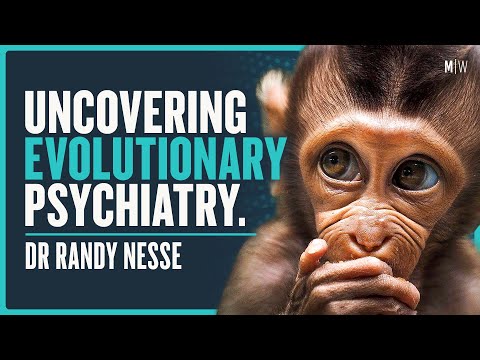
Can Evolution Explain Human Emotions? - Dr Randy Nesse
Randy Nesse (guest), Chris Williamson (host), Narrator
In this episode of Modern Wisdom, featuring Randy Nesse and Chris Williamson, Can Evolution Explain Human Emotions? - Dr Randy Nesse explores evolutionary psychiatry: why bad feelings exist and often misfire Chris Williamson and psychiatrist Dr. Randy Nesse explore how evolutionary theory explains human emotions, mood disorders, and mental illnesses. Nesse argues that emotions like anxiety, low mood, and panic are adaptive tools shaped to maximize gene transmission, not happiness, and that many modern problems arise when these systems misfire or meet mismatched environments. They discuss the smoke-detector principle for anxiety, the usefulness of low mood for disengaging from futile goals, and how social selection pressures shaped our moral emotions and social anxiety. The conversation closes on how an evolutionary framework can reduce shame, guide more nuanced treatment, and inspire better research into conditions like ADHD, eating disorders, and schizophrenia.
Evolutionary psychiatry: why bad feelings exist and often misfire
Chris Williamson and psychiatrist Dr. Randy Nesse explore how evolutionary theory explains human emotions, mood disorders, and mental illnesses. Nesse argues that emotions like anxiety, low mood, and panic are adaptive tools shaped to maximize gene transmission, not happiness, and that many modern problems arise when these systems misfire or meet mismatched environments. They discuss the smoke-detector principle for anxiety, the usefulness of low mood for disengaging from futile goals, and how social selection pressures shaped our moral emotions and social anxiety. The conversation closes on how an evolutionary framework can reduce shame, guide more nuanced treatment, and inspire better research into conditions like ADHD, eating disorders, and schizophrenia.
Key Takeaways
Emotions evolved for survival, not for our happiness.
Nesse emphasizes that natural selection shaped emotions to maximize gene transmission; feelings like anxiety, desire, and sadness are regulatory tools that improve survival and reproduction, even if they often make us miserable.
Get the full analysis with uListen AI
Many ‘excessive’ fears follow the smoke detector principle.
Because the cost of a false alarm is tiny compared to missing real danger, anxiety and panic systems are calibrated to overreact—so frequent useless panic attacks can still be the output of a normal, well-designed system.
Get the full analysis with uListen AI
Low mood can be adaptive by pushing us to abandon futile goals.
Depressive states often arise when repeated effort toward an important goal fails; evolutionarily, low mood helps conserve energy, reconsider strategies, or disengage entirely, although in modern life this mechanism can overshoot and become pathological.
Get the full analysis with uListen AI
Progress toward goals matters more for happiness than goal attainment.
Nesse highlights that ongoing movement toward realistic, meaningful goals tends to generate more sustained well-being than actually achieving them, which often triggers a comedown (opponent process) to prevent runaway mania.
Get the full analysis with uListen AI
Viewing symptoms as potentially useful reduces shame and self-blame.
Reframing anxiety, panic, or low mood as evolved responses that are sometimes producing false alarms helps patients feel less “defective,” opening more constructive conversations about whether their feelings are meaningful, excessive, or due to broken mechanisms.
Get the full analysis with uListen AI
Modern environments amplify feedback loops that worsen mental disorders.
Social isolation, constant digital surveillance, and performance pressure create novel positive feedback cycles (e. ...
Get the full analysis with uListen AI
An evolutionary lens should guide individualized, not one-size-fits-all, treatment.
Nesse argues clinicians should ask in which ancestral situations a given emotion was useful and then, case by case, decide whether a patient’s response is appropriate to current circumstances, a normal but useless alarm, or a true dysfunction needing medical or psychotherapeutic intervention.
Get the full analysis with uListen AI
Notable Quotes
“The whole damn system is not designed for happiness. It's designed for maximizing gene transmission.”
— Dr. Randy Nesse
“Panic attacks are cheap. Not having a panic attack with real danger is expensive.”
— Dr. Randy Nesse
“What gives us happiness is making progress towards goals. Getting there is not such a good thing.”
— Dr. Randy Nesse
“I think I've cured more people by helping them give up useless goals than by helping them pursue goals.”
— Dr. Randy Nesse
“You have an anxiety system that would be useful in life-threatening situations. You're having really unfortunate, useless false alarms.”
— Dr. Randy Nesse
Questions Answered in This Episode
How can individuals practically distinguish between an emotion that is adaptively signaling a real problem versus a ‘normal but useless’ false alarm?
Chris Williamson and psychiatrist Dr. ...
Get the full analysis with uListen AI
In a world designed around constant performance and digital exposure, what concrete environmental changes might reduce the maladaptive feedback loops Nesse describes?
Get the full analysis with uListen AI
How should schools and workplaces be redesigned if we took seriously the idea that ADHD reflects diverse foraging/attention strategies rather than pure pathology?
Get the full analysis with uListen AI
What ethical or clinical risks come with framing serious disorders like schizophrenia as outcomes of evolutionary “wrenching transitions” rather than purely as brain diseases?
Get the full analysis with uListen AI
How can therapists be trained to integrate evolutionary thinking into standard CBT, medication management, or psychodynamic therapy without oversimplifying or over-pathologizing?
Get the full analysis with uListen AI
Transcript Preview
What's the situation in which a panic attack is useful? You start suddenly feeling like your heart is pounding. You start getting short of breath. Your muscles tighten up. You feel like you're maybe going crazy and you've got to get out of there, wherever you are. So that is a perfect suite of things to get you out of life-threatening danger. It's- it's a fight or flight response, a pre-programmed emergency response. But why would it go off when it's not needed?
I saw a quote from Robert Wright's Why Buddhism is True, which says, "Humans are designed to be effective, not happy." How accurate do you think that is?
That's so sad. One of the first articles that I wrote is why happiness is so elusive from an evolutionary viewpoint. And everybody wants to be happy. Everybody tries to be happy. There are all kinds of businesses and professionals and therapists who help us be happy, and it's not working very well. And there's a very specific answer, is that the whole damn system is not designed for happiness. It's designed, as Robert Wright knows all so well, uh, for maximizing gene transmission. What a bitch.
(laughs) So-
It's- it's ter- It actually is- I- I joke about it a little bit, but I- I think it's a terrible, traumatic, awful thing. Uh, natural selection doesn't give a fig about our fitness or- or about our happiness. A- and so a lot of people are just wandering around all the time miserable 'cause the system is shaped to, you know, goad them to do stuff that is not in their interests, it's in their genes interests, and it makes me a little pessimistic sometimes about, you know, the idea we're all going to be happy if we only do the right thing and think the right way, you know? O- on the other hand, that way of deeper thinking, I'm so glad you mentioned B- Bob Wright, 'cause I'm very impressed by him and his work. And he's right. Desire is the problem, right? Um, we all have all these desires and none of us can satisfy all of them, and it's all built into the design.
"Desire is a contract you make with yourself to be unhappy until you get what you want." That's from Naval Ravikant.
You know, I- I don't buy that. Desire is something that pushes us to do stuff that's good for our genes, and it doesn't matter what we accomplish. As soon as we do it wants us to do something more. And so there's- there's no winning that particular one, the hedonic treadmill and all that.
I was talking to a couple of friends who were recently on a very big podcast over here in Austin, and one of them mentioned that he was fearful of gold medalist syndrome, which I wasn't familiar with, but I went and learned about afterward, which is after you've completed the crowning achievement of your life's work, well, what- what do you do next? What hap- wha- what happens after that?
Install uListen to search the full transcript and get AI-powered insights
Get Full TranscriptGet more from every podcast
AI summaries, searchable transcripts, and fact-checking. Free forever.
Add to Chrome